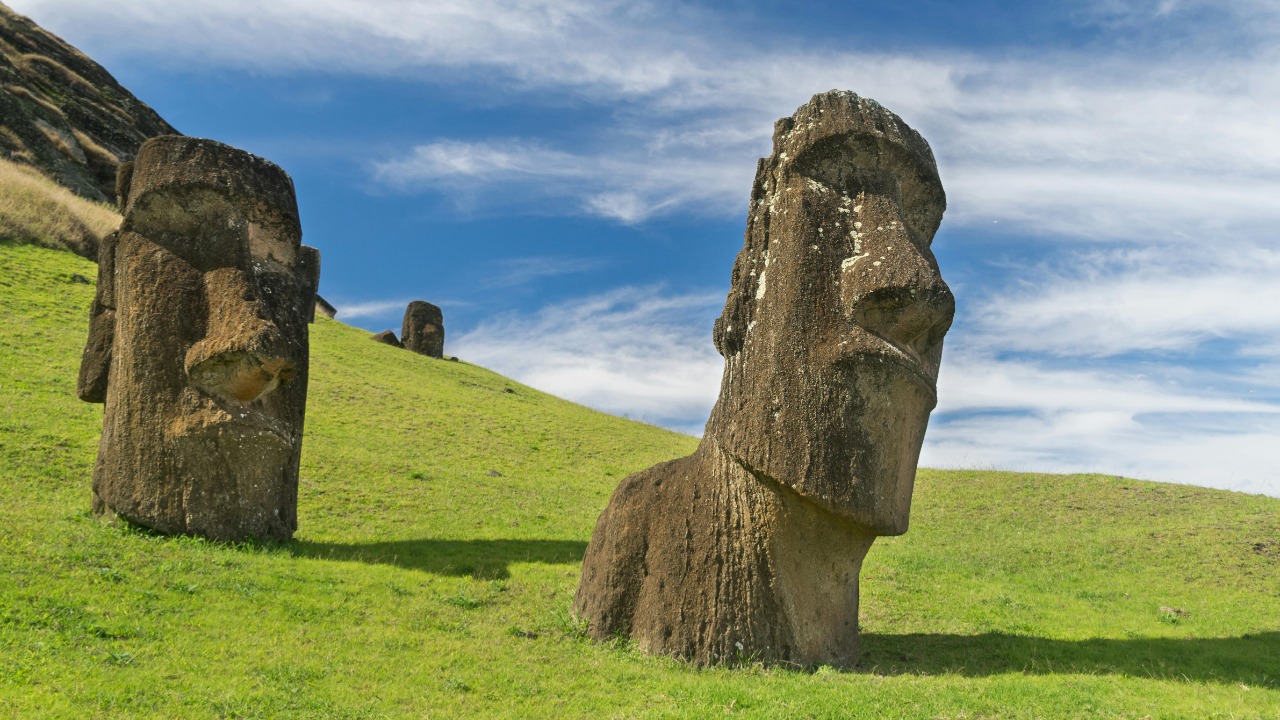

New excavations and high tech scans on one of the world’s most remote islands are forcing archaeologists to redraw the story of how complex societies rise, adapt and endure. On Rapa Nui, better known as Easter Island, a cluster of fresh discoveries in a single quarry and its surroundings now suggests that the islanders’ achievements, from their towering statues to a unique script, unfolded along a very different timeline than the familiar tale of sudden collapse.
Instead of a morality play about self inflicted “ecocide,” the emerging picture is of a small but resilient Polynesian community that engineered its landscape, innovated in art and writing, and weathered environmental stress for centuries before outside forces intervened. If that interpretation holds, the new Easter Island find will not just tweak dates in a specialist debate, it could upend how I, and many others, think about the fragility of civilizations.
The quarry that changed the questions
The latest shift in thinking begins in a volcanic quarry where researchers have mapped how the island’s famous moai were carved directly from the rock. Detailed work at this site shows how Polynesians organized labor, shaped tools and sequenced the carving process, revealing a production system that was more distributed and experimental than a single centralized workshop. That level of organization implies a society with stable leadership and shared ritual goals, not one teetering on the edge of disaster.
At the same time, the quarry evidence dovetails with broader research that situates Easter Island within a wider Polynesian world of long distance voyaging and sophisticated stonework. By tying the quarry’s stratigraphy to regional seafaring and settlement patterns, archaeologists can now argue that the moai tradition emerged as part of a centuries long cultural experiment, not a brief flourish before a crash. That reframing is what makes this quarry more than a local curiosity, it becomes a fulcrum for rethinking the island’s entire historical arc.
From “ecocide” to endurance
For years, the dominant story held that the people of Rapa Nui destroyed themselves by overexploiting their environment, cutting down forests, exhausting soils and triggering warfare and cannibalism. In that narrative, the population supposedly grew unchecked until, as one summary of the old model puts it, Eventually their numbers ballooned to unsustainable levels and the society imploded. That interpretation, popularized by writers such as Jared Diamond in his book Collapse, turned Easter Island into a cautionary tale about environmental hubris.
New work is steadily dismantling that storyline. Ancient DNA studies of Easter Island genomes indicate that, Instead of a boom and bust, the island was home to a small population that steadily increased in size until the era of European contact. A separate genetic analysis concludes that the Easter Island population was surprisingly stable, and that the real demographic shock came with disease, slavery and other European colonial activity after 1722. When I put those findings alongside the quarry evidence of sustained monument building, the old “ecocide” script starts to look less like history and more like projection.
Rewriting the collapse timeline
Chronology is where the new discoveries bite hardest. By re dating the construction and use of ceremonial platforms, Researchers have developed a chronology of monument building that stretches well into the period after Europeans first arrived. According to these new findings, the descendants of Polynesian settlers continued to build, maintain and use the monuments long after they were supposed to have descended into chaos, which pushes the start of any societal decline much later than long thought.
That revised timeline aligns with the genetic picture of continuity and with accounts that Rapa Nui is today a part of Chile and has long been a source of fascination for outsiders. When early European visitors described toppled statues and social unrest, they were likely witnessing the aftermath of disease and slave raids, not the climax of a centuries long environmental tragedy. For me, that shift in timing is crucial, because it moves the focus from inevitable self destruction to the disruptive impact of global contact.
How the moai were really made and moved
The quarry excavations are also transforming what I thought I knew about how the moai themselves were produced. A detailed 3D model now shows that Rapa Nui‘s famous moai were created by many separate carving groups working across the quarry, each with its own style and sequence. Complementary analysis of statue fragments indicates that Stunning New Evidence Shows Easter Island Moai Came From Dozens of Secret Workshops, suggesting Independent Carving Efforts Ac that were coordinated through shared rituals rather than a single command economy.
Movement has been another long running mystery, and here too the new work is striking. Experimental teams have shown that scale models of the statues can be “walked” upright using ropes, and one study reported that researchers managed to walk a model moai 300 feet in 40 m. A separate project that involved New study uses 3D modeling and field experiments to confirm how villagers could have moved the statues, and another team, Studying the moai statues, notes that Lipo and Hunt studied nearly 1,000 m statues to test how Their findings fit what one would expect from a physics perspective. When I combine those experiments with the quarry mapping, the statues look less like impossible feats and more like the product of iterative engineering.
Rats, gardens and a subtler deforestation story
One of the most contentious pieces of the old narrative has been deforestation, often framed as a simple story of people cutting down every tree. New ecological modeling paints a more complex picture in which invasive rodents and human land use interact. A recent study argues that Invasive Rats May Have Contributed to Deforestation of Rapa Nui by eating seeds before they could even sprout, while Meanwhile, the humans cut down swathes of trees to establish their sweet potato fields, and the combination of the two led to a landscape where large timber was no longer available for canoes, houses or firewood.
Another line of research revisits the scale of rock gardens and other intensive farming systems. One synthesis notes that, Previously, it had been thought that 12 per cent of the island’s 63 square miles had been turned into rock gardens, and that this transformation was evidence of desperate overuse. The two new studies, however, arrived some 800 years later in the debate and argue that these gardens were part of a sustainable adaptation to poor soils rather than a final gasp before ruin. When I look at the deforestation story through that lens, the islanders appear less as reckless destroyers and more as farmers making the best of a constrained ecosystem.
A script that should not exist
Perhaps the most startling element of the new Easter Island find is not carved in stone at all but incised on wood. Fresh radiocarbon work on the enigmatic script known as Rongorongo suggests that Rapa Nui, also known as Easter Island, developed a script, now engraved on fewer than 30 wooden objects, which is still undeciphered and appears to have emerged in the eighteenth century AD. That timing matters because it places the invention of writing in a small, isolated community at roughly the same moment that literacy was spreading in Europe, upending assumptions that complex scripts only arise in large, densely connected states.
One recent report goes further, arguing that a Dec discovery at Easter Island could rewrite how we think about the global history of writing. The other strong piece of evidence for this homegrown language theory is that Rongorongo functions much differently than the writing systems on the European side of the European divide, suggesting that it was not simply copied from visiting sailors. When I connect that claim to the quarry’s evidence of distributed statue workshops, I see a pattern of local innovation that challenges the idea of Rapa Nui as a passive backwater.
Rapa Nui in a global frame
These scientific revisions are unfolding against a backdrop of long standing fascination with the island. Today, Rapa Nui is today a part of Chile and its moai have become global icons, but for the island’s Indigenous community the new findings are also about reclaiming their own history. A recent feature on a New Discovery at Easter Island Could Rewrite History As We Know highlights how local voices are pushing back against older portrayals that emphasized collapse and cannibalism while downplaying resilience and creativity.
The debate over Rapa Nui’s past is also entangled with broader arguments about how societies respond to environmental limits. Some scholars still lean on the older model, and More recent research has suggested the opposite of collapse, so That theory remains contentious. A separate discussion of the Fierce debate over Rapa Nui’s society notes that Some writers, such as geographer Jared Diamond, still see the island as a warning, while others point to new discoveries, scientific advancements and more nuanced readings of the evidence. I find that tension productive, because it forces archaeologists and the public alike to confront how much of our storytelling about the past is shaped by present day anxieties.
Lessons from a contested island
When I step back from the technical details, what stands out is how quickly a single site can reshape a global narrative. The quarry work, the DNA studies and the reanalysis of farming systems collectively suggest that the people of Rapa Nui were skilled managers of a fragile environment, not simply victims of their own excess. A synthesis that asks what happened to Easter Island’s trees concludes that rats, gardens and careful land use all played roles, which complicates any attempt to use the island as a one dimensional parable.
At the same time, the new research underscores how outside forces can distort both history and memory. The genetic work that shows the However stable population only collapsed after European colonial activity after 1722 sits uneasily beside older accounts that blamed the islanders alone. A broader review of how the New timeline rewrites history of Easter Island’s long thought collapse shows that You are free to share this article under the Attribution framework, but the deeper point is that our interpretations are always provisional. In that sense, the island’s story is less about a fixed lesson and more about the ongoing work of revising what we think we know.
Why the stakes reach far beyond the Pacific
The implications of the new Easter Island find extend well beyond archaeology. If a small, remote community could develop monumental architecture, a unique script and resilient farming systems without triggering inevitable collapse, then our models of how complexity and sustainability interact may need to change. A recent feature on Who is to Blame for Easter Island Deforestation, framed as New Study Finds Rats Played a Role, notes that New research suggests invasive rats may have become a fallback food for the Rapanui, which hints at flexible responses to scarcity rather than simple overshoot.
Even the political language used to describe change on the island can echo debates elsewhere. In an entirely different context, the Communist chief Rodolfo Salas once remarked that “In fact, there has been a steady growth on a national scale,” and added that While there were some setbacks, the overall trend was positive. That phrasing, applied metaphorically, captures how the new Rapa Nui research sees long term trajectories: not as simple rises and falls, but as uneven paths with resilience and disruption intertwined. When I read that a tabloid report on the walking statues began with the line that it Looks like one of archaeology’s greatest mysteries is finally taking a step in the right direction, I am reminded that the real step may be in how we think about the durability of human societies.
More from MorningOverview