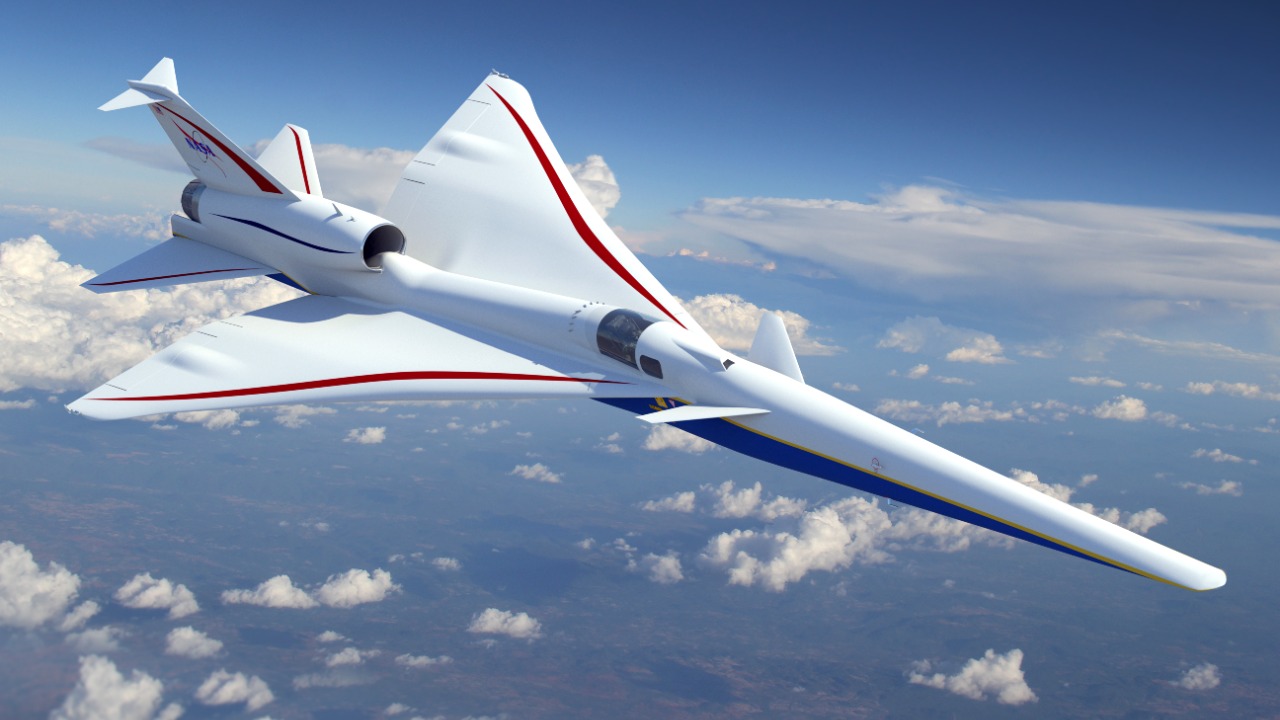

NASA’s experimental X-59 has finally traded the hangar for the sky, marking a historic first flight that could rewrite the rules for how fast passenger jets move over land. The ultra-quiet research aircraft is designed to slice through the sound barrier while turning the traditional sonic boom into a far softer thump, a shift that could eventually open supersonic corridors over cities again. With that maiden sortie complete, the program has moved from theory and wind tunnels into the unforgiving realm of real-world flight test.
The milestone is more than a photo op. It is the first proof that the long, needle-nosed jet, shaped around the number 59 and its promise of quiet shock waves, can safely take off, climb, and land as a fully integrated machine. What happens next, from exhaustive inspections to community noise trials, will determine whether regulators and airlines ever treat this sleek demonstrator as the template for a new generation of high-speed travel.
The quiet breakthrough NASA has been chasing
The X-59’s debut in the air capped years of work under NASA’s Quesst program to tame the physics of supersonic shock waves instead of simply outrunning them. During its historic first sortie, the aircraft flew from the agency’s Armstrong base with a NASA test pilot at the controls, validating that the radical airframe, propulsion system, and digital cockpit could operate together as intended. Images released by NASA show the slender jet climbing cleanly away from the runway, a visual confirmation that the Quesst Mission Marks effort has moved from ground tests to a true Historic First Flight.
That initial hop was not about speed records, it was about proving the aircraft is controllable and safe enough to expand its envelope. Engineers are now comparing the jet’s behavior to the predictions baked into their simulations and wind tunnel data, checking that the unique shaping around the number 59 is delivering the pressure signatures they expect. A companion release from NASA underscores that this first outing is only the start of a methodical campaign to show the quiet supersonic design meets performance and safety expectations before it ever flies over communities.
Inside the X-59’s radical design and test campaign
What makes the X-59 so unusual is how every line of its structure is drawn around the sound it will make at Mach speeds. Instead of a conventional cockpit canopy, the nose stretches far ahead of the pilot, and the forward view comes from a high-resolution camera and monitor mounted where a front window would normally sit. Engineers adopted this virtual windshield because, as one technical brief notes, “Because a canopy window affects the sonic boom potential,” the team at NASA and Lockheed replaced it with sensors to keep the shock waves as smooth as possible.
The airframe itself was built in partnership with Lockheed Martin’s Skunk Works in Palmdale, where the company has described the X-59 as the start of a New Era in quiet high-speed travel. In its own announcement from Palmdale, the manufacturer highlighted how the jet’s long fuselage and carefully sculpted inlets are intended to turn a traditional sonic boom into a gentle thump, a goal that underpins the broader New Era of Supersonic Flight Begins narrative. Earlier test flights in Southern California airspace, captured in coverage that described aviation history being made very quietly, showed the jet cruising above the region as it moved one step closer to routine operations over land in the skies of Southern California.
Behind the scenes, the flight test campaign is tightly choreographed. After the first sortie, technicians stripped panels from the fuselage and wings to inspect structural joints, control linkages, and systems that cannot be fully evaluated in ground runs alone. Reporting on this phase describes how NASA pulled the X-59 apart for post-flight inspections ahead of a second sortie, a standard but crucial step to confirm that loads and vibrations stayed within predicted limits. Only once those checks are complete will pilots begin to push the aircraft closer to its intended cruise conditions and the supersonic regime where its quiet-shaping really matters.
From desert test ranges to future passenger routes
The X-59 is not flying alone. To measure and validate its acoustic footprint, NASA has been pairing it with chase aircraft, including F-15 jets that can gather data on shock waves and noise patterns in real time. One account notes that the Space agency doubled the jet fighter research fleet for this purpose, using the F-15s as airborne laboratories that can fly formation with the X-59 and record how its pressure waves evolve at different speeds and altitudes, a strategy detailed in a Jan overview of the campaign. Another summary of Key Takeaways explains that these flights will unfold over the deserts of California this year, where the wide-open ranges give engineers room to experiment without disturbing dense populations, a point underscored in the program’s Key Takeaways.
More from Morning Overview