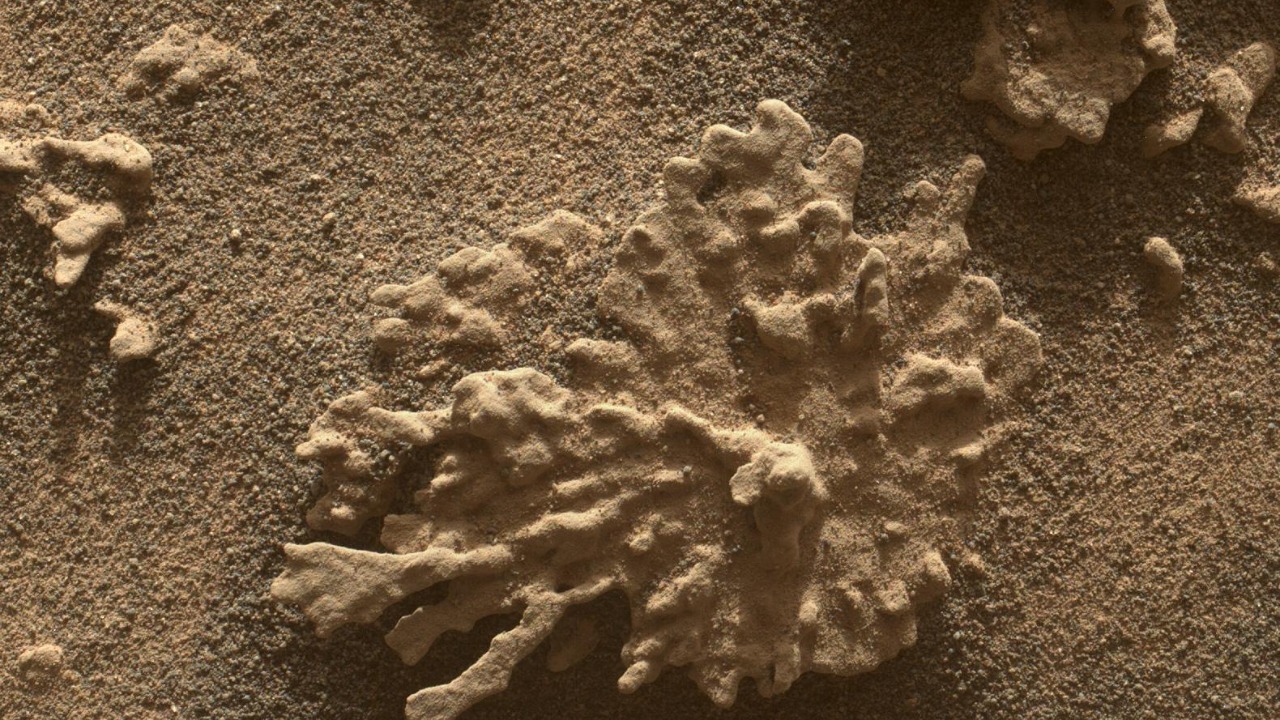

The strongest hints yet that Mars once hosted living microbes are no longer theoretical models or ambiguous chemistry. They are etched into a single, oddly speckled rock in an ancient riverbed, where a robotic geologist has been quietly drilling and sampling for years. NASA now says the evidence from that rock, and from the wider landscape around it, represents the most compelling case so far that the Red Planet was once biologically active.
At the heart of the announcement is a 3.5-billion-year old rock that appears to preserve both the chemistry and the textures scientists associate with microbial life in Earth’s oldest sediments. The claim is still cautious, framed as “potential biosignatures” rather than a definitive detection, but the convergence of clues is forcing researchers to talk seriously about ancient Martian life in the present tense.
The rock that changed the Mars conversation
The story begins with a 3.5-billion-year old rock that NASA’s Perseverance rover drilled from an ancient river system on Mars, a setting that once carried flowing water across the Red Planet’s surface. In that rock, mission scientists see patterns that look less like random mineral growth and more like the layered, fine scale textures familiar from Earth’s oldest microbial habitats. NASA has described the sample as so evocative that it could be direct evidence that microbes were present there billions of years ago, a claim that would fundamentally reshape how I think about Mars as a once-living world, rather than a permanently sterile one, and that framing is echoed in reporting on the 3.5-billion-year sample.
What makes this rock so disruptive is not a single spectacular feature but a stack of mutually reinforcing clues. The chemistry points to organic carbon and other ingredients that, on Earth, are intimately tied to biology, while the physical structure of the rock suggests it formed in a calm, long lived body of water that would have been stable enough for microbes to colonize. A newly peer reviewed analysis argues that the combination of mineralogy, carbon signatures, and sedimentary context is most consistent with biological processes, a conclusion that NASA has highlighted as its strongest evidence yet that ancient life once took hold on Mars.
Cheyava Falls and the “leopard spots” of Jezero Crater
The rock that has captured so much attention is not an isolated oddity, it sits within a broader pattern of intriguing finds in Jezero Crater, the ancient lake basin where Perseverance has been working. In July 2024, NASA’s rover spotted a reddish rock nicknamed Cheyava Falls, marked by tiny dark specks that scientists quickly dubbed “leopard spots,” a texture that immediately raised the possibility of complex mineral growth tied to past microbial activity in this part of Jezero Crater.
NASA later revealed that Perseverance had actually discovered this potential biosignature the previous year, and that the “leopard spots” were part of a suite of minuscule features scientists also describe as “poppy seeds,” all embedded in rock that formed in an ancient riverbed. Researchers led by Hurowitz and his team have emphasized that these specks occur alongside organic carbon, a building block of life, and that the textures are difficult to explain through simple inorganic chemistry alone, a point underscored in coverage of how Hurowitz and colleagues interpret the data.
From “signs of life” to “closest thing yet”
For years, NASA has carefully described Perseverance’s discoveries as “signs of life” rather than proof, a linguistic hedge that reflects how easily non biological processes can mimic biosignatures on another planet. Earlier reporting on the rover’s work highlighted intriguing mineral formations and organic molecules that, while exciting, could still be explained by purely chemical reactions in the Martian crust, a tension that shaped how I read the initial claims about Life on Mars.
The Cheyava Falls rock and its riverbed cousin have shifted that balance. On Sept. 10, 2025, NASA publicly described the Cheyava Falls textures as the “closest” evidence yet of past microbial life on Mars, a striking escalation that reflects how multiple lines of data now converge on a biological interpretation. Detailed analysis of the site argues that the rock’s environment, chemistry, and textures together represent Our best proof so far that Mars once hosted microbes, a view laid out in depth in a technical deep dive into Cheyava Falls.
Inside NASA’s cautious language on “potential biosignatures”
Even as NASA officials talk about their strongest case yet for Martian life, they continue to label the evidence as “potential biosignatures,” a phrase that signals both excitement and restraint. Among the Martian samples that Perseverance has collected, scientists have cataloged several candidates that could be biological in origin, but they stress that no single measurement can explain their specific origin without laboratory level scrutiny, a nuance that By Cat Hofacker January and colleagues have emphasized in their review of Among the Martian rocks.
Agency leaders have echoed that caution in public briefings, calling the Cheyava Falls findings “potential evidence of past life” while underscoring how much work remains to rule out exotic non biological explanations. They have also been frank about the limits of rover based instruments, noting that truly definitive tests will likely require returning these samples to Earth, a point that has shaped internal debates over how to prioritize Mars Sample Return and how much more Perseverance can realistically do to analyze the rock in situ, as reflected in comments from the Agency.
Why Jezero’s riverbed is such a powerful test case
Jezero Crater was chosen as Perseverance’s landing site precisely because it preserves an ancient river delta, a type of environment that on Earth is rich in organic matter and microbial life. The newly scrutinized rock comes from a dry riverbed that once fed that crater lake, a setting where sediments would have settled slowly, trapping any microbes and their chemical byproducts in fine layers that could survive for billions of years, a scenario that helps explain why a rock sampled by Perseverance has become such a focal point.
Scientists argue that this riverbed rock is particularly valuable because it records both the chemistry of the water that once flowed through Jezero and the broader climate conditions of early Mars. A newly peer reviewed paper cited by NASA notes that the mineral assemblage and carbon signatures in the rock align closely with how biological processes imprint themselves in Earth’s ancient river and lake sediments, a comparison that has led mission leaders to describe the finding as the strongest evidence yet for ancient life on NASA’s long running Mars program.
More from Morning Overview