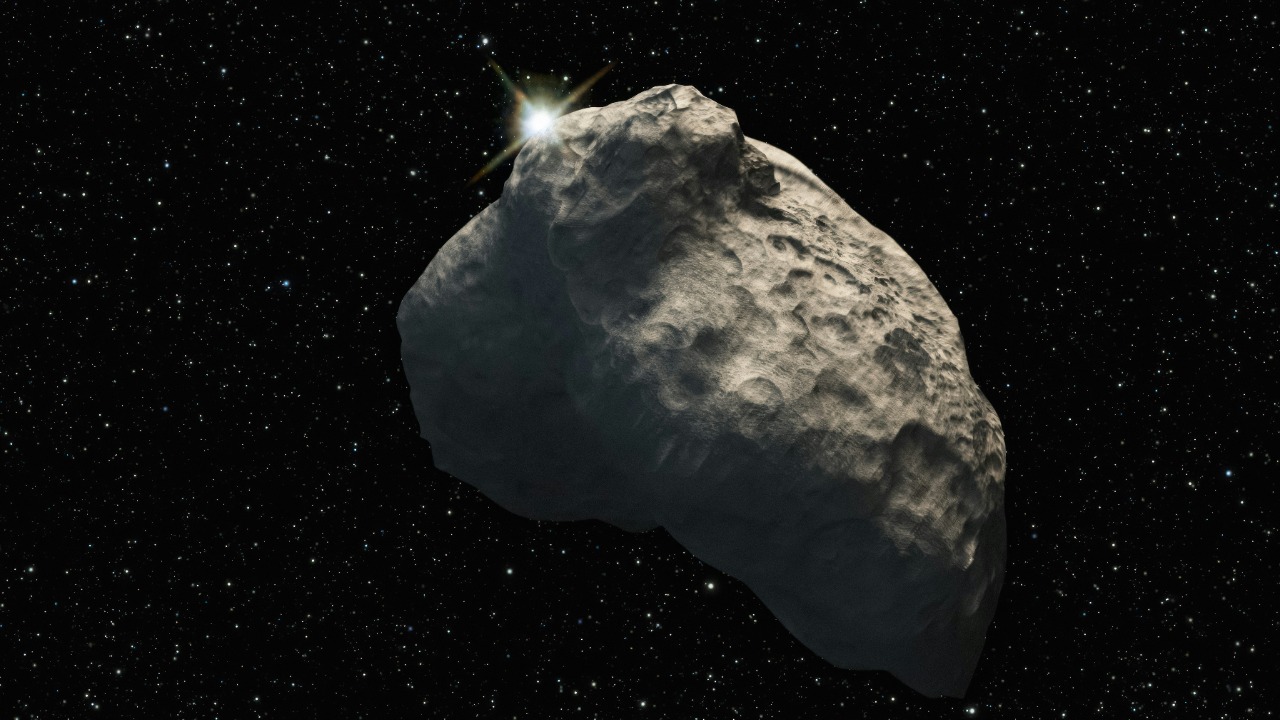

A bus-size asteroid is racing through space on a trajectory that will bring it close to Earth, and NASA is watching it with the kind of precision that has turned near misses into routine science rather than cause for panic. The object is part of a steady stream of space rocks that sweep past our planet, close enough to study but, based on current tracking, not on a collision course.
What sounds like a disaster movie setup is, in reality, a test of how well humanity understands its cosmic neighborhood. By following this asteroid and others like it, NASA is refining its ability to spot potential threats early, measure their paths, and reassure a nervous public that “hurtling toward Earth” does not automatically mean “heading for impact.”
What NASA knows about the bus-size visitor
NASA’s planetary defense teams treat every new near-Earth object as a math problem, not a mystery. Radar and optical observations are used to pin down an asteroid’s orbit, then powerful models project where it will be when it sweeps past Earth, how far away it will be, and whether that path intersects our planet at any point in the foreseeable future. The agency’s public asteroid watch page lists the next five close approaches, a running reminder that flybys are constant and that this bus-size rock is one more entry in a long logbook rather than an outlier.
Earlier cases show how this works in practice. In one recent instance, NASA highlighted a bus-size object that would zip past Earth at a safe distance, part of a family of rocky bodies that orbit the Sun between Mars and Jupiter and occasionally cross Earth’s path as they loop around our star, a pattern echoed in recent coverage. The current object falls into the same general category: large enough to be worth tracking, small enough that even a hypothetical impact would be regional rather than global, and, crucially, on a trajectory that calculations show will miss our planet.
How dangerous is a bus-size asteroid, really?
When people hear “bus-size asteroid,” they tend to imagine city-level devastation, but the physics are more nuanced. The energy released in an impact depends on the asteroid’s size, speed, composition, and the angle at which it hits the atmosphere. Small asteroids measuring up to 30 feet across actually strike the atmosphere quite often, and many of them break apart before reaching the ground, a pattern highlighted in analyses of how small asteroids interact with Earth. A bus-size rock is larger than that, but still far from the kilometer-scale giants that can alter climate on a global scale.
NASA’s own risk scales reflect this difference. Earlier this year, the agency tracked a similar object, cataloged as 2025 DU25, and made clear that while it was a “Tracking Bus, Sized Asteroid Nearing Earth,” its orbit kept it at a safe distance even at closest approach, as documented in technical notes on 2025 DU25. The current bus-size visitor fits that same pattern: big enough to be carefully monitored, not big enough, or close enough, to trigger the kind of emergency planning that would accompany a genuine impact threat.
Why “racing toward Earth” is routine for planetary defense
From a planetary defense perspective, the phrase “racing toward Earth” describes geometry, not intent. Any asteroid whose orbit crosses Earth’s path will, at some point, be moving in our direction, but that does not mean the two bodies will occupy the same point in space at the same time. NASA’s tracking programs are designed to resolve that timing question with exquisite precision, and they have been tested repeatedly as bus-size and larger objects have swept past in recent years. One widely discussed case involved a bus-size rock that some commentators framed as a close call, even though NASA’s own modeling showed a comfortable miss, a scenario explored in detail in assessments of how NASA tracks bus-size near-Earth objects.
What matters most is the minimum distance at closest approach, and here the numbers are reassuring. In one recent cluster of flybys, Three additional asteroids were expected to pass on Saturday, including a car-size object known as 2023 RX1 that would come within 2,090,000 miles of Earth, followed by others that would get up to 2,860,000 miles from our planet, according to detailed tracking of Three more asteroids. Distances like that are close in astronomical terms but vast compared with the size of Earth itself, and the current bus-size asteroid is on a similarly distant track.
A crowded week in near-Earth space
The bus-size asteroid is not traveling alone. Near-Earth space is busy, and NASA’s logs show that close approaches often come in clusters as different objects reach similar points in their orbits around the Sun. In one recent window, Three more asteroids were forecast to follow on Saturday, with 2023 RX1 and two other small bodies all passing within a few million miles of Earth, a pattern that illustrates how these events tend to arrive in groups rather than as isolated curiosities, as seen in the sequence of Saturday flybys. The bus-size rock now in the spotlight is part of that same dynamic, one more object in a steady procession that NASA’s systems are built to handle.
Other recent passersby underscore how varied these visitors can be. More asteroids are expected to zoom past the Earth in the coming days, and also, a house-size object known as 2026 BK has been singled out as another example of a small but trackable near-Earth body, according to forecasts that highlight how More asteroids share the same general neighborhood. Against that backdrop, a single bus-size asteroid, even one that headlines a news cycle, is better understood as a representative of a much larger population than as a lone outlier.
From ancient debris to modern video players
To understand why these encounters are so common, it helps to zoom out in time. Asteroids are small, rocky objects that are remnants from the formation of the solar system around 4.6 billion years ago, and they still occupy the orbits carved out in that chaotic early era, a basic fact summarized in primers on what Asteroids are. They tend to cluster in belts and families, but gravitational nudges from planets can shift some of them into Earth-crossing orbits, which is why NASA’s catalogs keep expanding as new objects are discovered.
Public interest in these discoveries has grown alongside the technology used to share them. When Jan reports on a bus-size asteroid approaching Earth, readers often encounter the story through a Video Player embedded in a news site or a social feed, complete with looping animations of an object streaking toward the planet, a style of presentation reflected in coverage that notes how a Video Player frames the event. I see that tension every time a new flyby trends online: the visuals lean into drama, while the underlying data, from NASA’s orbital models to its risk assessments, tell a calmer story of ancient debris passing by, watched closely but not feared.
More from Morning Overview