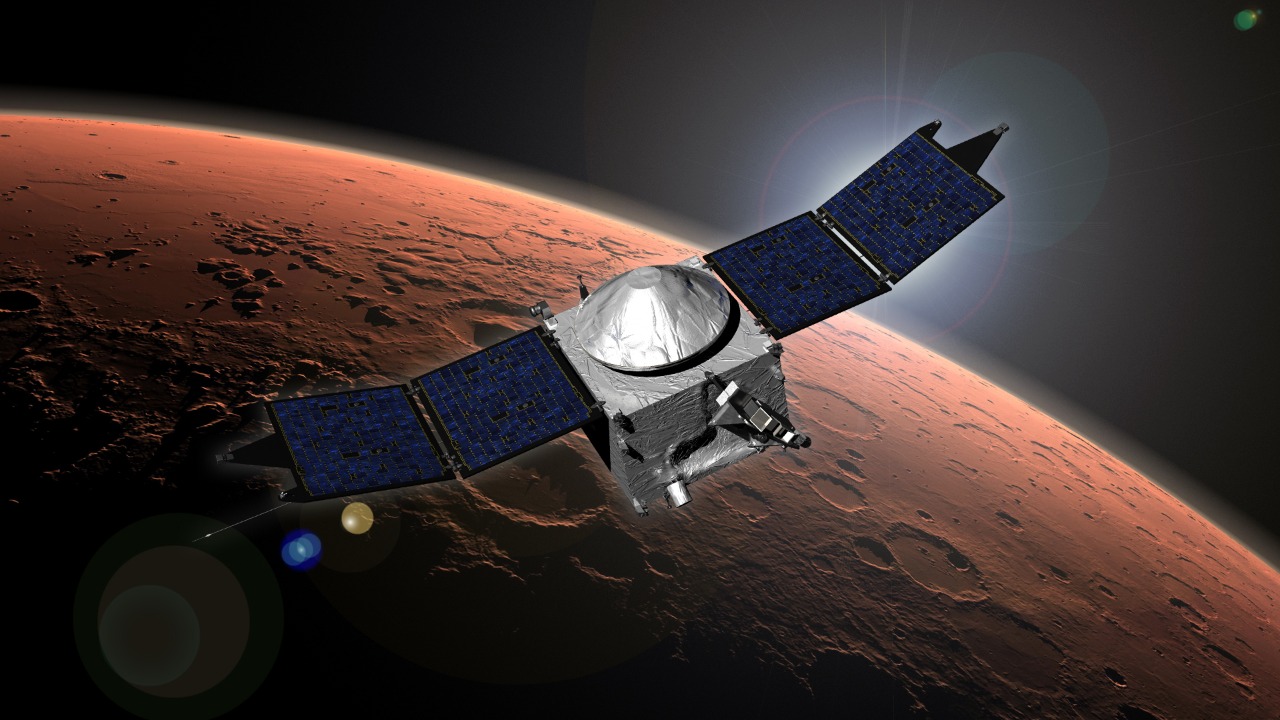

NASA’s long record of Martian exploration has trained the public to expect a steady stream of images and data from the Red Planet, not sudden silence. So when a veteran orbiter that had just helped reveal some of the most intriguing sights on Mars abruptly stopped talking to Earth, it felt less like a routine glitch and more like a cliffhanger. The quiet that followed has left scientists juggling two storylines at once: a planet that keeps looking more familiar, and a spacecraft that vanished from the conversation just as the questions were getting interesting.
In recent months, cameras and instruments circling and roving Mars have picked out rock formations that resemble doorways and other eerily terrestrial shapes, while samples drilled from ancient terrain have raised the stakes in the search for past life. At the same time, one of the orbiters that helped knit this picture together, MAVEN, slipped behind Mars during a normal maneuver and never checked back in, forcing NASA to confront how fragile its Martian presence can be.
The veteran orbiter that went quiet
For more than a decade, the Mars Atmosphere and Volatile EvolutioN mission, better known as MAVEN, was one of NASA’s quiet workhorses at Mars, looping around the planet to study its upper atmosphere and how it leaks into space. The 11‑foot‑tall spacecraft launched in Nov on a United Launch Alliance Atlas rocket from Cape Canaveral Space Forc, then settled into orbit to watch how solar radiation strips gases away from the planet, a process that helps explain how Mars transformed from a wetter world into the dry landscape we see today, according to mission details on MAVEN. By the time contact was lost, the orbiter had been circling Mars for roughly 11 years, long past its original prime mission.
The break in communications came without warning. NASA has said it lost contact with the spacecraft on Dec 6, after MAVEN slipped behind the Red Planet during what was supposed to be a routine pass. Teams on the ground have been working urgently to diagnose the loss of signal and restore communications, with Teams focusing on whether the spacecraft’s orientation or power system might be to blame. For now, the orbiter that once provided a steady stream of atmospheric data has become a silent object somewhere above Mars, leaving engineers to troubleshoot at interplanetary distance.
“Spotted on Mars”: familiar shapes and unsettling timing
Even as MAVEN fell silent, other NASA hardware around Mars continued to send back images that captured public attention. In Jan, new visuals highlighted by NASA showed features on Mars that looked almost uncannily familiar, including a rock wall with a shape that resembled a doorway and other formations that seemed to echo structures on Earth. These scenes, shared in a widely viewed NASA video, underscored how easily the human brain projects meaning onto alien landscapes, and how every new image from Mars can ignite speculation far beyond the scientific details.
At almost the same time, NASA confirmed publicly that it had lost contact with the Maven spacecraft that was orbiting Mars, a reminder that the same communications links that deliver those striking images can also fail without much warning. The agency described how the Maven orbiter, which had been relaying data and supporting surface missions, simply stopped responding, even as other assets like the Mars rovers Curiosity and Perseverance remained active, a contrast noted in NASA updates. The juxtaposition of fresh, almost playful imagery with the sudden disappearance of a key orbiter sharpened the sense that Mars can pivot from familiar to unforgiving in a single news cycle.
Life hints in Martian rocks
Behind the viral images, the more consequential Martian story is unfolding in the rocks themselves. NASA has reported that a sample called Sapphire Canyon, Taken from a rock named Cheyava Falls last year, contains potential biosignatures that could point to ancient microbial activity. The sample, drilled and cached by a rover for later return to Earth, is part of a broader analysis described in a paper in the journal Nature, and NASA has framed the Cheyava Falls material as one of the most promising clues yet in the search for past life, as outlined in its Taken announcement.
That claim did not come out of nowhere. Earlier, NASA had described the same Cheyava Falls outcrop as the “closest we have ever come to discovering [ancient] life on Mars,” after a Martian rover examined the site and found chemical and textural evidence consistent with past microbial life in a once watery environment. A detailed examination of the Cheyava Falls region, including the Sept 10 briefing that highlighted its significance, has been chronicled in a deep dive into the Martian evidence. Together, these findings suggest that Mars not only looks familiar in photographs, but may also preserve chemical traces of life that once thrived there, locked in rocks that rovers are only now beginning to sample systematically.
Silence is part of the Martian story
For engineers, the MAVEN blackout is not an isolated mystery but part of a pattern that comes with operating hardware on a distant, dusty world. NASA has acknowledged that, despite ongoing efforts, contact has not been re‑established and that analysis of retrieved data suggests the probe may be rotating in an unexpected way, a scenario that complicates any attempt to regain control. That assessment, shared in an update that emphasized the role of detailed analysis, highlights how even small changes in a spacecraft’s orientation can cascade into a full loss of signal when there is no one on site to intervene.
The emotional weight of such losses is not new. When another Mars mission, the InSight lander, finally fell silent after years of listening to marsquakes and even capturing the sound of a Martian dust devil, NASA officials publicly thanked the spacecraft for its service. Coverage of that moment quoted the line “You did good work,” and identified the Author as MARCIA DUNN, an Aerospace Writer who chronicled how the InSight lander’s power faded as dust accumulated on its solar panels, as described in a Dec report. The MAVEN situation is different in its technical details, but it taps into the same mix of pride and grief that comes when a robotic explorer reaches the end of its voice.
NASA has been careful not to rush into risky commands that might make the situation worse. After waiting out a planned two‑week communication blackout caused by Mars passing near the Sun from Earth’s perspective, the agency prepared to listen again for a signal from the silent orbiter, while weighing whether more aggressive attempts to wake it could trigger unintended, potentially dangerous behavior. That cautious approach was outlined in a briefing that described how, After the initial loss of contact, NASA would try hailing its quiet Mars orbiter again once conditions improved, as detailed in a After update. The silence, in other words, is not for lack of effort, but because the margin for error at Mars is thin.
A planet that keeps surprising its explorers
Even as one spacecraft drifts out of contact, others continue to show that Mars is more varied and dynamic than early missions suggested. The Perseverance rover, working inside Mars’ Jezero crater, has cataloged a wide range of rocks since its landing, including a “spider‑egg” rock and a “turtle‑shaped” formation that stand out from the surrounding terrain. One particularly odd‑looking rock has been described as totally alien to the Red Planet’s usual geology, underscoring how Perseverance keeps encountering materials that challenge assumptions about how Jezero formed. Each new find adds context for the samples that may one day be brought back to Earth, including those from Cheyava Falls and Sapphire Canyon.
More from Morning Overview