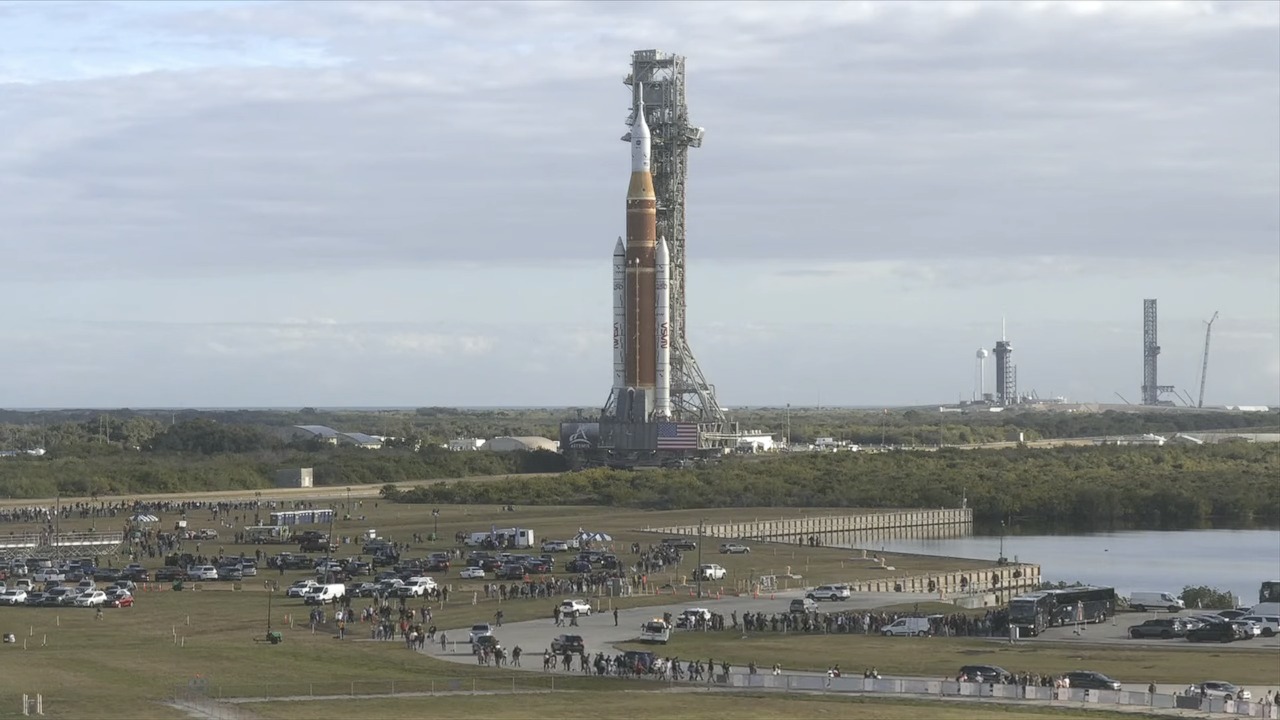

The Space Launch System that will carry Artemis II astronauts around the Moon and back has now taken on its most precious cargo yet: hundreds of thousands of gallons of supercold propellant. With the rocket fully fueled in a high stakes rehearsal at Kennedy Space Center, NASA has moved from abstract planning into a tangible countdown toward the first crewed lunar voyage of the post Apollo era. I see this fueling test as the moment the mission shifted from concept art to concrete schedule.
The wet dress rehearsal, as engineers call it, is more than a plumbing check. It is a full scale simulation of launch day that forces every valve, sensor, and console team to perform as if four people were already strapped into Orion. The outcome will shape when Artemis II flies, how confident NASA feels about its hardware, and how quickly the agency can pivot from testing to training.
The rocket finally drinks deep
For the first time, NASA has completely loaded the Artemis 2 Space Launch System with propellant, filling the core stage and upper stage with liquid hydrogen and liquid oxygen until the moon rocket stood on the pad at full weight. The agency confirmed that the Artemis 2 moon rocket was fully fueled, a milestone that transforms the towering orange and white stack from a static exhibit into a flight ready vehicle. I read that as a clear signal that the complex cryogenic systems that bedeviled earlier missions are now behaving within the tight limits required for crew.
The fueling run was not a simple tanking exercise but a carefully choreographed rehearsal that mirrored launch day procedures down to the final seconds of the countdown. NASA described how the Space Launch System was brought to flight levels, with both stages topped off and conditioned as if a real ignition were imminent. That full stack rehearsal gives controllers the data they need to validate models of how the rocket flexes, chills, and vents under the stresses of a real countdown.
Countdown as crucible
The wet dress rehearsal unfolded as a full dress countdown, with clocks ticking toward a simulated liftoff while teams at Kennedy Space Center worked through every launch commit criterion. Earlier in the campaign, NASA invited the public to Follow NASA through this last major test of SLS before a crew of astronauts flies around the Moon, underscoring how much rides on a single day of operations. In a normal launch sequence, the crew would head for the pad shortly after fuel loading to strap in and check their pressure suits, and planners have already outlined how that flow would work between potential launch dates in March, described in detail in a Feb briefing.
From the public side, the countdown played out on live video feeds that showed the rocket venting and frosting as propellant flowed. Viewers could Watch Live as NASA fueled its Space Launch System rocket in a crucial prelaunch test for Artemis, with coverage extending into the final seconds of the mock countdown. Behind the scenes, controllers were also running the same sequences on an official static feed that highlighted how Engineers at NASA’s Kennedy Space Center are conducting a prelaunch test to fuel the Artemis II Space Launch System, treating the rehearsal as a vital step in verifying ground systems as much as the rocket itself.
Lessons from Artemis 1 baked into Artemis 2
What struck me most about this rehearsal is how explicitly it reflects the scars and successes of Artemis 1. NASA has said it is utilizing troubleshooting procedures put in place as a result of that first mission to address any fueling issues that arise during the current campaign, a point underscored in an Feb update. In another status note, NASA emphasized that these refined procedures are being applied in real time as controllers work through the Artemis fueling timeline.
The hardware itself is also being monitored with a level of scrutiny that reflects the leap from uncrewed to crewed flight. During the rehearsal, Orion remained powered on the pad, and non essential personnel were cleared from the launch area ahead of SLS fueling, a detail captured in a live log that noted Non essential staff were pulled back as the countdown reached a key point at 48, with Image credit given to NASA and Sam Lott. A parallel entry described how SLS and Orion have remained powered over several days on the launch pad here, a stress test of avionics and power systems that will be essential once a crew is aboard.
Astronauts in quarantine, schedules on the line
While the rocket was being fueled, the human side of Artemis II was already living on mission time. The four astronauts who will ride this vehicle have been in quarantine for about one and a half weeks, waiting for the outcome of the practice countdown that will determine when they travel to Florida and how their final training blocks are arranged. A detailed account of the test noted that They have been in quarantine while teams verify not only propulsion but also life support and other vital systems that will keep them safe on the journey.
NASA has been clear that the wet dress rehearsal is the final major gate before committing to specific launch dates. One planning document explained that the agency is just days away from the critical test that will shape when a crew of astronauts flies around the Moon, a point highlighted in a Sunday update that framed the rehearsal as the last major hurdle. Another overview of the campaign noted that NASA gets the countdown rolling for a practice run of the Artemis II moon launch, with NASA, Artemis II, Richard Tribou, Orlando Sentinel and Sun all referenced as part of the broader narrative that this is a dress rehearsal in every sense.
From wet dress to real launch
The immediate question after a successful fueling test is simple: when does Artemis II actually fly. One analysis of possible timelines noted that NASA’s Artemis II mission to send astronauts round the Moon and back could launch as early as the spring, marking the first time since the Apollo era that humans travel that far from Earth, a prospect laid out in detail by NASA planners. Another schedule focused report explained that in a normal countdown the crew would head to the pad after tanking, and that mission managers are eyeing windows between March 6 and 11, a range spelled out in a Feb overview.
NASA itself has already sketched the next decision point. Following a successful wet dress rehearsal, NASA leaders will make a final call to send the Artemis II astronauts to Kennedy, a step that will formally shift the mission from testing to launch operations, as described in a Following statement. That same release explained that NASA will discuss early results of the Artemis II wet dress rehearsal before greenlighting the move of all four Artemis II crew members to Florida, a reminder that the agency is pacing itself carefully even as public anticipation builds.
More from Morning Overview