
For years, scientists suspected that waves breaking on plastic-littered seas were a major source of the tiny fragments now turning up in the air we breathe. A new global analysis flips that story, showing that most airborne microplastics are actually lofted from land, not ocean, and that the atmosphere itself is a powerful conveyor belt moving these particles around the world. The findings are unsettling, not because the numbers are higher than anyone imagined, but because they point straight back to how I live on land, from the clothes I wear to the roads I drive on.
The research also delivers a second surprise: the total amount of microplastic in the air may be far lower than some earlier, headline-grabbing estimates, even as the particles that are present reach into remote mountains and polar regions. That combination, a smaller but more clearly human-made plume, sharpens the policy question from a vague fear of invisible pollution to a concrete challenge about how to curb emissions at their terrestrial source.
What the new global model actually found
The new work builds on a decade of field measurements that tracked airborne plastic particles across the world between 2014 and 2024, then stitched them together into a single picture of global emissions. The team behind the study, working under the banner of Environment, set out to quantify how much plastic is actually entering the atmosphere and where it is coming from. They did not just count particles at a few sites, they used those measurements to calibrate a global emissions inventory that could be compared with previous, much rougher guesses.
One of the most striking results is how unevenly microplastics are distributed between land and sea. The authors report that median concentrations reach 0.08 particles per cubic meter over land but only 0.003 particles per cubic meter over the ocean. That gap, more than an order of magnitude, is the first clear, global-scale signal that the atmosphere’s plastic burden is overwhelmingly a land problem, even though the particles themselves can later drift far offshore.
Land, not ocean, is driving airborne plastic
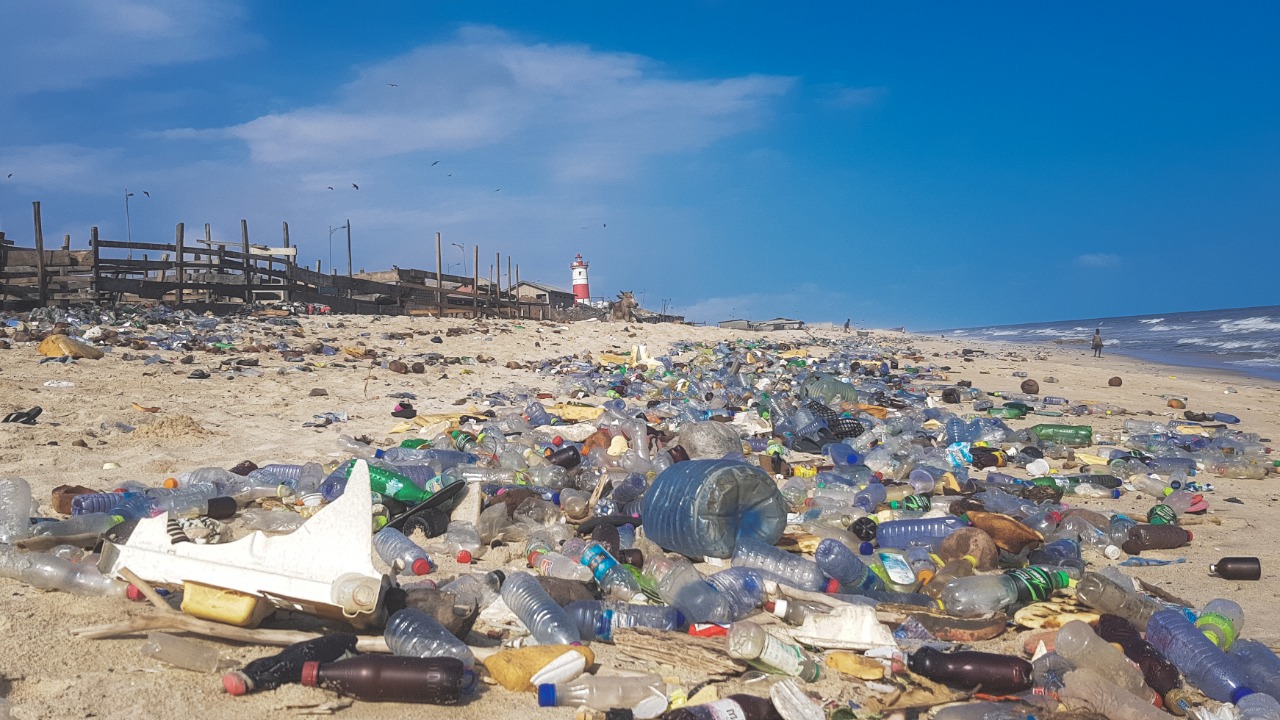
For years, some models treated the ocean surface as a kind of plastic aerosol factory, with breaking waves flinging fragments into the air that would then be carried inland. The new analysis, described in detail in a technical note on microplastic emissions, finds that this marine source is far smaller than once feared. Instead, the dominant emissions come from land based activities, including abrasion from synthetic textiles, tire and road wear, and the breakdown of littered packaging that is then stirred into the air by wind and traffic.
That conclusion is echoed in a separate synthesis of field and modeling work that notes how a new study has found the ocean is not a significant source of microplastics to the atmosphere, despite the vast amounts of plastic floating at the surface. According to that assessment, described in a report on airborne microplastics, the key processes that loft particles into the air are happening on land, where wind can scour fields, cities and industrial sites, and where vehicles and human activity constantly grind larger items into respirable fragments.
How scientists built a global picture of plastic in the air
To move beyond scattered measurements, researchers turned to sophisticated atmospheric modeling. One group focused on Investigating global atmospheric microplastic emissions by combining observations from multiple continents with a chemical transport model that simulates how particles move, settle and are removed from the air. This approach allowed them to estimate not just where microplastics are found, but how much must be emitted in different regions to reproduce the observed concentrations.
Another team, described in a feature on Creating a chemical transport model, used a similar simulation to mimic the movement of atmospheric components, including plastic particles, in and from the air. By feeding in different assumptions about sources, such as coastal seas versus urban centers, they could test which combinations best matched real world measurements. The convergence of these independent modeling efforts on a land dominated emissions pattern is part of what makes the new findings so difficult to dismiss as a quirk of one dataset.
Emissions may be lower than feared, but exposure is global
One counterintuitive twist in the new research is that the total amount of microplastic entering the atmosphere each year may be far smaller than some earlier studies suggested. A detailed analysis of measured concentrations found that previous models had likely overestimated emissions by up to a factor of 10,000. Reporting on this work notes that Significantly less microplastics appear to be present in air than once thought, even as scientists caution that estimating how many particles are emitted into the atmosphere remains challenging.
Using these concentrations, Using field data from multiple sites, Dr Evangelou and her co authors scaled up previous emissions models to get a more realistic total estimate of how much plastic is actually being lofted into the air. A separate summary of the same work notes that Dr Evangelou and colleagues still see gaps in the data, particularly over parts of Africa and South America, but the overall message is that while emissions are lower than feared, they are still high enough to matter for human health and ecosystems.
Scientists are still reckoning with the health stakes
Even with a clearer emissions picture, researchers are only beginning to understand what inhaling these particles means for the body. A feature that describes how Scientists calculated the number of microplastics in our atmosphere notes that the sheer count is “absolutely shocking,” even if the mass is relatively small. The same work emphasizes that Microplastics travel long distances in the air and can be deposited in remote parts of the world, meaning that no community is entirely shielded from exposure.
Another overview of the new modeling results, published as a news analysis of Microplastics in the atmosphere, underscores that the particles can act as carriers for other pollutants, including heavy metals and organic chemicals that adhere to their surfaces. That possibility, combined with evidence that microplastics can lodge in lung tissue, is driving a new wave of toxicology studies that will likely shape air quality guidelines in the years ahead.
More from Morning Overview