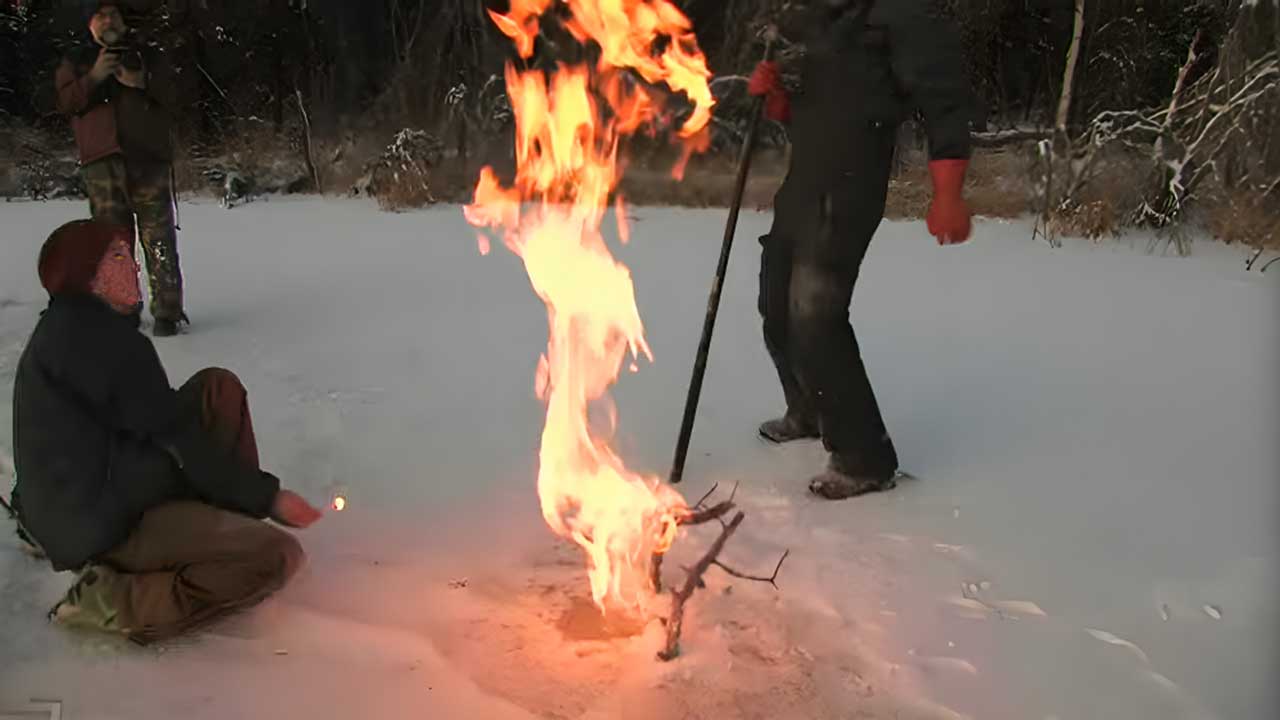

The image is surreal: a frozen lake, a scientist kneeling on the ice, and then a sheet of flame racing across the surface as trapped gas turns the air itself into fuel. What looks like a stunt is in fact a stark demonstration of how methane can accumulate in water bodies until a single spark sets the atmosphere above them on fire. From polluted urban reservoirs to thawing Arctic basins, these methane-choked lakes are becoming both a local hazard and a global climate warning.
I see these fires as a convergence of two crises. In cities, neglected sewage and industrial waste are turning once-celebrated water bodies into combustible dumps. In the far north, warming permafrost is releasing ancient gases that bubble up through lakes and into the sky. The result is the same unsettling spectacle: water that burns, and air that ignites.
The science of a lake that breathes fire
At the heart of these fiery scenes is a simple chemistry lesson. Methane is a colorless, odorless gas that becomes explosive when it mixes with air in the right concentration, and it can suffocate people long before any flame appears. In one Arctic demonstration, a researcher showed how You can stand on a frozen surface, see nothing unusual, and yet be surrounded by Methane that has seeped up from below, ready either to displace oxygen or to ignite if someone introduces a flame.
In interior Alaska, outside the University of Alaska, a video shows a scientist cutting a hole in lake ice, lighting a match, and watching a fireball roar across the opening as gas vents from below. A similar clip from another northern basin, where thawing permafrost has released so much gas into Esieh Lake near Fairb that the surface boils with bubbles, captures how Methane can turn a quiet pond into a torch. In both cases, the water itself is not burning. It is the gas, pooling just above the surface or trapped under ice, that feeds the flames.
From City of Lakes to City of Burning Lakes
Far from the Arctic, a different kind of methane lake fire has become grimly familiar in India’s technology hub. Bengaluru, once celebrated as the City of Lakes, is now just as often described as the City of Burning Lakes after repeated blazes on its polluted reservoirs. At Bellandur Lake, the city’s largest water body, untreated sewage and industrial effluent have created a toxic stew that periodically erupts into fire, sending smoke and chemical fumes over nearby neighborhoods for hours at a time.
Residents watched in alarm when Dense smoke emerged from the middle of Bellandur on a Thursday, then caught fire, with flames so intense that they leapt toward an adjacent flyover. A later account from a Bangalore event recalled that in 2018, Bellandur Lake‘s water caught fire and burned for 30 hours, with methane from untreated sewage making the surface itself effectively combustible. A detailed local analysis tied those infernos to layers of organic sludge, oil, and chemicals that trap gases in the water, then release them in bursts when wind, temperature shifts, or physical disturbances stir the lake.
How pollution turns urban lakes into fuel
The mechanism in Bengaluru’s burning lakes is different from the permafrost story, but the end product is the same flammable gas. In Bellandur Lake and other city reservoirs, years of dumping sewage and industrial waste have created thick mats of organic material that rot without oxygen. As this sludge decomposes, it generates methane and other gases that accumulate in the water column and in floating foam. Local reporting describes how, in Jun, solid waste from households and industries, mixed with detergents and oils, forms a frothy layer that can trap these gases until they escape in concentrated pockets that are easy to ignite.
Officials in other Indian cities have seen similar warning signs. In Hyderabad, Pollution board officials described frothing lakes as a sure indication that methane molecules in the water were building up inexorably, raising the risk of fire or explosion. In Bengaluru, another water body, Varthur Lake, has also ignited, with one report warning that Varthur in Bengal had burned again, putting migratory birds at risk while firefighters scrambled for ways to douse the flames. When I look at these accounts together, the pattern is unmistakable: chronic neglect and unregulated discharge are literally weaponizing urban water.
Arctic methane lakes and a warming feedback loop
In the high north, the story is not sewage but thaw. As the Arctic warms, permafrost that has locked away organic carbon for millennia is softening, creating depressions that fill with water and form what scientists call thermokarst lakes. Microbes in these basins get to work on newly thawed material, and Microbes decompose organic carbon in the lake sediments and in the thawed-out zone under the lake into methane gas that bubbles up to the surface. NASA researchers have described these “leaking lakes” as both a measurement challenge and a looming climate wildcard, since the gas they emit is far more potent than carbon dioxide over short timeframes.
Field reports from the region describe Positive feedback at work, with Thousands of thermokarst lakes dotting the Arctic landscapes of Alaska, Canada and Russia, each one a small but growing source of greenhouse gas. A broader climate Assessment from the Arctic Monitoring and Assessment Programme, or AMAP, in its Arctic Climate Change Update, has highlighted how warming is altering not only ice and snow but also the region’s fire regime, including the potential for more frequent ignition in dried-out tundra and peat. When I connect those dots to the images of scientists setting fire to methane bubbles on frozen lakes, the symbolism is hard to miss: the Arctic is literally venting fuel into an already overheated atmosphere.
Frozen bubbles, viral videos and the risk we do not see
Part of why these methane lakes capture public attention is their visual drama. Online compilations show how, in winter, large flammable bubbles of gas can build up and get stuck underneath the ice on some lakes, then erupt into spectacular flames when lit. One popular clip walks viewers through the “Top 5 Methane Bubble Releases,” explaining that Nov is a prime time to see these frozen pockets before deep snow covers them. Another explainer notes that the amount of methane released by one lake will not have much effect on global climate, but the combined emissions from the millions of methane lakes around the world are a different story, a point underscored in a feature on Oct demonstrations of explosive frozen bubbles.
Scientists and educators have leaned into this visual hook to explain a deeper risk. One outreach video asks bluntly why a particular lake’s water is so flammable, then traces the answer to a slurry of oil and phosphorus from untreated sewage, with experts warning that the foam on India’s Bellandur Lake Ignites From Pollution Experts when exposed to a spark. That same piece invites viewers to respond to a Poll about whether they would feel safe near such a water body, a question that feels less hypothetical when you watch the flames. Elsewhere, a social media reel framed as Big News for celebrates plans to revive Byramangala Lake, part of a broader push to restore Lakes After years of pollution, even as it reminds viewers through a poll of how close the city came to normalizing burning water.
More from Morning Overview