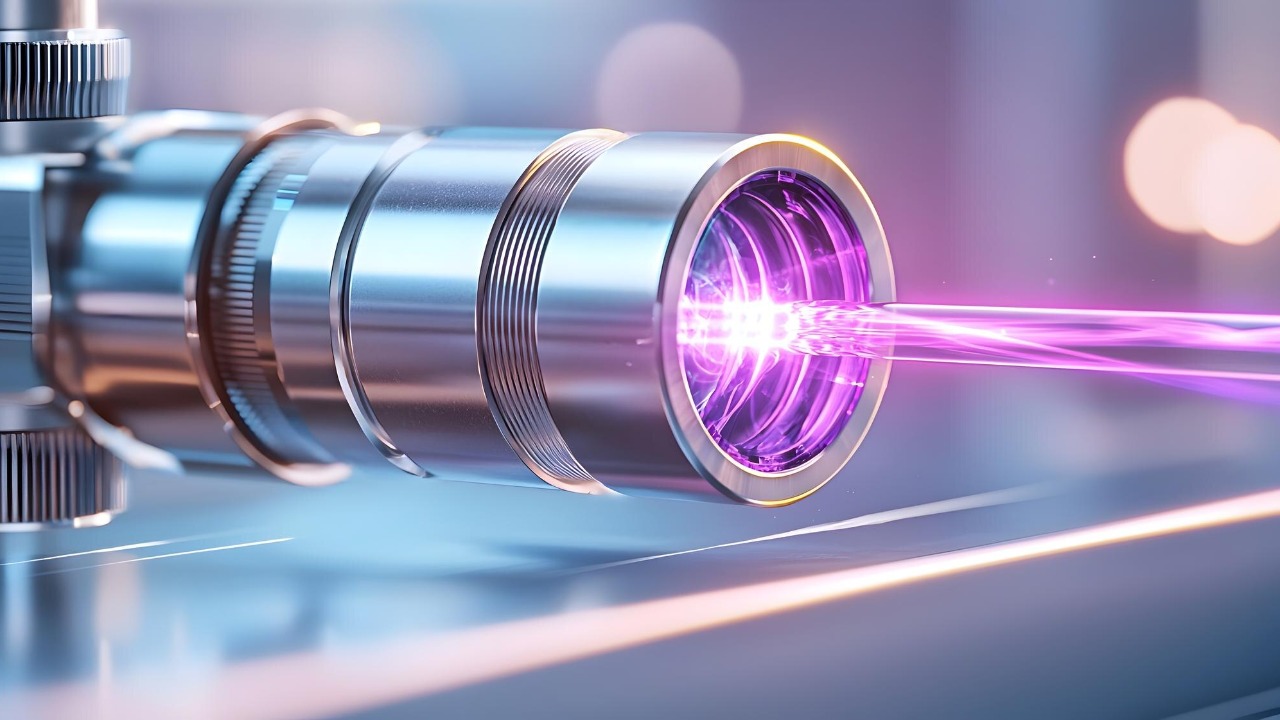

Physicists are learning to carve laser beams into intricate shapes that can grab hold of electrons and push them with a precision that once sounded like science fiction. Instead of simply blasting matter with brute-force light, they are now sculpting the pulse itself in space and time to tune how particles surf the violent waves that follow. That shift is turning laser-wakefield acceleration from a wild ride into something closer to a controllable machine.
By tailoring the structure of a pulse, researchers can adjust the speed, shape, and stability of the plasma “wake” that drags electrons to high energy over just millimeters. I see this as a pivotal moment: the field is moving from proving that laser-driven accelerators work at all to engineering how they work, with direct measurements and new imaging techniques finally catching the wake in the act.
From blunt beams to structured light
Traditional laser-wakefield accelerators rely on a simple idea: fire an intense, ultrashort pulse into a plasma and let the displaced electrons form a trailing wave that can accelerate particles. For years, the main knobs were brute-force ones such as pulse energy, duration, and focus, which limited how finely researchers could tune the resulting wake. The new generation of experiments treats the laser not as a single spike of light but as a malleable object whose phase, amplitude, and even transverse profile can be engineered to control how the wake evolves.
That shift is only possible because experimentalists can now watch the wake in unprecedented detail. With the development of minimally intrusive single-shot measurements of the spatio-temporal behavior of the pulse, teams have begun to directly map how the plasma responds to different beam shapes and timing. Those measurements, described as a way to probe extreme light–matter interactions, turn what used to be a largely inferential science into one where the wakefield itself can be imaged and compared shot by shot as the laser is sculpted.
Beating the dephasing limit by reshaping the pulse
One of the fundamental obstacles in laser-wakefield acceleration is dephasing, the moment when electrons outrun the accelerating phase of the plasma wave and start to lose energy instead of gaining it. Conventional setups accept this as a hard limit set by the plasma density and the laser’s group velocity. The new work challenges that assumption by modifying the velocity with which the intensity peak of the laser moves, effectively changing how the wake’s phase velocity matches the electrons’ motion.
In recent experiments, researchers used structured light to adjust this intensity peak so that the wake’s phase velocity could be tuned along the propagation path. A report from Dec described how a promising way to overcome the dephasing limit is to control the apparent motion of the laser envelope, which in turn alters the balance between the wake and the electrons. By carefully shaping the pulse, the team showed that the phase velocity of the wake in a laser-wakefield accelerator can be steered, opening a route toward reducing electron dephasing rather than simply working around it.
Directly observing a sculpted wake
For years, the idea of using structured light to control the phase velocity of a wake was largely theoretical, supported by simulations and indirect signatures in electron spectra. That changed when a collaboration reported the first direct observation of a wakefield generated with a deliberately shaped pulse. In that work, described in Mar, the researchers used structured light to control the phase velocity of the wake in laser-wakefield accelerators and then directly imaged how the plasma wave responded.
The key result was that the wake could be made to propagate in a way that kept electrons locked into the accelerating phase for much longer distances than in a conventional configuration. By comparing different beam structures, the team showed that sculpted pulses could, in principle, support dephasing-free electron acceleration, at least over the scale of their experiment. The use of structured light to control the phase velocity of the wake, documented in detail in the direct observation study, turns a long-standing theoretical proposal into an experimentally grounded tool.
Imaging the wake: FREM and “walls of light”
To make sense of sculpted wakes, researchers need more than energy spectra and beam profiles; they need to see the wake itself. That is where advanced microscopy techniques come in. FREM, highlighted in Jul as a powerful microscopy technique, uses an ultrashort, high intensity laser pulse to form a laser-wake that acts as a probe with high spatial and temporal resolution. By timing a secondary pulse to intersect the wake, FREM can reconstruct the evolving plasma structure in a single shot, revealing how different laser shapes carve different cavities in the plasma.
Those images are not just pretty pictures. They show that the wake can be made to resemble “walls made of light” that confine and guide particles along specific trajectories. In one widely shared description from Jun, an experimental triumph was framed as proof that particles can ride light, propelled not by mechanical force but by the electric and magnetic fields of the pulse, at speeds approaching the speed of light. That evocative language reflects a real physical effect: carefully structured pulses create electromagnetic barriers and channels that act like optical rails, a concept captured in the description of particles that ride light inside the wake.
Toward compact accelerators and extreme physics
The ability to sculpt laser pulses and directly observe the resulting wakes is not just a technical flourish; it is central to the long-term goal of building compact, high-gradient accelerators. If dephasing can be mitigated and beam quality stabilized, laser-wakefield devices could shrink facilities that now span kilometers into labs or even industrial settings. That prospect depends on pushing lasers to ever higher intensities and then taming those fields with precise structuring, a combination that is starting to look realistic as facilities report record performance.
One benchmark came from a facility in Korea that reported record-high laser pulse intensity, emphasizing the laser’s unique capability to simulate extreme conditions akin to those found near neutron stars or black holes. Those extreme fields are not just for astrophysics analogues; they are exactly the regime where sculpted pulses can drive wakes with gradients far beyond conventional radio-frequency technology, potentially turning tabletop setups into sources of multi-gigaelectronvolt beams. The same report stressed that such capabilities are expected to accelerate progress from fundamental discovery to real-world impact, a trajectory that depends on pairing raw intensity with the kind of fine-grained control that structured light and wakefield imaging now provide, as highlighted in the description of the laser’s unique capability.
What precision control could unlock next
As I look across these developments, the common thread is that laser-wakefield acceleration is evolving from a proof-of-principle curiosity into a platform technology. With the development of minimally intrusive diagnostics, techniques like FREM, and the deliberate use of structured light, researchers can now iterate on wake design almost as engineers tune a circuit. The fact that Dec and Mar experiments both focus on controlling the phase velocity of the wake, and then directly observing the outcome, signals a maturing field that is ready to optimize rather than merely demonstrate.
The next steps will likely involve integrating these sculpted wakes into staged accelerators, where multiple plasma modules hand off an electron beam without degrading its quality. That will demand even tighter synchronization between pulse shaping, plasma density profiles, and diagnostic feedback, but the core ingredients are already visible in the current work. If those pieces come together, the “laser sculpting” that now offers rare control over particle acceleration could become a standard tool, enabling compact sources for medical imaging, ultrafast materials studies, and tests of high-field quantum electrodynamics that once required the largest machines on Earth. The trajectory from structured light to practical accelerators is not guaranteed, but the combination of direct wakefield observation, advanced microscopy, and record-breaking laser systems suggests that the field has finally found the levers it needs to try.
More from Morning Overview