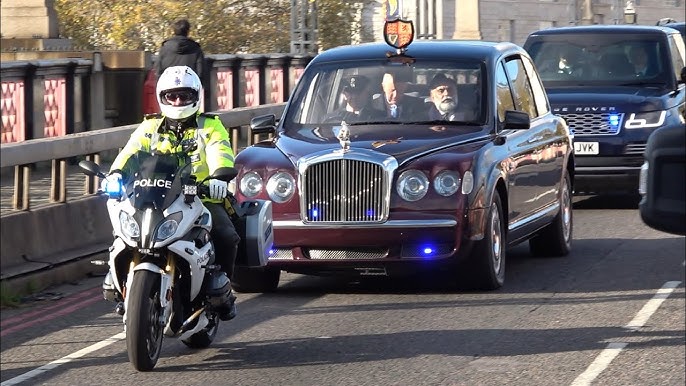

King Charles’s latest addition to his garage, a China-backed luxury electric car, has now been photographed within the grounds of a royal residence, turning a private purchase into a public talking point. The bespoke Lotus Eletre SUV, built under Chinese ownership but trading heavily on British heritage, crystallises the tension between the monarch’s green ambitions and the geopolitical scrutiny that now follows any high-end technology from China. It is also a vivid symbol of how the modern monarchy navigates global supply chains, soft power and domestic expectations, all through the choice of a set of wheels.
The sight of the vehicle at a royal home confirms that this is not a mere showpiece but a working part of the King’s life, used on the same estates that once echoed to the sound of classic British combustion engines. As the images circulate, the car’s origins, price tag and environmental credentials are being pored over, turning a personal preference into a case study in twenty‑first century royal optics.
The bespoke Lotus Eletre at the royal residence
The vehicle at the centre of the debate is a bespoke Lotus Eletre electric SUV, described as belonging to the King and now seen parked at a royal residence. Photographs show the large, high-riding model within the grounds, confirming that the monarch’s Chinese-backed choice has moved from the showroom into active use on the estate. Reports on the Lotus Eletre emphasise that it is an SUV and that its components originate from China, even as it carries the badge of a storied British marque.
Further coverage underlines that this is not a standard showroom car but a tailored commission, with The King’s new bespoke Lotus Eletre added to his multimillion‑pound car collection and captured in images credited to Mark Cuthbert and Getty Images. Those reports stress that the model is Chinese-backed because The Geely group, a Chinese multinational, owns a controlling stake in Lotus, and that many of the vehicle’s components were made in China before being assembled into a luxury product marketed as a British sports and racing brand. The combination of a royal owner, a Chinese industrial backer and a British performance nameplate is what gives this particular SUV its political and cultural charge.
Chinese backing and the Geely connection
The corporate structure behind the King’s new SUV is central to why the car has attracted so much attention. The Geely group, a Chinese multinational, owns 51 per cent of Lotus, the famous British sports and racing car company, giving China a decisive role in the direction of the brand. That majority stake means the Eletre is widely described as Chinese-backed, even as it trades on decades of British engineering prestige. Reports on The Geely stake make clear that the company’s 51 per cent holding places it at the heart of Lotus’s strategy, including the pivot to high‑end electric SUVs.
That ownership structure is not an abstract detail when the buyer is the monarch. The King’s choice of a vehicle whose components were made in China, and whose parent company is controlled from there, lands at a time when Chinese investment in strategic industries is under intense scrutiny in the United Kingdom and beyond. At the same time, the car’s presence at a royal residence that is itself a symbol of British continuity, such as the Sandringham estate referenced in coverage of the Lotus Eletre SUV, highlights how globalised supply chains now intersect with the most traditional corners of national life. The fact that the car is both Chinese-backed and marketed as a British performance product encapsulates the broader debate over how far national identity can be separated from ownership and manufacturing.
Green credentials and the King’s environmental image
For King Charles, the environmental dimension of the Lotus Eletre is not incidental, it is central to the story he has long tried to tell about his public role. His Majesty has been known for pro‑environmental views for decades, and earlier reporting on his decision to add an electric Lotus to his collection framed the move as a logical extension of that record. The Eletre is a fully electric SUV, praised in motoring circles for its green credentials and its ability to deliver performance without tailpipe emissions, which aligns with the King’s desire to be seen cutting his own carbon footprint. Coverage of how His Majesty added the car to his private automobile collection stresses that the choice of an electric model fits a long‑standing pattern rather than a sudden conversion.
Reports on the King’s broader transport habits reinforce that narrative. Although King Charles already owns a range of vehicles, he has been portrayed as someone who tries to live out his environmental principles even when off duty, including through the use of alternative fuels and lower‑emission options. The Eletre’s positioning as a luxury SUV with strong green credentials, capable of serving as a countryside runabout without the noise and fumes of older models, dovetails with that image. Coverage that notes how the King shows his green credentials by choosing electric transport underscores that the new Lotus is meant to be read as a climate‑conscious decision as much as a status symbol.
A royal garage shaped by global brands
The Lotus Eletre does not sit in isolation, it joins a royal garage that has quietly become a catalogue of global automotive shifts. The Rolls-Royce joined other cars in his fleet, including a $215,000 Lotus Eletre, and a couple of custom Bentleys, illustrating how the King’s collection spans ultra‑luxury British brands and newer electric entrants. That reference to the $215,000 Lotus Eletre places a clear price marker on the SUV, while the presence of The Rolls, Royce and Bentleys in the same sentence shows how the electric model is being treated as a peer to the most traditional symbols of motoring opulence. The report on the Lotus Eletre in that context underlines that the electric SUV is not a token eco‑car but a core part of the high‑end fleet.
Other reporting has noted that King Charles and Queen Camilla have also revealed a new £160,000 electric sports car, with the monarch joking that it is “silent but deadly”, a quip that captures both the quietness of electric drivetrains and their performance potential. That figure of £160,000 places the latest electric addition firmly in supercar territory, and the description of supercar performance with green credentials shows how the royal couple are leaning into the idea that sustainability and speed can coexist. The coverage of King Charles and unveiling that car reinforces the impression that the Eletre is part of a broader shift in the royal garage toward high‑value electric models rather than a one‑off experiment.
Soft power, symbolism and the China question
The decision to embrace a Chinese-backed electric SUV also intersects with wider questions about soft power and industrial strategy. One report framed the King’s move as a choice to snub American electric brands in favour of a model linked to Wuhan in China, setting it against the backdrop of Another iconic British brand, Aston Martin, which has struggled under a succession of owners and is now owned 18 per cent by overseas investors. That comparison, drawn in coverage of how the King’s purchase reflects on Another British marque, highlights how few truly independent domestic carmakers remain and how entangled British automotive heritage has become with foreign capital, including from China.
More from Morning Overview