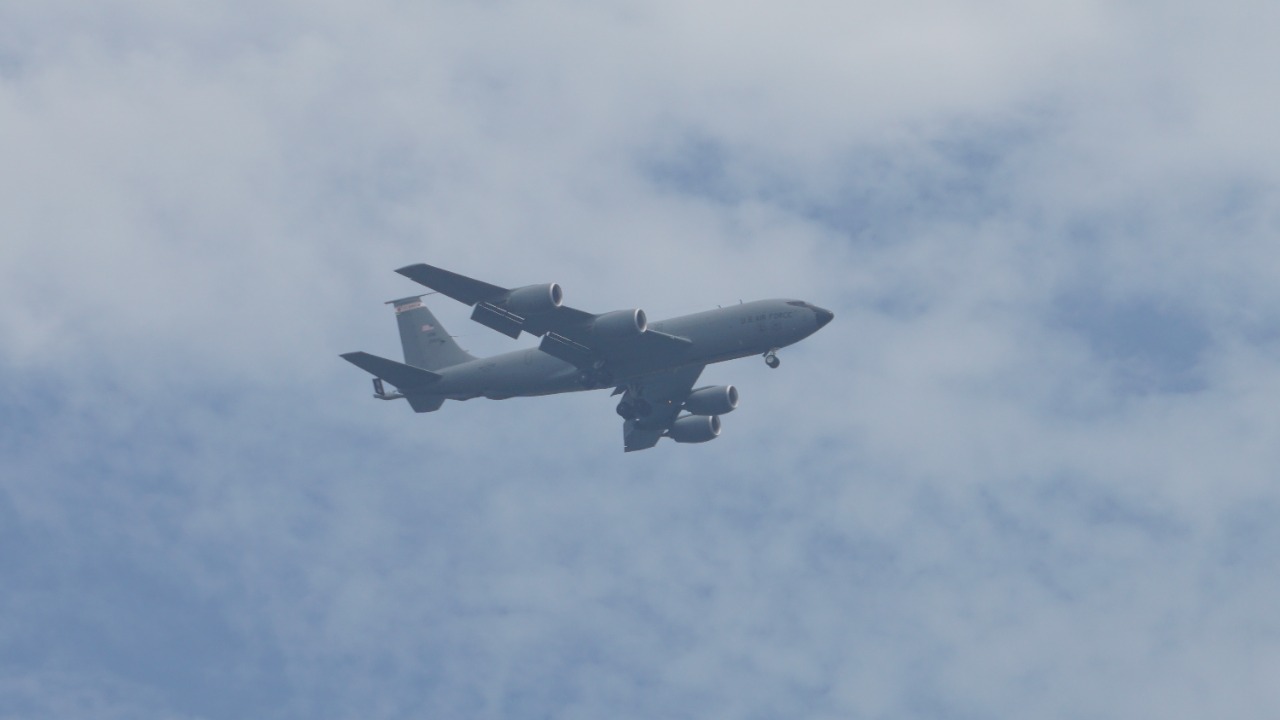

The steeply banked go around by a KC-135 at RAF Mildenhall was not just a viral clip of a big jet muscling through the sky. It was a glimpse into how close-run airspace, demanding training and split-second airmanship intersect over one of the United States Air Force’s busiest overseas tanker hubs. The maneuver, dramatic to watch from the ground, sits on a continuum that includes near misses, aggressive evasive turns and the quiet routine of crews who practice for the worst so that it never happens.
Seen in that light, the Stratotanker’s sharp climbing turn over Suffolk is less an isolated stunt and more a case study in how a 135,000‑pound refueling aircraft is flown at the edge of its envelope when safety margins suddenly shrink. To understand what unfolded, I need to put that moment alongside recent investigations, training footage and official accounts from RAF Mildenhall.
The dramatic banked go around on short final
From the ground, the first thing that stands out in the video of the KC-135’s go around is the bank angle. As the USAF jet abandons its approach and powers away, the wings roll decisively, the fuselage carving a tight arc that looks more fighter than tanker. The clip, shared as a USAF KC-135 BANK, shows the aircraft low over the runway environment at RAF Mildenhall before the crew commits to full power and a steep climbing turn. For a lay viewer, it looks almost reckless. For pilots, it is a textbook example of how a heavy jet can be maneuvered aggressively yet within its certified limits when the situation demands immediate action.
What the camera does not capture is the decision chain in the cockpit. A go around at that stage of an Approach Go is rarely taken lightly, because it means trading a stable landing for a high workload climb in close proximity to the ground and other traffic. The crew must manage thrust, pitch, BANK and ANGLE while retracting flaps and gear, all while staying inside the airfield’s noise abatement and obstacle clearance constraints. That the Stratotanker appears to pivot smartly away from the runway suggests the pilots were reacting to a specific conflict or instruction, not improvising for the sake of spectacle.
Near miss with a JS1 glider and the role of investigators
The context for such assertive maneuvering becomes clearer when set against a serious near miss involving the same aircraft type in the same patch of sky. Investigators have detailed how a USAFE Boeing KC-135R Stratotanker, flying training circuits from RAF Mildenhall, came close to colliding with a JS1 glider in the East of England. According to Investigators, the tanker was operating near RAF Mildenhall in Suffolk when the glider appeared in its path, forcing an abrupt avoidance maneuver that cut separation to a frighteningly small margin.
A separate account notes that Sep and other Investigators traced the incident to a USAFE Boeing KC Stratotanker that had been flying a routine training profile when it encountered the JS1. The fact that a large refueling aircraft, crewed by professionals and supported by radar, could still end up in such proximity to a glider underscores how crowded and complex the airspace is around Mildenhall. It also explains why crews are trained to roll into aggressive banks and climb away the instant a conflict appears, even if that produces heart-stopping footage from the ground.
Airprox findings and the razor-thin margins over East Anglia
The official Airprox Board report on the same episode paints an even starker picture of the margins involved. According to the report, the USAF Boeing KC-135 Stratotanker was flying training circuits at RAF Mildenhall when it started a turn that brought it within an estimated 50 ft of the glider near Cambridgeshire. That detail, set out in an Airprox Board summary, is chilling: 50 ft is less than the wingspan of the tanker itself, and far inside the buffer that controllers and pilots normally rely on to keep aircraft safely separated.
Another passage notes that, According to the report, the USAF Boeing KC Stratotanker had been flying a standard pattern from RAF Mildenhall when it encountered the JS1 in uncontrolled airspace. That account, set out in a second According to the extract, highlights a structural challenge: military traffic from a busy refueling base shares the sky with recreational gliders that may not be in constant radio contact. When a 135 is turning at low altitude and a silent sailplane appears in its path, there is no time for gentle corrections. The only safe option is an immediate, sometimes violent change in BANK and ANGLE, exactly the kind of maneuver that startled viewers in the go around video.
Training for the worst: go arounds, low visibility and base readiness
The steeply banked escape at Mildenhall did not happen in a vacuum. KC-135 crews are drilled to handle go arounds and tight departures in challenging conditions, because their mission often demands launches and recoveries when the weather is marginal and the schedule unforgiving. One training video from Nov shows a KC-135 GO AROUND in which the narrator explains that in both cases, the pilot must apply continuous control inputs for ailerons and rudder to manage drift and maintain alignment during the maneuver. That description, captured in a KC-135 GO AROUND clip, matches what is visible in the Mildenhall footage: a heavy jet being flown with constant, precise corrections as it claws away from the runway.
Another video, shot on a misty Autumn morning, shows a two-ship of KC-135R Stratotankers attempting to depart in extremely low visibility, with the second aircraft making a particularly demanding takeoff. The sequence, shared in a Autumn Stratotankers clip, underlines how often these aircraft operate at the edge of what the weather and runway will allow. At RAF Mildenhall, that pressure is formalized in exercises like Aw-R-Go, where a U.S. Air Force KC-135 Stratotanker from the 100th Air Refueling Wing takes off from Roy in England as part of a base readiness drill. The official description of that sortie, recorded in an Air Force KC release, makes clear that these are not one-off heroics but rehearsed responses to the kind of sudden go around that played out in the viral clip.
Why Mildenhall’s tankers matter, and what “providence” has to do with it
RAF Mildenhall is not just another airfield on the map. The 100th Air Refueling Wing, based there in England, uses a fleet of KC-135 Stratotankers to provide critical air refueling and flexibility throughout Europe and Africa. That mission, described in an official Air Refueling Wing video, means the aircraft seen banking hard away from the runway are the same ones that keep fighters, transports and surveillance platforms on station from the High North to the Sahel. On the ground, Military aircraft sit on the tarmac at RAF Mildenhall in England, a scene captured in Military RAF Mildenhall imagery that hints at the tempo of operations. There is no slack in that system, which is why crews train so hard to salvage a bad approach or avoid a conflict without bending metal.
When things do go wrong, the language used by officials can be striking. In the JS1 incident, one account from Sep in the East of England notes that George King reported how the near miss involved a USAF plane and a glider in circumstances that seriously concerned the Airprox Board. That concern is spelled out in a News East of report, which emphasizes how close the aircraft came to disaster. Another passage from the same case records that Providence played major part, with the military pilot maneuvering aggressively upon seeing the glider and the Board concluding there had been a serious risk of collision. That stark assessment, captured in a Providence summary, is a reminder that even with training, technology and discipline, sometimes only luck and a well-flown steep bank separate a routine circuit from catastrophe.
More from Morning Overview