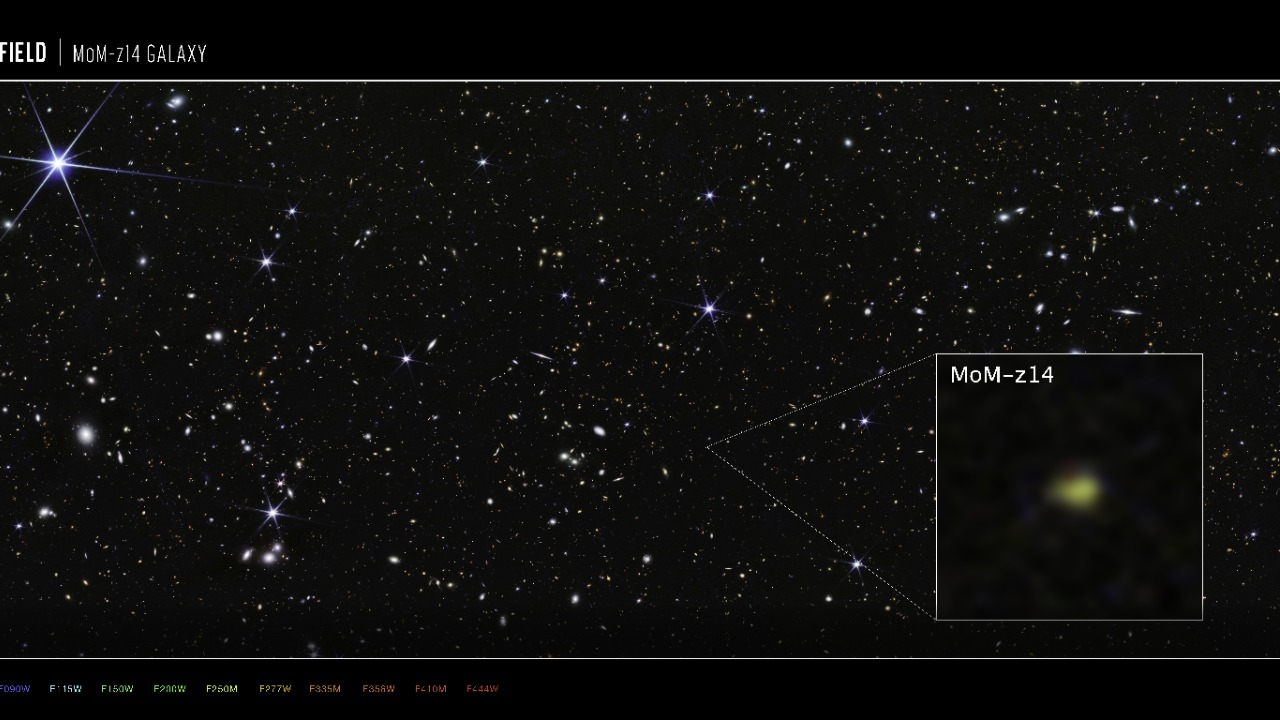

The James Webb Space Telescope has pushed the edge of the observable universe deeper into the past, revealing a galaxy whose light began its journey when the cosmos was only a few hundred million years old. That record breaker, known as MoM-z14, is not just far away, it is structurally and chemically unlike what standard models predicted for such an early era. Instead of a tiny, chaotic proto-galaxy, Webb is seeing something surprisingly massive, bright, and complex, forcing astronomers to rethink how quickly the first galaxies assembled.
This discovery builds on earlier Webb finds such as JADES-GS-z14-0, which already hinted that the young universe was forming stars and heavy elements far faster than expected. With MoM-z14 now confirmed as the farthest galaxy ever detected, the tension between theory and observation has sharpened, and the early universe looks less like a slow dawn and more like a sudden ignition.
Webb’s new record: MoM-z14 at the edge of time
The basic claim is stark: Scientists using NASA’s James Webb Space Telescope have identified the farthest galaxy yet seen, a system labeled MoM-z14 whose light comes from only about 280 million years after the Big Bang. In technical terms, the galaxy sits at a redshift of 14.4, corresponding to just 280-Million Years After the Big Bang, a regime cosmologists call the “cosmic dawn.” NASA has framed this as Webb pushing the boundaries of the observable universe closer to the Big Bang, with MoM-z14 providing a new anchor point for how early galaxies emerged in the first few percent of cosmic history, according to Webb Pushes Boundaries.
NASA’s announcement, made after detailed analysis of JWST data, describes MoM-z14 as the farthest galaxy detected to date by Scientists using the James Webb Space Telescope. The same result is highlighted in coverage that notes how the galaxy’s light, captured by NASA’s Webb, effectively lets astronomers “time travel” back to a universe that was only a tiny fraction of its current age. One report describes the system as the Furthest galaxy EVER spotted, seen in an image from just 280 m years after the Big Bang, as Nasa reveals.
A galaxy that “looks nothing like what we predicted”
What makes MoM-z14 so disruptive is not only its distance but its appearance and brightness. The James Webb Space Telescope data show a galaxy that is already relatively luminous and structured, rather than a faint, irregular clump of stars. Coverage of the discovery notes that The James Webb Space Telescope has spotted the most distant galaxy yet detected and that it “looks nothing like what we predicted,” as James Webb Space observations have been described. That mismatch between theory and image is the core of the story: models expected tiny, slowly growing systems, not a bright, already substantial galaxy.
The confirmation of MoM-z14’s distance relied on spectroscopy from JWST, with the discovery based on JWST data from April 2025 and later analysis that was published in the Open Journal of. One detailed account emphasizes that pinning down such a high redshift with any telescope other than JWST would be extraordinarily difficult, underscoring how Webb’s infrared sensitivity and resolution are uniquely suited to this frontier. A separate Story by Sharmila Ku reinforces that MoM-z14 now sits at the extreme edge of the earliest known galaxies ever observed.
From JADES-GS-z14-0 to MoM-z14: a pattern of precocious galaxies
MoM-z14 did not appear in a vacuum. Earlier in Webb’s mission, astronomers working on the JADES survey identified another record-breaking system, JADES-GS-z14-0, which already hinted that the early universe was forming stars and heavy elements at a startling pace. One overview of JADES notes that NASA’s JWST, the James Webb Space Telescope, was credited with “Discovering the Most Distant Galaxy” when JADES-GS-z14-0 was first reported, underscoring how quickly Webb began to overturn expectations. A community post on Webb enthusiasts described that earlier find as a new record holder that shattered the telescope’s own previous mark.
Subsequent analysis of JADES-GS-z14-0 has only deepened the puzzle. Research summarized in Nature Astronomy portrays this galaxy as “surprisingly mature for its age,” with a stellar population and structure that look more like a later epoch than a primordial fragment. Another report on the Most distant known galaxy notes that in 2024 the James Webb Space Telescope spotted this system and found a key surprise in this galaxy: oxygen. Together, JADES-GS-z14-0 and MoM-z14 suggest that the first generation of galaxies did not grow slowly and chaotically, but instead reached significant mass and complexity in a cosmically brief window.
Oxygen at the edge of time and the rush of early star formation
The detection of oxygen in JADES-GS-z14-0 is one of the clearest signs that early galaxies are evolving faster than models anticipated. Light from this galaxy, according to one analysis of JADES, left when the universe was only about 2% of its current age, yet already carries the spectral fingerprints of heavier elements. A detailed breakdown of the chemistry stresses that Heavier elements like oxygen are forged inside stars and released when they die, and that Finding oxygen so early suggests this distant galaxy has already gone through multiple stellar generations.
Another summary of the same result notes that the presence of oxygen in JADES-GS-z14-0 means that multiple generations of stars must have formed, lived, and died extremely quickly, reshaping how astronomers think about early star formation and chemical evolution, as highlighted in a post about JADES. A separate report on how Light from JADES-GS-z14-0 carries this oxygen signature reinforces that this is the most distant galaxy ever recorded with such chemical complexity. When I put that chemical maturity next to MoM-z14’s extreme distance, the picture that emerges is of a universe that wasted no time building and enriching its first galaxies.
Why MoM-z14 and JADES are forcing cosmologists back to the drawing board
For cosmologists, MoM-z14 and JADES-GS-z14-0 are not isolated curiosities, they are data points that strain the standard timeline of structure formation. NASA’s own description of Galaxy MoM-z14 emphasizes that it provides another confirmation that the earliest galaxies were already surprisingly bright, suggesting that the first stars and black holes may have formed more efficiently than expected. A technical overview of how JWST pushed direct galaxy observations deeper into the cosmic dawn notes that this confirmation reshapes current models of early galaxy formation, a point echoed in a feature on how Even a single object at this distance can have outsized theoretical impact.
At the same time, other lines of evidence are challenging the broader cosmological framework. One widely shared analysis of large scale structure argues that Astronomers may have found signs that our galaxy sits inside a massive cosmic void, a low density region so large that it could help explain the “Hubble tension” in measurements of the universe’s expansion. If the Milky Way really does inhabit such a void, and if galaxies like MoM-z14 and JADES-GS-z14-0 are as common as Webb’s early data suggest, then the standard picture of a smoothly evolving early universe will need significant revision. In that context, the James Webb Space Telescope is not just adding detail to an existing story, it is forcing a rewrite of the opening chapters.
More from Morning Overview