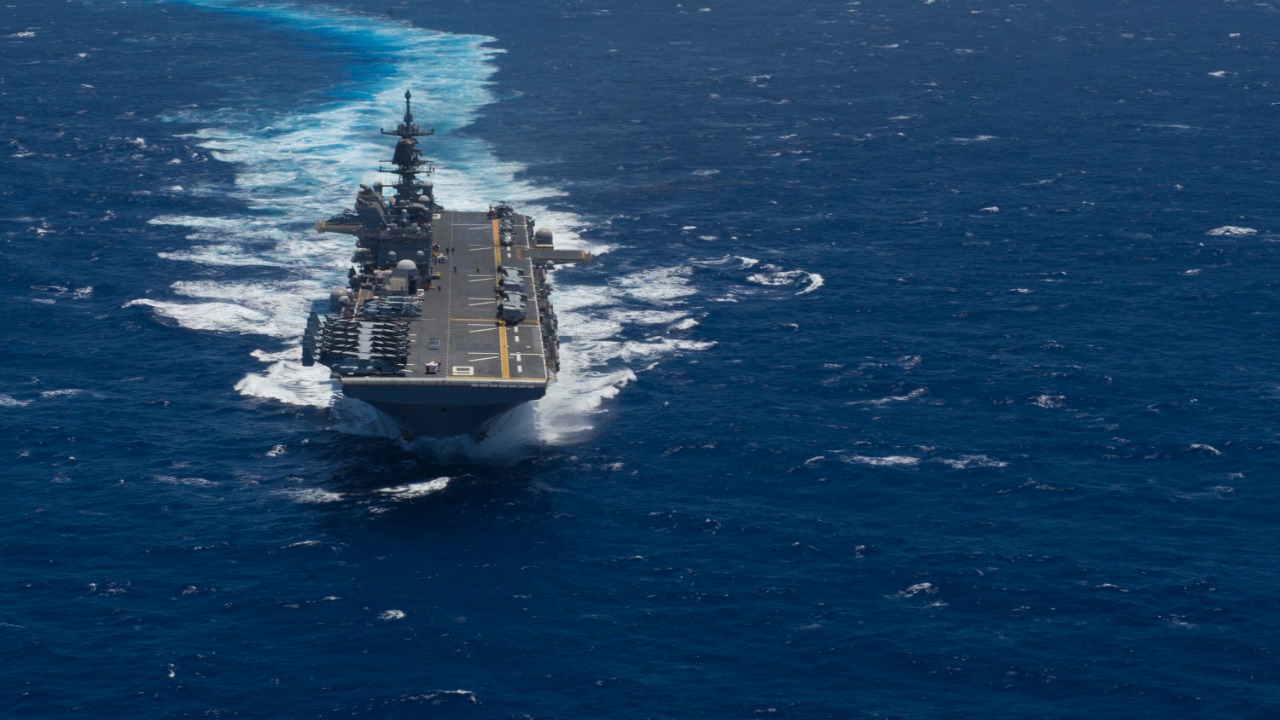

The USS America (LHA-6) looks every bit like a small aircraft carrier, which naturally raises the question of whether it shares the nuclear heart that drives the Navy’s largest flattops. It does not. Instead, the first-in-class amphibious assault ship relies on a sophisticated conventional power plant that blends gas turbines and electric drive to deliver carrier-like capability without a reactor.
Understanding how the ship is actually powered is more than a technical curiosity. It goes to the core of how the United States Navy balances cost, range, survivability, and maintenance across its fleet, and why only a handful of its biggest combatants are nuclear while a workhorse like USS America runs on a different mix of technology.
What really powers USS America (LHA-6)?
USS America is driven by a conventional propulsion system built around marine gas turbines and electric motors, not a nuclear reactor. The ship’s Propulsion arrangement is described as Two marine gas turbine engines working alongside Two auxiliary propulsion motors, a configuration that firmly places the ship in the non‑nuclear category. In other words, its power plant burns fuel oil to spin turbines, which then drive the ship directly or feed electricity to motors, rather than drawing heat from a reactor core.
The ship’s physical scale can make the nuclear assumption understandable. At a full load displacement of 44,971 long tons (45,693 t), a Length of 844 ft (257 m), a Beam of 106 ft (32 m), and a Draft of 26 ft (7.9 m), USS America occupies a footprint that overlaps with older fleet carriers. Yet despite those carrier-like dimensions, the Navy chose to equip the ship with a hybrid conventional system rather than the nuclear plants used on Nimitz and Ford class carriers, a decision that shapes everything from its operating costs to its deployment patterns.
The hybrid gas turbine and electric drive system
At the heart of USS America’s machinery are LM2500+ gas turbines that give the ship the sprint speed and electrical power it needs for aviation operations. The United States Navy selected these gas turbines as part of a hybrid propulsion concept that allows the LHA 6 ship’s hybrid system to drive the hull in excess of 20 knots when high speed is required. In this mode, the turbines are mechanically connected to the shafts, delivering the kind of performance needed to keep up with a carrier strike group or reposition quickly in a crisis.
For lower speed steaming, the ship can shift to a more economical electric mode that uses auxiliary propulsion motors instead of running the main turbines continuously. The America class design is described as being powered with a combination of gas turbines and electric drive that can operate in an efficient mode across its speed range, a feature highlighted in analyses of the America class amphibious assault ship. This hybrid approach gives commanders flexibility: they can conserve fuel during routine transits, then unleash the full turbine power when aviation tempo or tactical maneuvering demands it.
How the ship’s power plant supports aviation and onboard systems
Beyond turning the propeller shafts, the propulsion system also feeds a hungry electrical grid that keeps the ship’s aviation and combat systems running. Reporting on the program notes that the LM2500+ units are integrated with the ship service electrical system, allowing the same Marine gas turbines that drive the ship at high speed to also support radar, communications, and aircraft support equipment. This arrangement is particularly important for an amphibious assault ship that must sustain flight operations for helicopters and short takeoff and vertical landing jets while also powering command and control suites for embarked Marines.
Program documentation for LHA-6 underscores that Propulsion is provided by two marine gas turbine engines, two electric auxiliary propulsion motors, and supporting generators that together supply both movement and onboard power. The same report explains that the ship is designed to embark and support Marine combat elements, which means the propulsion and electrical systems must be robust enough to handle not only ship operations but also the demands of embarked forces and their equipment, a role captured in the detailed FY14 NavY PROGRaMS assessment.
Why the Navy chose conventional power instead of nuclear
The decision to avoid nuclear propulsion on USS America reflects a broader Navy calculus about where reactors make sense. Nuclear plants offer virtually unlimited range and high sustained speed, but they come with higher construction costs, specialized maintenance infrastructure, and stringent training and safety requirements. For an amphibious assault ship that spends much of its time operating closer to shore and cycling between training, presence missions, and crisis response, the Navy judged that a sophisticated conventional system could deliver the needed performance without the expense and complexity of a reactor.
Design studies of the America class emphasize that the ship is powered with a hybrid gas turbine and electric drive arrangement that can operate efficiently across its speed range, a choice that aligns with its role as an aviation-centric amphibious platform rather than a blue-water strike carrier. Analyses of the America design point to the balance between fuel efficiency at cruising speeds and the ability to surge above 20 knots when needed, a balance that conventional systems can achieve without the strategic and political implications that accompany nuclear-powered warships entering foreign ports.
USS America’s role and what its power plant enables
USS America is more than a large hull with a flight deck; it is a mobile airfield and logistics hub for Marine forces. Official welcome materials highlight that During her war tenure a previous ship named America transported nearly 90,000 American service members to and from the war effort, a legacy that the current LHA-6 is built to continue in a modern form. The tri-fold for USS America underscores the ship’s role in projecting Marine power ashore, a mission that depends on reliable propulsion to position the ship and steady electrical power to sustain aviation, medical, and command facilities.
The hybrid propulsion system directly supports that mission profile. By combining Two marine gas turbine engines with Two auxiliary propulsion motors, the ship can loiter economically in an amphibious operating area, then reposition quickly if the tactical situation changes. The detailed description of Propulsion on the class makes clear that the system is sized not only for ship movement but also for the heavy electrical loads of aviation fuel pumps, elevators, and maintenance facilities. In practice, that means the question of whether USS America is nuclear powered misses the more interesting story: how a carefully engineered conventional plant underwrites the ship’s ability to act as a front-line sea base for Marines in an era of dispersed, fast-moving operations.
More from Morning Overview