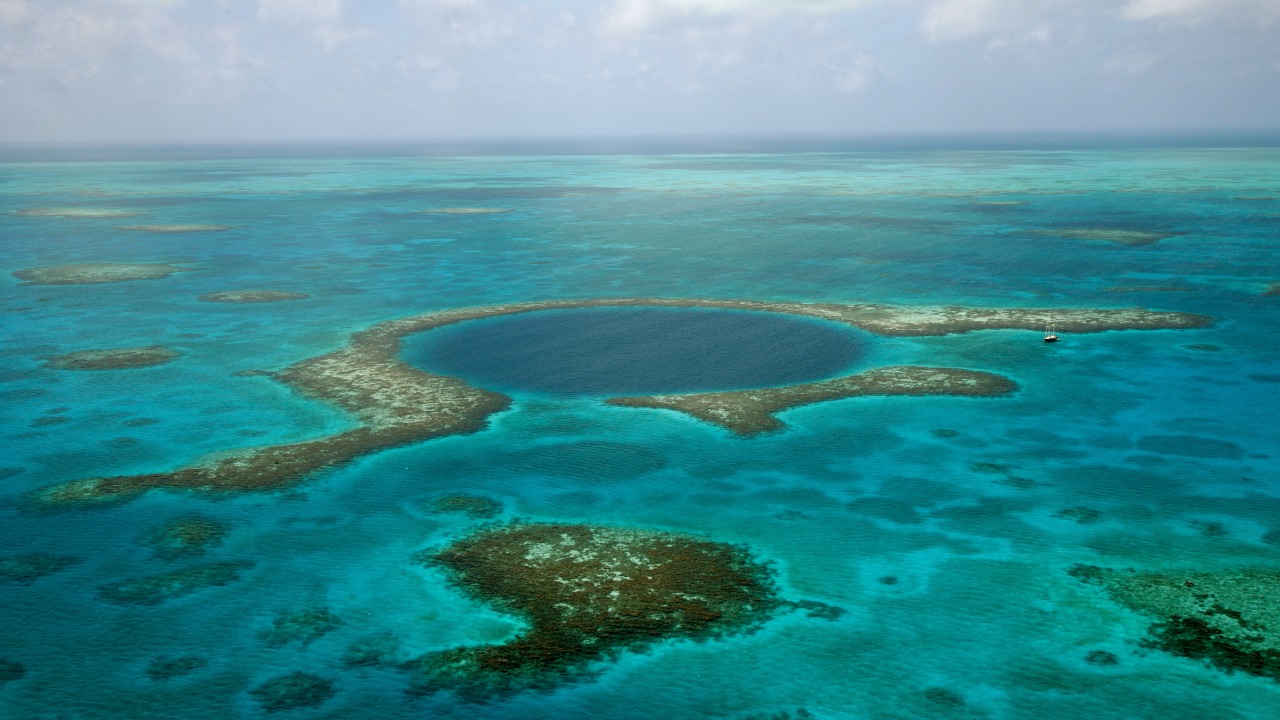

From the air, it looks like an ink spill in turquoise water, a perfect circle that seems to drop straight into the planet. For decades, Belize’s Great Blue Hole has pulled in explorers, filmmakers and scientists who suspect its depths hold clues to Earth’s past and perhaps even to life beyond our world. What they are finding is stranger, and more unsettling, than the postcard images suggest.
I see this sinkhole as a kind of natural archive, a place where geology, biology and human history have been filed away in layers of rock and water. As researchers push deeper into its darkness, they are uncovering not just eerie relics and lost divers, but also new life forms and warning signs about the future oceans we are creating.
How a limestone cave became a vertical ocean
The Great Blue Hole sits in the middle of Lighthouse Reef, a coral atoll off the coast of Belize, where the Caribbean shallows suddenly give way to a near perfect circle of deep navy water. Geologists describe blue holes as giant underwater sinkholes that form when limestone bedrock collapses, often after long periods when sea level was lower and the site was a dry cave system. As ice sheets melted and oceans rose, those caverns flooded and their roofs in places gave way, leaving vertical shafts that drop hundreds of meters beneath the surface, a process that has also shaped Blue holes in the Gulf of Mexico.
On the rim of Belize’s formation, divers fin across a shallow coral shelf before the seafloor suddenly vanishes beneath them, revealing the sheer-sided shaft that has made the Great Blue Hole famous. That ridge is the eroded edge of a massive limestone cave system, now isolated from the surrounding Mesoamerican Reef by a sharp change in depth and light. Similar features dot the seafloor off Florida, where Blue holes are thought to be ancient sinkholes created 10,000 years ago when the peninsula extended farther into the Gulf, a reminder that these pits are really time capsules from a very different coastline.
The new record holder that hid from satellites
For years, Belize’s sinkhole was shorthand for the deepest of its kind, until Researchers working off Mexico announced a blue hole plunging 420 meters below sea level in the Chetumal Bay region. That discovery underscored how little of the seafloor has been mapped in detail, and how these vertical caverns can remain hidden even in shallow coastal waters. A podcast investigation later described how the world’s deepest known blue hole stayed largely undetectable from orbit, its narrow opening and surrounding sediment making it effectively invisible to satellites until divers and sonar teams closed in, a story unpacked in a recent WION segment.
To probe such depths, scientists rely on instruments like The CTD, a package that measures conductivity, temperature and depth as it descends. In the Mexican pit, the CTD revealed a striking jump in water temperature and salinity around 1,312 feet, or 400 meters, below sea level, hinting at hidden connections to offshore currents and perhaps to underground cave systems. A separate dive mission reported that On December 6, 2023, a scuba team entered what they call TJBH, short for TJBH, to document environmental conditions and search for side tunnels that might extend the system even farther.
A vertical graveyard and a trash pit in paradise
Belize’s Great Blue Hole may not hold the depth record, but it has become the most iconic, in part because of what explorers have found at the bottom. When a team led by submersible pilot Erika Bergman descended through what she described as a thick layer of toxic hydrogen sulfide, they emerged into a chamber of still, anoxic water where ordinary marine life cannot survive. At the very bottom of the Great Blue Hole, they found human-made trash, including a two liter plastic bottle lying on the seabed, a detail later echoed in a separate account that described how Jan divers also recovered a lost camera with vacation footage.
The same expedition encountered the skeletal remains of divers who had vanished years earlier, a discovery later detailed when However, Bergman told Business Insider that the pair were believed to be two of the three people known to have been lost in the sinkhole. Another report described how, despite the shock, the team decided not to disturb the bodies, with one account noting that Though the sight would have been unnerving, they treated the hole as a kind of underwater memorial. For me, that decision captures the uneasy mix of curiosity and respect that these places demand.
Tracks, stalactites and a frozen record of sea level rise
Below the hydrogen sulfide layer, the walls of the Great Blue Hole are lined with stalactites that formed when this chamber was a dry cave, a detail that helps pin its origin to the last glacial period when sea level was far lower. One expedition led by the grandson of Jacques Cousteau described how the eerily beautiful hole lies at the center of Lighthouse Reef, and how the formations show that it was once part of a limestone cave system that collapsed as the ocean flooded in. That story echoes broader reconstructions of coastal change, including work suggesting that at one point there would have been dry land stretching out 160 kilometres from Australia’s current shoreline, a reminder that much of today’s continental shelf was once exposed and inhabited.
When a later mission sent cameras across the floor of Belize’s sinkhole, the team noticed strange linear marks that some viewers initially interpreted as evidence of mysterious creatures or even machinery. A closer look showed that the so called Feb tracks were likely made by conch or other animals dragging themselves across the soft sediment, their last movements preserved in the still, oxygen starved water. One scientist noted that You could be 20 or 30 meters away and still see a stalactite or a chunk of wall, the water was that clear, which helps explain why such delicate traces have survived.
Alien oceans, extreme microbes and Florida’s hidden pits
What fascinates astrobiologists is not just the geology of blue holes but the life that manages to thrive in their most hostile layers. In several systems, researchers have found that Blue Holes Lined With Microbe Mats Over the walls and floors, with Iliffe and colleagues documenting dense colonies of bacteria that feed on sulfur and other chemicals instead of sunlight. A broader survey of blue holes has turned up new life forms that may offer clues to how organisms could survive in the dark oceans thought to exist beneath the ice of Jupiter’s moon Europa. Similar logic drives studies of possible microbes in the Mariana Trench, where one team argued that Because they do not rely on any life swimming above, these communities might resemble ecosystems on Europa or Saturn’s moon Enceladus.
Closer to shore, scientists are now treating Florida’s offshore pits as natural laboratories for extreme environments. A recent campaign off the state’s west coast framed scientists embarking to explore a mysterious blue hole hidden off the coast, while a companion report quoted NOAA describing how Blue holes are diverse biological communities full of corals, sponges, mollusks, sea turtles, sharks and more. That mix of charismatic megafauna and invisible microbes mirrors what researchers see in other extreme settings, from toxic brine pools in the Red Sea, where These deadly waters are also home to special microbes, to icy worlds like Europa, where scientists note that the battered surfaces of Earth’s Moon and Europa tell very different stories about radiation and resurfacing.
More from Morning Overview