
China’s sprint into orbit has produced spectacular milestones, from lunar landings to Mars missions, but it has also opened a shadowy front in global security. Behind the glossy launch videos sits a program that fuses civilian science with military power, reshaping the balance of forces far above Earth. I see that duality as the real story of China’s rapid space expansion, and it is where the risks for the rest of the world now lie.
Beijing’s leaders present their space push as peaceful development and national pride, yet the same rockets, satellites and deep-space probes are being woven into a strategy to project power and control critical infrastructure. The darker side is not one secret weapon or one test, but a pattern of activity that blurs the line between exploration and coercion in orbit.
From prestige missions to strategic leverage
China has invested heavily in headline-grabbing missions that showcase technological prowess and signal that it intends to be a leading space power by mid century. Its robotic explorers have reached Mars and the Moon, and its crewed program is building out a permanent presence in low Earth orbit, positioning China as a peer competitor to the United States. These achievements are not just about science, they are about demonstrating that Beijing can match or surpass capabilities that once defined American leadership in space.
At the same time, Chinese officials and state media frame this surge as part of a broader national rejuvenation, a narrative that plays well at home but obscures how tightly the civilian and military strands are intertwined. A recent video report on the rapid growth of the program highlighted both the remarkable progress and the security anxieties it is generating abroad, underscoring that the same launch pads and tracking networks can support deep-space science or precision military operations in orbit, a dual use that is central to the dark expansion now worrying strategists.
Anti-satellite weapons and the debris problem
The clearest early warning of China’s willingness to weaponize space came with its anti-satellite testing. In one widely cited case, a Chinese interceptor destroyed the FY-1C weather satellite, cataloged as a COSPAR object in the Fengyun series, in low Earth orbit. That single test created a cloud of long-lived debris that still threatens spacecraft today, signaling that Beijing was prepared to accept global collateral damage to prove it could hold satellites at risk.
Technical details from that event underline how destabilizing it was. The target was a Fengyun platform in a polar orbit at an altitude of 865 k, and the engagement geometry maximized debris spread across key orbital lanes. Since then, analysts have tracked further Chinese testing and experimentation with systems that could disable or inspect foreign satellites, reinforcing concerns that anti-satellite capability is now embedded in Beijing’s broader space doctrine rather than being a one-off demonstration.
Missiles, militarization and a new arms race
On the ground, China is rapidly expanding the industrial base that underpins its space and missile forces, a buildout that directly feeds its ability to threaten assets in orbit. High resolution satellite imagery has revealed missile production facilities spreading across the country, with at least 99 sites linked to manufacturing and testing. This surge in capacity is not limited to traditional ballistic systems, it also supports the development of precision strike weapons that could be cued by space-based sensors or used to target satellites themselves.
Officials and experts who have reviewed these images describe a mindset in Beijing that is focused on denying adversaries access to key theaters while protecting its own assets. One assessment captured the logic bluntly, noting that “They want to destroy things in theater and keep everything else out,” a phrase that appeared in a detailed CNN investigation. When paired with the growth of Chinese surveillance and communication constellations, this missile infrastructure points to a tightly integrated kill chain that runs from orbit to the battlefield.
Lunar ambitions and cislunar control
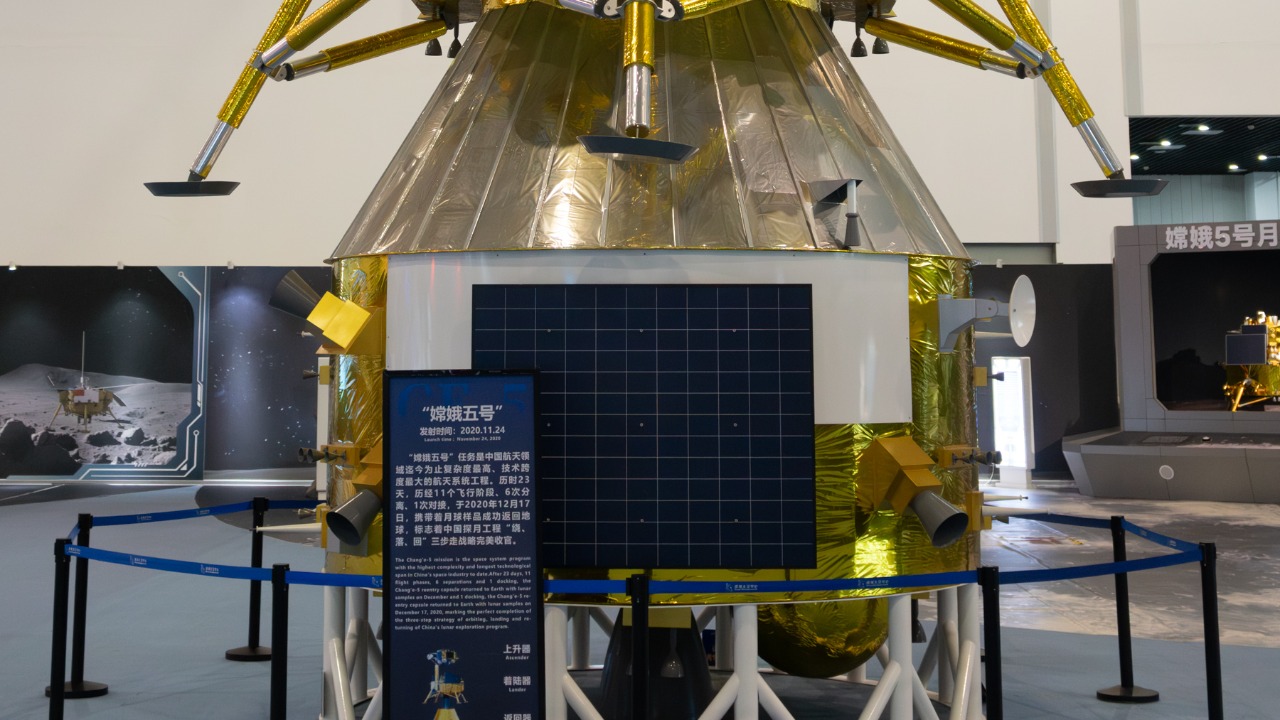
China’s ambitions do not stop at low Earth orbit, they extend to the Moon and the vast cislunar volume where future economic and military competition is likely to unfold. Analysts note that China was the first nation to land on and conduct a sample return from the far side of the Moon, a technically demanding feat that required sophisticated navigation and communications infrastructure. Since 2018, it has also operated a relay satellite at the Moon L2 Lagrange point, a vantage that supports far-side missions and could eventually underpin broader cislunar operations.
Those capabilities are now being extended. The Chinese probe Chang’E 6, identified in one scientific analysis as a mission by The Chinese program, launched to bring back to Earth the first samples from the far side, with Chang returning material that researchers hope will clarify how gas is continuously produced in regolith and how the lunar environment evolved. In that same report, scientists emphasized that bringing Earth the far-side samples is not just a scientific coup, it is a strategic marker that Beijing can operate complex logistics chains between Earth the Moon, a prerequisite for any future resource extraction or military presence in cislunar space.
Global response and the risk of miscalculation
Other powers are scrambling to respond to this mix of scientific achievement and military potential. A detailed assessment of space security trends noted that Apr marked a turning point in how the United States and the Soviet Union once viewed orbital Competition, with Space emerging as a distinct warfighting domain after Moscow’s early breakthroughs. Today, that same report warns that the United States and the Soviet Union era assumptions no longer apply, because China is now the pacing challenge in orbit and is building systems designed to exploit American dependence on satellites.
Inside Washington, that shift is driving new debates over budgets and strategy. A recent Report concluded that current Force planning and resources are insufficient to counter China in space, arguing that the United States risks falling behind in key technologies and operational concepts. The analysis, which was echoed in a separate Force focused review, stressed that without sustained investment and clearer rules of the road, the risk of miscalculation in orbit will grow as more dual use systems crowd the same orbits.
Economic stakes and the race for dominance
The contest is not only military, it is economic, with Beijing’s space rise tied directly to its industrial and technological ambitions. A comprehensive study by the Defense Innovation Unit, Space Force and Air Force warned that China is on track to outpace the United States by 2045 and potentially displace it as the world economic leader, in part by dominating key space-enabled industries. That assessment, which linked orbital infrastructure to terrestrial supply chains, argued that whoever controls the high ground of satellite networks and lunar resources will shape the next phase of globalization, a point underscored in a detailed Defense Innovation Unit analysis.
In congressional testimony, witnesses have warned that Dec hearings about China are no longer “Usually” framed only as abstract national security debates, but as concrete discussions about how China is beating America to the Moon and capturing the commodification of space machinery. One account of those sessions described how lawmakers were told that China is leveraging state-backed financing and industrial policy to dominate launch, satellite manufacturing and lunar infrastructure, raising fears that American firms could be locked out of emerging markets if policy does not catch up.
Norms, responsibility and the path ahead
As China’s footprint in orbit grows, so do questions about how responsibly it is behaving. NASA administrator Bill Nelson has been blunt, saying that “It is clear that China is failing to meet responsible standards regarding their space debris,” a criticism rooted in episodes where large rocket stages reentered uncontrolled and in the lingering fallout from earlier anti-satellite tests. His comments, captured in a detailed Bill Nelson interview, reflect a broader frustration among spacefaring nations that Beijing is not aligning its practices with emerging norms on debris mitigation and transparency.
Chinese strategists, for their part, argue that their country is simply catching up after decades of exclusion and that Western criticism is a cover for preserving dominance. An in depth study of the dark side of Chinese space activities noted that official planning documents explicitly state that China intends to “deal with security threats and challenges” in orbit, language that folds space into a comprehensive national security framework. That same analysis, which traced how Chinese doctrine blends civilian and military goals, concluded that Beijing sees no contradiction between building a scientific powerhouse and fielding capabilities that could disable adversary satellites if conflict erupts.
For outside observers, the challenge is to recognize both sides of this expansion at once. A widely shared video posted with the label Dec and tagged as Posted and Last updated in late 2025 captured how China’s achievements inspire genuine admiration even as they trigger new anxieties among rivals. That piece, which framed why both aspects matter, highlighted how China is simultaneously expanding scientific frontiers and testing the limits of existing norms. A related segment on the same theme stressed that the dark side of China’s rapid space expansion is not just about weapons, it is about opacity, debris and the potential for missteps in a domain where mistakes are hard to reverse, a warning reinforced in a follow up China focused video.
More from Morning Overview