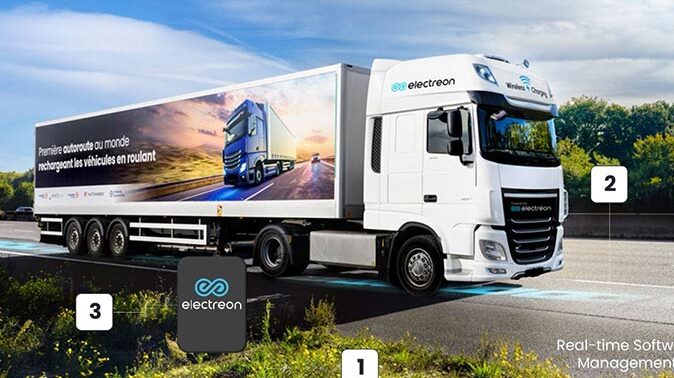

Electric vehicles are about to gain a new kind of fast charging lane, one that hides in the asphalt instead of standing in a parking lot. Infineon’s latest silicon carbide power modules are turning the long discussed idea of high power in-road charging into a concrete system that can move hundreds of kilowatts while a vehicle is in motion. The result is a step change in how quickly an EV can be replenished without plugs, queues or even slowing down.
Rather than treating wireless road charging as a futuristic curiosity, Infineon and Electreon are now framing it as infrastructure that can rival the power levels of today’s top DC fast chargers. By pairing customised SiC modules with an inductive roadway, the partners are reporting continuous power transfer in the 200 k range with peaks that reach 300 k, a level that starts to match the experience drivers expect from the fastest public chargers while adding the convenience of never leaving the lane.
Infineon and Electreon push dynamic charging into the fast lane
The core of this story is a tight partnership between Infineon Technologies and Electreon, the company that has spent years embedding coils into road surfaces to charge vehicles on the move. Infineon has confirmed that it will supply customised silicon carbide power modules as the heart of Electreon’s latest electric road system, positioning its high voltage devices as the bridge between the grid and the inductive pads in the pavement. In its own description of the project, Infineon highlights that these modules are tailored specifically for the demands of dynamic wireless charging rather than repurposed from stationary chargers.
Electreon, for its part, is using those modules to scale up from pilot projects to what looks more like a fully fledged high power corridor. Reporting on the collaboration notes that Infineon’s customised SiC devices sit at the core of the roadside power units, converting grid energy into the high frequency current that feeds the embedded coils and enables inductive transfer to vehicles in motion. In technical briefings, the partners describe this as a system-level design exercise, where the semiconductor choice, cooling strategy and control electronics are all tuned to keep efficiency high even as power levels climb toward the 300 kW class, a claim that is backed up by detailed coverage of the joint Electreon reports.
From 200 kW average to 300 kW peaks in the roadbed
The headline performance numbers are striking because they move dynamic charging out of the trickle charge category and into genuine fast charging territory. According to technical descriptions of the system, the customised SiC modules support continuous power transfer with an average output of 200 kW and peak capabilities exceeding 300 k, figures that are explicitly tied to the way the modules are packaged and cooled for this application. Those metrics, cited in specialist coverage of Infineon’s supply deal, show that the road can deliver power at a rate that would have been considered cutting edge even for a stationary charger only a few years ago, and they are central to the value proposition outlined in power semiconductor reports.
Additional reporting on the same system reinforces those numbers, noting that the electric road achieves an average power transfer of 200 kW with peaks exceeding 300 k when vehicles pass over the active segments. That performance is linked directly to Infineon’s EasyPACK 3B CoolSiC modules, which are configured here as 2000 V building blocks capable of handling the high DC bus voltages and fast switching speeds required for efficient inductive transfer. The description of this configuration in automotive industry coverage makes clear that the 200 kW average is not a theoretical lab figure but a system level rating for vehicles like buses, trucks and passenger cars in motion, as detailed in the analysis of Infineon to power Electreon’s wireless road charging.
Why silicon carbide is the enabler for high power wireless roads
Silicon carbide has been steadily displacing traditional silicon in high voltage power electronics, and this project shows why that shift matters for infrastructure as much as for inverters inside cars. Infineon’s customised 2000 V CoolSiC modules are designed to switch faster and with lower losses than comparable silicon devices, which is crucial when the system must operate at high frequency to drive inductive coils while still keeping efficiency and thermal performance within tight limits. Commentary from industry analysts, including Mark’s take on the announcement, underscores that these 2000 V CoolSiC power modules are not generic parts but are tuned to meet Electreon’s specific needs for dynamic charging of vehicles like buses and trucks, a point highlighted in Mark’s analysis.
Technical coverage of the collaboration frames the use of SiC as a way to boost performance, reliability and energy efficiency in a system that must endure constant cycling and harsh roadside conditions. Under the banner of Infineon Enhances Electreon, Electric Road Charging, High, Power Silicon Carbide Technology, Semiconductor Digest describes how the high voltage capability and thermal robustness of these modules allow the road units to run at elevated power levels without ballooning in size or requiring exotic cooling. That reporting on Infineon Enhances Electreon makes the case that silicon carbide is not just a marginal efficiency upgrade but a foundational technology that makes 200 kW class inductive roads practical at scale.
How the inductive road system actually works
At a system level, Electreon’s approach embeds a series of inductive coils in the road surface, each connected to a roadside power unit that conditions grid electricity into the high frequency alternating current needed for wireless transfer. Infineon’s SiC modules sit inside those power units, forming the core of the application that efficiently converts energy from the grid to enable high power inductive charging in Electreon’s dynamic wireless EV charging system. Reporting on the technical setup explains that as a compatible vehicle passes over the active segment, a receiver coil in the underbody couples magnetically with the road coil, allowing energy to flow across the air gap without any physical connector, a process that is described in detail in the coverage of Electreon reports 300 kW inductive charging power.
Because the coils are segmented, the system can energise only the sections directly under a vehicle, which limits stray fields and improves overall efficiency. The high power capability of the SiC based converters means each segment can deliver substantial energy in the brief window when an axle passes overhead, which is how the system reaches an average of 200 kW with peaks above 300 kW even though any given coil is only active for a fraction of a second per vehicle. Industry descriptions of the EasyPACK 3B CoolSiC implementation emphasise that this segmentation, combined with fast switching and precise control, is what allows the road to serve everything from heavy duty trucks to smaller passenger cars without needing separate hardware for each class, a point that is reinforced in the technical overview of wireless road charging.
Charging while driving at speeds that rival Tesla Superchargers
What makes this development resonate beyond the engineering community is how closely it mirrors the experience of today’s fastest DC fast chargers, but without the stop. Coverage of an early highway deployment notes that the road can charge an EV while it drives at a whopping 300 kW, and points out that, in case you missed it, that is nearly as fast as the very latest Tesla Superchargers, without wires and without stopping. That comparison, drawn explicitly in reporting on this highway, captures the leap from low power inductive pads in parking spaces to a system that can meaningfully refill a modern battery pack in motion.
For drivers of vehicles like a Hyundai Ioniq 6, a Kia EV9 or a Mercedes EQE SUV, that kind of power means the car could maintain a high state of charge over long distances simply by spending part of the journey on an equipped lane. Instead of planning trips around 20 to 30 minute fast charging stops, fleets could schedule routes that intersect with dynamic charging segments, effectively turning sections of highway into rolling energy stations. The fact that the road can deliver power at a rate comparable to Tesla Superchargers, while the vehicle keeps moving at highway speeds, is central to the argument that this is not just a convenience feature but a potential rethinking of how range and refuelling are managed on busy corridors.
Targeting buses, trucks and high duty cycle fleets first
While the technology is compatible with passenger cars, the early focus is clearly on heavy duty and high utilisation vehicles that stand to benefit most from charging on the move. Industry commentary, including Mark’s assessment of the announcement, stresses that Infineon Technologies is using customised 2000 V CoolSiC power modules to support dynamic charging for vehicles like buses and trucks, where the ability to top up during operation can dramatically reduce downtime and shrink the size of onboard battery packs. That perspective, laid out in Mark’s post, aligns with Electreon’s long standing strategy of targeting public transit and logistics corridors before mass market private vehicles.
Technical briefings on the system note that the power levels involved, with an average of 200 kW and peaks above 300 kW, are particularly well suited to large vehicles that can accept high charging rates and have predictable routes. A city bus line that runs repeatedly over an equipped stretch of road, or a regional freight route that includes a dynamic charging segment near a distribution hub, can use that infrastructure to keep state of charge within a narrow band, reducing the need for overnight depot charging or oversized packs. The same EasyPACK 3B CoolSiC based power units can, however, also serve compatible passenger cars in motion, which is why automotive industry coverage of Infineon to power Electreon’s wireless road charging explicitly mentions both commercial vehicles and passenger cars as targets.
From pilot projects to scalable electric road infrastructure
One of the most important shifts in the latest announcements is the move from small scale pilots to systems that are described in terms of scalability and industrialisation. Infineon’s own description of the collaboration emphasises that it will supply customised SiC power modules as part of a broader push to industrialise electric road charging, rather than treating each installation as a bespoke engineering project. The press material on Infineon’s press release notes that the company is leveraging its existing module platforms and manufacturing capacity to deliver the volumes and quality levels needed for infrastructure deployments, which is a different proposition from supplying a handful of prototypes.
Electreon’s communications around the same time frame, including a social media post that frames the collaboration as powering the future of EV charging, underline that wireless EV charging is gaining momentum for public transit, fleets and commercial vehicles. In that post, shared in early Dec, the company highlights how customised SiC power modules from Infineon enable Electreon’s dynamic wireless EV charging system to reach high power levels suitable for real world operations, a message that is captured in the Instagram update on Electreon powers EV future. Taken together, these signals suggest that the partners are positioning electric roads not as experimental showcases but as infrastructure that cities and highway operators can plan around.
Efficiency, reliability and safety at 2000 V
Running a dynamic charging system at 2000 V and hundreds of kilowatts raises obvious questions about efficiency, reliability and safety, and the technical reporting around this project addresses those head on. Semiconductor Digest’s coverage under the title Infineon Enhances Electreon, Electric Road Charging, High, Power Silicon Carbide Technology explains that the choice of high voltage CoolSiC modules allows the system to transmit the same power with lower current, which reduces resistive losses and enables smaller conductors and components. That, in turn, helps keep the roadside units compact and easier to cool, while the inherent robustness of SiC at high temperatures supports long term reliability in outdoor environments, as detailed in the analysis of High Power Silicon Carbide Technology.
On the safety side, the segmented coil design and precise control electronics mean that only the road sections directly under a vehicle are energised, and only when a compatible receiver is detected. Automotive industry reports on the system note that this approach, combined with shielding and careful field management, keeps stray electromagnetic exposure within regulatory limits while still allowing the system to hit its 200 kW average and 300 kW peak targets. The use of 2000 V CoolSiC modules also allows for robust isolation and protection schemes, since the devices are designed from the outset for high voltage traction and grid applications, a point that is echoed in technical commentary on custom silicon carbide power modules.
What high power electric roads could mean for EV adoption
Stepping back from the technical details, the implications of a 300 kW capable electric road are significant for how quickly and broadly EVs can replace combustion vehicles. If sections of highway and key urban corridors can deliver an average of 200 kW to vehicles in motion, then range anxiety becomes less about the size of the battery and more about whether the route includes dynamic charging segments. For fleet operators, that could justify smaller, lighter packs that reduce vehicle cost and increase payload, while for private drivers it could mean that long distance trips in vehicles like a Volkswagen ID.7 or a Ford Mustang Mach-E feel less constrained by charging stops.
There is also a grid angle to consider. By spreading charging over time and distance, rather than concentrating it at stationary fast charging hubs, dynamic systems can smooth demand peaks and potentially integrate more easily with renewable generation that varies throughout the day. Infineon’s positioning of its SiC modules as enablers of efficient, controllable high power conversion fits into that narrative, since the same hardware that drives the road coils can also support sophisticated load management and communication with grid operators. As more details emerge from the collaboration between Infineon and Electreon, the combination of 200 kW average and 300 kW peak in-road charging looks less like a technical stunt and more like a blueprint for how electric mobility infrastructure could evolve in the decade ahead.
More from MorningOverview