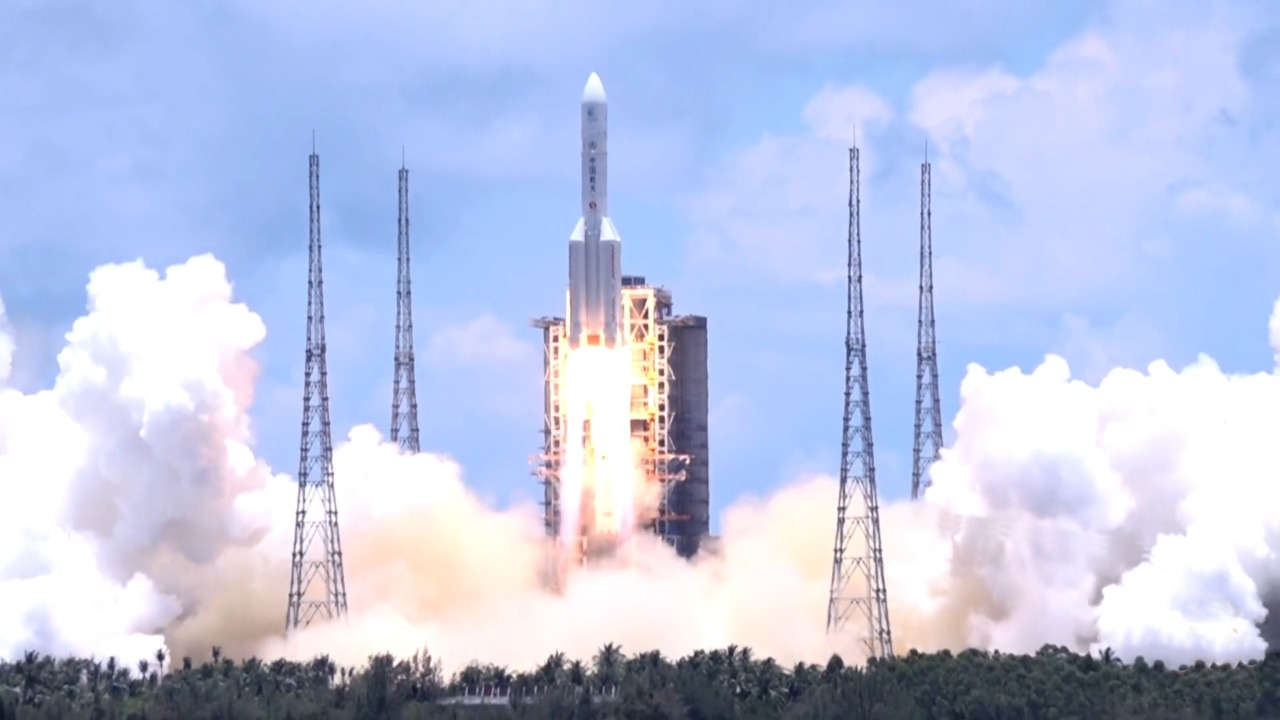

China has just notched a space achievement that quietly shifts the balance of exploration. By bringing back the first rocks ever collected from the Moon’s Far Side and pairing that feat with a surge in launches and global infrastructure, Beijing has turned a single mission into a strategic pivot point. The result is a space program that now rivals any on Earth in both scientific reach and geopolitical weight.
What looks like a technical milestone is also a story about patient statecraft. China has used its Chang’e lunar series, a record cadence of launches and a fast‑growing overseas ground network to build a space presence that is far more comprehensive than many casual observers realize.
The farside breakthrough that changed the Moon race
The Chang’e‑6 mission marked the moment China moved from fast follower to genuine pathbreaker. Earlier in 2024, the robotic probe landed in the South Pole‑Aitken basin and returned the first samples ever taken from the Moon’s Far Side, a region that never faces Earth and is shielded from our planet’s radio noise. That made China the first country to physically retrieve material from this hidden hemisphere, a feat that scientists describe as a historic step in understanding how the Moon formed and evolved.
Unlike earlier sample returns, Chang’e‑6 had to operate without direct line‑of‑sight communications, relying on relay spacecraft and precise autonomous navigation. Mission profiles from the China program highlight how the lander drilled and scooped regolith before launching a small ascent vehicle back to lunar orbit for rendezvous with an orbiter. That choreography, carried out on the Far Side, signaled that Beijing’s engineers are now comfortable with some of the most complex operations in robotic exploration.
Inside Chang’e‑6: from mythic name to scientific engine
Chang’e‑6 is part of the broader Chinese Lunar Exploration Program, which has deliberately linked modern hardware to cultural heritage. The spacecraft is named after the moon goddess Chang’e, and official descriptions note that, like its predecessors, it carries that mythology into a very contemporary contest for technological prestige. Technical data on Chang show a multi‑module architecture with a lander, ascent vehicle, orbiter and reentry capsule, mirroring the complexity of crewed missions but flown robotically.
Chinese scientists have already begun publishing early results from the returned material. In BEIJING, research teams described how the samples shed light on the evolution history of the lunar crust, with Xinhua highlighting the role of Chinese laboratories in analyzing the Chang samples. That scientific payoff is what turns a symbolic first into a durable advantage, giving China unique data on a part of the Moon no other country has touched.
How China pulled off the Far Side return
The road to this mission ran through years of incremental testing. Earlier Chang’e flights rehearsed soft landings, sample drills and ascent launches on the near side, while engineers refined guidance and control in facilities such as the Beijing Aerospace Cont. Reports on the Chang’e‑6 campaign describe extensive use of simulation to model the landing and ascent sequence before committing hardware to the Far Side.
International technical write‑ups note that China launched Chang’e‑6 in a window that allowed the lander to touch down and depart during favorable lighting and thermal conditions, with coverage detailing how, on June 25, 2024, the spacecraft completed its return to Earth with its sealed sample capsule. That timeline, described in detail by On June analyses, underscores how tightly choreographed the mission had to be to hit its reentry corridor and recovery zone.
Why the Far Side samples matter for science and strategy
For planetary scientists, the Far Side rocks are a once‑in‑a‑generation opportunity. Detailed coverage of how Moon samples were snagged explains that the Far Side crust is thicker and more heavily cratered than the near side, which could help resolve debates over how the lunar interior cooled. A separate deep dive on how China Makes History stresses that this is the first time anyone has been able to directly test theories about the Far Side’s composition with real rock, not just remote sensing.
Strategically, the mission gives Beijing a powerful narrative tool. Analyses of China Returns First and Ever Samples from the Far Side describe the mission as a historic milestone in space science, language that Chinese officials have echoed in domestic messaging. By positioning itself as the country that opened up the Far Side, Beijing can argue that it is not only catching up with past lunar powers but setting the agenda for the next phase of exploration.
A launch machine in low Earth orbit
The Far Side success did not happen in isolation. It sits atop a launch sector that has quietly become one of the busiest on the planet. According to official tallies, China carried out a record 92 space launches in 2025, a figure that underlines how routine access to orbit has become for Beijing. That number is echoed in separate coverage that notes China logs historic of 92 launches in a single year, with Beijing using that record to showcase its ability to place payloads into low Earth orbit at scale.
Independent tracking of China launch activity notes that the country has already smashed its previous annual records, with new rockets, reusable technology tests and even an in‑orbit rescue of a malfunctioning spacecraft. A detailed breakdown of China’s launches in 2025 points out that a high percentage of missions were flown by the Long March family, while commercial providers and new vehicles filled in the rest. That industrial base is what allows Beijing to support deep‑space missions like Chang’e‑6 without sacrificing its growing constellation of Earth‑orbiting satellites.
More from Morning Overview