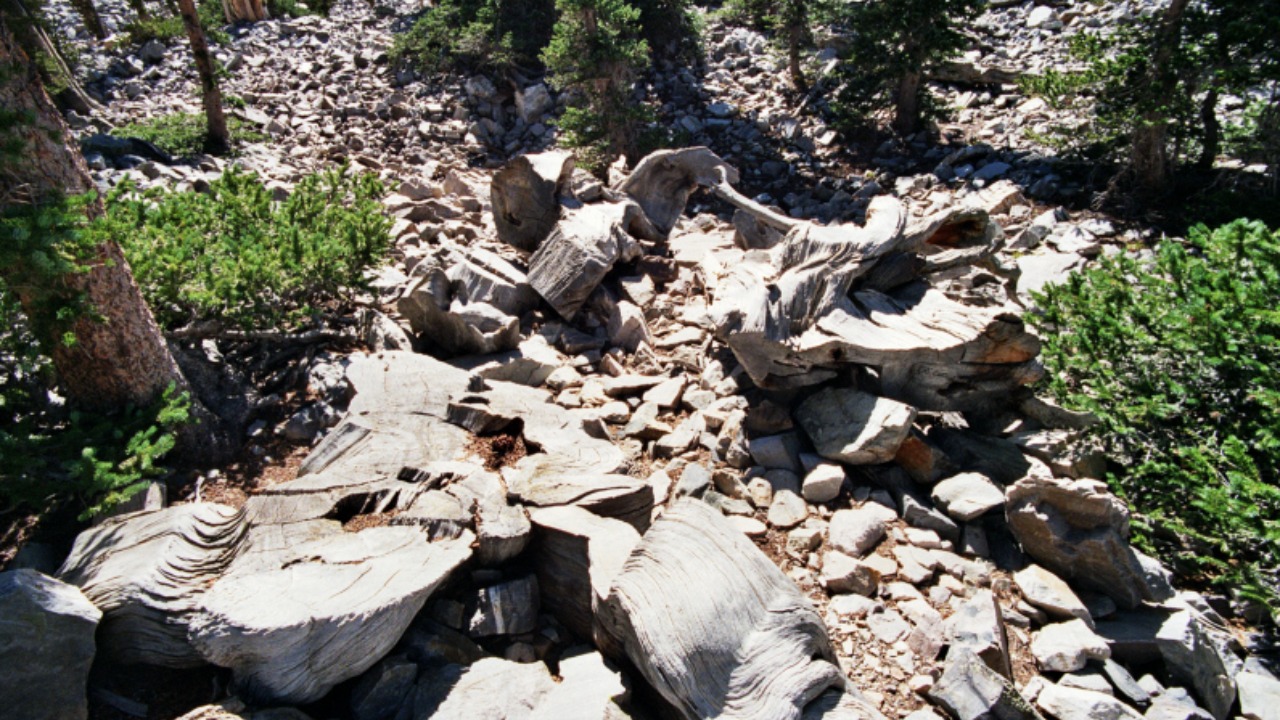

High on a windswept Nevada mountainside in the 1960s, a young researcher set out to read the history of climate written in tree rings. By the time he left, a living organism that had survived nearly 5,000 years of storms, droughts, and civilizations rising and falling lay in pieces on the ground. The story of how a scientist’s mistake destroyed one of Earth’s oldest known trees is now a cautionary tale about curiosity, hubris, and how science treats the natural wonders it studies.
The bristlecone pine later known as Prometheus had already stood for millennia when humans first carved stone tools, yet it was felled in a single day with a chainsaw. I want to trace how that decision unfolded, what it revealed about the culture of research at the time, and how the loss reshaped the way scientists and land managers think about irreplaceable life.
The ancient tree that outlived civilizations
Long before it was a scientific specimen, the tree that would be called Prometheus was a gnarled bristlecone pine clinging to the slopes of Wheeler Peak in what is now Great Basin National Park. Local mountaineers had already given the tree the name Prometheus, a nod to the mythic figure who stole fire from the gods, by the time researchers began to focus on the grove of ancient pines there. According to park histories, Currey found a in this grove he believed to be well over 4,000 years old, already marked out as extraordinary even among long‑lived bristlecones.
Later analysis would show that Prometheus was not just old, but among the very oldest known non‑clonal trees on Earth. After the trunk was cut and its rings counted, researchers concluded that Prometheus was not 3,000 years old, as some had guessed, but at least 4,682 years old, with other estimates placing its age at 4,847 or even 4,862 years. The National Park Service recounts that when the rings were tallied, the tree was found to be “only 4,847 years old,” a dry understatement for a lifespan that stretched back well before the construction of the Egyptian pyramids, a detail preserved in a later park account.
The young geographer and his impossible problem
The man at the center of the story, Donald Rusk Currey, was not a botanist obsessed with record‑breaking trees. He was a geography graduate student interested in how climates had changed over thousands of years, and he saw bristlecone pines as natural archives of that history. According to biographical notes on Currey, he was working in the 1960s on tree‑ring records to reconstruct past environments, part of a broader wave of interest in dendrochronology as a tool for understanding long‑term climate patterns.
Currey’s research took him to the high ranges of the American West, where bristlecone pines grow in scattered groves. The bristlecone pines that grow in the White Mountains of California were already famous among scientists, and a colleague, Donald E. Cox, suggested that similar trees on Wheeler Peak might hold equally valuable records. According to one account of the project, the bristlecone pines in these ranges were recognized as some of the oldest living things on Earth, and Cox encouraged Currey to seek permission to sample them.
When a coring tool meets a 5,000‑year‑old trunk
Currey was not planning on killing any trees. Like other dendrochronologists of his era, he carried a specialized drill called an increment borer, designed to remove a narrow core from a tree without seriously harming it. As one narrative of the episode puts it, Currey wasn’t planning on cutting anything down, only on extracting samples that would let him read centuries of rainfall and temperature in the width of each ring.
On Wheeler Peak, however, the plan began to unravel. Bristlecone pines are dense and twisted, and Currey struggled to obtain a continuous series of overlapping cores from the tree that would become infamous. According to a detailed account, Currey was unable to obtain the full sequence he needed, even after trying at least four times with a 28‑inch borer and breaking two of the tools in the process. Some say Currey’s increment borer, the tool used to take core samples, broke off in the tree, while Others say he did not know how to correct for the missing rings, a dispute reflected in later park retellings.
The decision to cut and the day Prometheus fell
At that point, Currey faced a choice that would define his legacy. Without a complete core, his data would be incomplete, and the stuck or broken tool posed a practical problem. In one version of the story, Currey needed to fell the tree to retrieve his drill, which had gotten stuck when he tried to take a sample, a detail echoed in later reporting. Another account suggests he believed the tree was similar in age to others in the grove and that cutting one would be justified by the scientific value of a full cross‑section, a rationale summarized in a more recent analysis.
Whatever his reasoning, Currey sought and received permission from the U.S. Forest Service to cut the tree, which was then on national forest land rather than inside a national park. A later summary notes that Currey was unable to get the cores he needed and that a request went up the chain to allow the tree to be felled. On the day the work was done, a crew used a chainsaw to bring down the massive, twisted trunk, an event recalled in a retrospective that describes how Currey cut down a bristlecone pine in a remote part of Nevada and later counted its rings back in his hotel room.
Counting the rings and realizing what was lost
Only after the tree lay in sections did the full magnitude of the decision become clear. When Currey and others began counting the rings on the cross‑sections, they realized that the tree was not just old, but among the very oldest ever documented. One account describes how, After analyzing the rings, researchers were stunned to find that Prometheus was at least 4,682 years old, while another reconstruction of the count put the age at 4,862 years, a figure cited in a later summary of the event.
In the years that followed, the story of Prometheus circulated among scientists and eventually among the public, often framed as a grim anecdote about a researcher who killed the oldest tree ever recorded. One widely shared retelling notes that in 1964, Donal Rusk Currey killed the oldest tree ever, a bristlecone pine nicknamed the Pro tree, and that the tree was almost 5,000 years old. Another version recounts that he got a tree corer stuck, a park ranger helped him cut the tree down to remove the tool, and Eventually, when he counted the rings, he realized the tree was almost 5,000 years old, a sequence preserved in a popular retelling.
More from Morning Overview