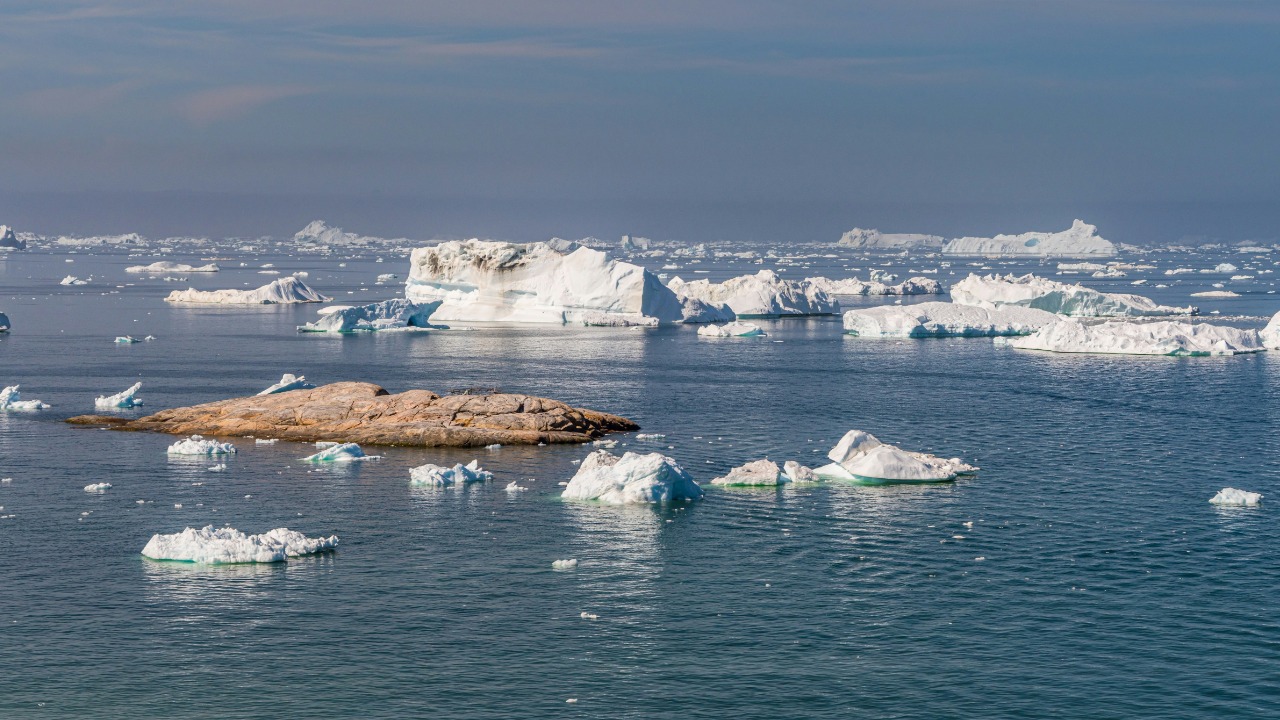

As global warming pushes average sea levels higher, a striking exception is emerging at the edge of the Arctic. Around Greenland, scientists now expect the ocean to retreat from the shore, even as the rest of the world braces for encroaching tides. The same melting that threatens coastal cities elsewhere is setting up a local sea level drop that could reach several meters by the end of the century.
The paradox is not a reprieve from climate change so much as a reminder of how uneven its impacts will be. The physics that govern ice sheets, gravity and the solid Earth are combining to produce a rare case in which a frontline region of warming will see the waterline fall, while its meltwater helps raise seas far away.
Why Greenland’s seas are set to fall while the world’s rise
At first glance, the idea that the ocean could fall around Greenland as the planet heats up sounds like a mistake in basic physics. I see it instead as a lesson in how gravity and rock respond when a massive ice sheet starts to disappear. The island’s ice has long exerted a strong gravitational pull on nearby seawater, effectively piling the ocean up along its coasts. As that ice melts and its mass shrinks, the pull weakens, so water redistributes toward the open ocean and distant shorelines.
Researchers who model this process find that the effect is not subtle. In high-emissions scenarios, the latest simulations suggest that relative sea level along parts of Greenland’s coast could drop by as much as 2.5 meters by 2100, even as the global average continues to climb. That counterintuitive outcome is rooted in the same ice loss that is driving worldwide sea level rise, but the local signal is flipped because the water is literally being pulled away from Greenland and toward coasts that are far from the ice.
The hidden forces: gravity, “memory foam” rock and icy magnetism
The gravitational story is only half of the paradox. Beneath the ice, the solid Earth is also responding to the loss of weight, a process scientists describe as glacial isostatic adjustment. As the ice sheet thins, the crust and mantle below it slowly rebound upward, lifting the land relative to the sea. One team, working within the Columbia Climate School, likens this to a long-squeezed cushion that begins to spring back once the pressure is removed.
Study co-author and geophysicist Jacqueline Austermann has compared the behavior to a memory foam mattress that slowly regains its shape after someone gets up. That rebound, combined with the shifting pull of the ice, means the land is rising at the same time the nearby ocean surface is sagging. Earlier work on what some scientists call “icy magnetism” showed that this pattern is not unique to Greenland, but the island’s size and rapid melt make it one of the clearest examples of how ice sheet mass loss reshapes the ocean in three dimensions.
From local drop to global surge
Even as the waterline retreats from Greenland’s harbors, the meltwater itself is helping to raise seas elsewhere. When ice that once sat on land turns to liquid and flows into the ocean, it adds volume that must be accommodated somewhere. Because the gravitational pull near the ice weakens, that “somewhere” is primarily far from the source, especially along coasts that are distant from the polar regions. Earlier analyses of heavy water redistribution have shown that sea level can rise rapidly near the Equator when large masses of ice or groundwater shift into the ocean.
In practical terms, that means communities in places like the Gulf of Mexico, West Africa or Southeast Asia will feel more of Greenland’s melt than many Greenlanders themselves. Projections summarized in recent work on gravitational pull show that the interaction between ice sheets, gravity and ocean circulation can amplify sea level rise in these far-flung regions. The paradox is stark: the more Greenland’s ice vanishes, the more its coastal waters fall, while low-lying deltas and island nations thousands of kilometers away face higher and more dangerous tides.
Life on a coastline where the sea retreats
For people living along Greenland’s fjords, a falling sea does not automatically translate into good news. Fishing communities, shipping operators and local governments have built harbors, docks and processing plants to match today’s waterline. As the land rises and the ocean surface drops, those facilities risk being left literally high and dry. Scientists involved in the new modeling warn that the biggest impact will be on local communities and the effects on shipping routes, fishing and infrastructure, as channels shallow and piers no longer reach the water.
Some projections suggest that in high-emissions pathways, Greenland’s coast will experience a significant drop that may reshape infrastructure and ecosystems. New tidal flats could emerge where deepwater berths once stood, while coastal ecosystems that evolved with a certain range of salinity and depth will have to adjust to a shoreline that is effectively climbing uphill. For planners in Nuuk or smaller settlements, the challenge will be to redesign ports and coastal roads for a future in which the sea is not an advancing threat but a receding, shifting partner.
A warning, not a loophole, in the climate story
It might be tempting to read Greenland’s falling seas as evidence that some places will escape the worst of climate change, or even benefit from it. I see the research instead as a warning about how complex and uneven the consequences will be. Analyses that track how Both the recent and historical loss of ice are driving the ongoing uplift of Greenland’s land show that the same process lowering local seas is locked to a global problem. The uplift is a delayed response to centuries of ice loss, and it will continue even if emissions fall, while the meltwater already in the ocean keeps pushing up tides elsewhere.
Researchers at the Lamont-Doherty Earth Observatory, cited in coverage that notes how Rising temperatures are causing sea levels to rise across the world while in Greenland the opposite is happening, estimate that local sea level could drop to 2.5 metres by the end of the century. That figure is striking, but it sits alongside a sobering reality: every centimeter of fall around Greenland is paired with a larger rise somewhere else. The island’s paradox is not an escape hatch from the climate crisis, it is a vivid illustration of how deeply the planet’s ice, oceans and rocks are intertwined, and how difficult it will be to find any truly safe harbor as the world warms.
More from Morning Overview