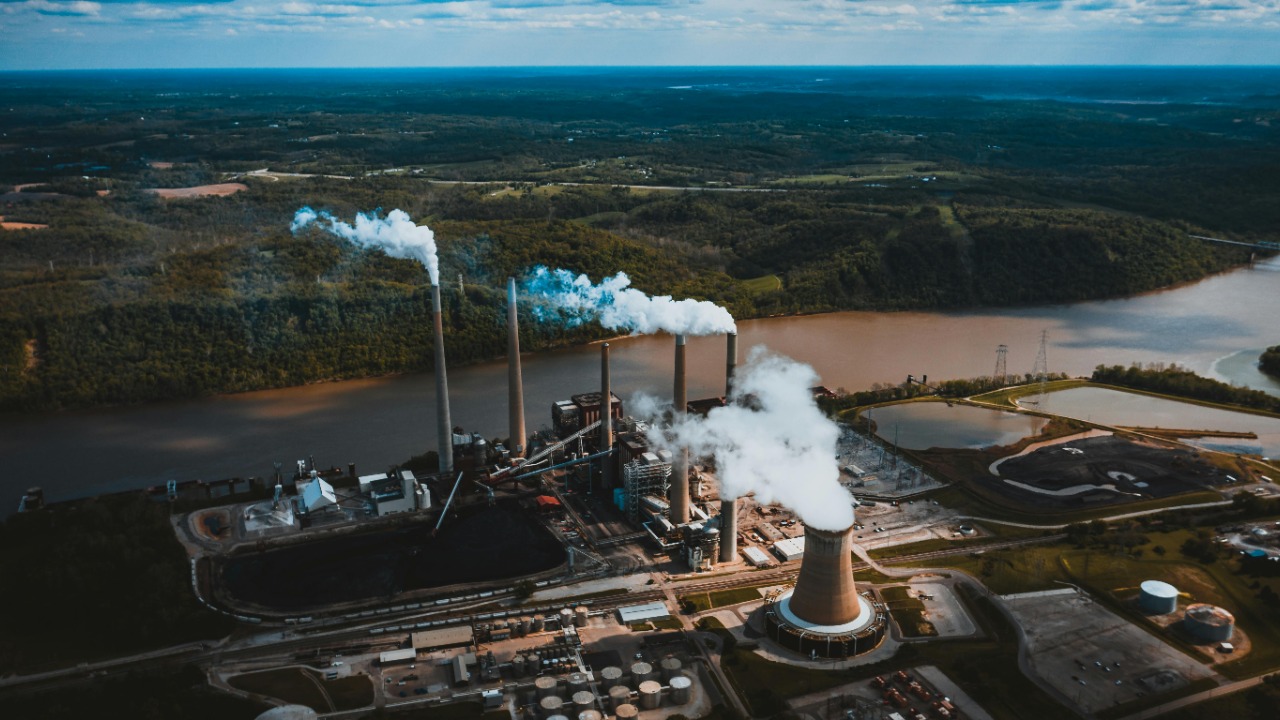

Turning pollution into propulsion is no longer a sci‑fi slogan. Around the world, chemists and engineers are learning how to pull carbon dioxide out of exhaust streams and even thin air, then upgrade it into liquid fuels that can power existing jet engines. The latest advance, a one‑step route from factory emissions to aviation‑grade energy, suggests that the dirtiest part of flying could eventually be supplied by its own waste.
I see this work as part of a broader shift in climate technology, where CO₂ is treated not just as a problem to bury but as a feedstock to reuse. If the chemistry scales, airlines could keep flying Boeing 787s and Airbus A320neos while dramatically cutting their net climate impact, rather than waiting decades for hydrogen aircraft or electric long‑haul planes that do not yet exist at commercial scale.
Inside the new one‑step route from smokestack to wing
The latest breakthrough comes from Scientists at the RMIT University in Aust, who have shown that carbon emissions from industrial sites can be converted into jet fuel precursors in a single integrated process. Their approach captures CO₂ from a factory flue, combines it with hydrogen, and runs it over a tailored catalyst so that the gas mixture is upgraded directly into energy‑rich molecules suitable for aviation rather than first making simple intermediates like carbon monoxide. Reporting on this work describes how the team’s method, highlighted under the banner of Australia emissions, is designed to bolt onto existing plants so that pollution becomes a feedstock rather than a liability.
Coverage of the same work notes that the approach does not directly make finished jet fuel, but instead produces a synthetic gas stream that can be refined into aviation fuel using established upgrading steps. In practical terms, that still counts as a single step from flue gas to a jet‑ready feedstock, which is why descriptions of the project talk about turning carbon emissions into jet fuel in one move and frame it as “Pollution to power.” A separate report on Pollution to power underscores that the RMIT team’s catalyst is tuned to work at lower temperatures than conventional systems, which is crucial for cutting both cost and energy use.
The chemistry that makes CO₂ behave like crude oil
To understand why this matters, I find it useful to look at how hard it is to persuade CO₂ to act like fuel in the first place. Carbon dioxide is a very stable molecule, so most routes to synthetic aviation fuel start by activating it with hydrogen and catalysts, then stitching the resulting fragments into longer hydrocarbons. One influential study on organic combustion describes how researchers used an iron‑based catalyst and an organic promoter to transform CO₂ and hydrogen into a mixture rich in jet‑range hydrocarbons, showing that fuels can be produced from carbon dioxide instead of fossil crude oil. In that work, the team emphasized that there are two main pathways, either via carbon monoxide or via direct hydrogenation, and that the choice of route affects both efficiency and cost.
Later analysis of the same chemistry explains that there are two ways to convert CO₂ into liquid fuels, and that combining capture, conversion, and product upgrading in a tightly integrated process can lower the overall energy penalty. A detailed discussion of these pathways in a follow‑up on liquid fuels stresses that the goal is to match the performance of petroleum‑derived kerosene while cutting lifecycle emissions. A separate section of the same research, focused on process design, notes that there are two ways to structure the reaction network and that careful catalyst choice can make the entire process more efficient, a point reinforced in a later technical note on two ways of arranging the steps.
Other teams have pushed this chemistry further by targeting jet fuel directly. Work on the direct conversion of CO₂ to aviation‑range hydrocarbons over CoFe alloy catalysts shows that using green hydrogen with a carefully tuned metal surface can yield advanced liquid fuels in a single reactor. In that study, the authors concluded that this route is a sustainable approach to jet fuel production, while also warning that, However, achieving high selectivity and stability remains challenging, a nuance captured in the detailed CoFe study. A related technical paper on the same system, presented as a PDF of direct conversion, reinforces that the combination of cobalt and iron can steer the reaction toward the C₈–C₁₆ range that aviation needs.
More from Morning Overview