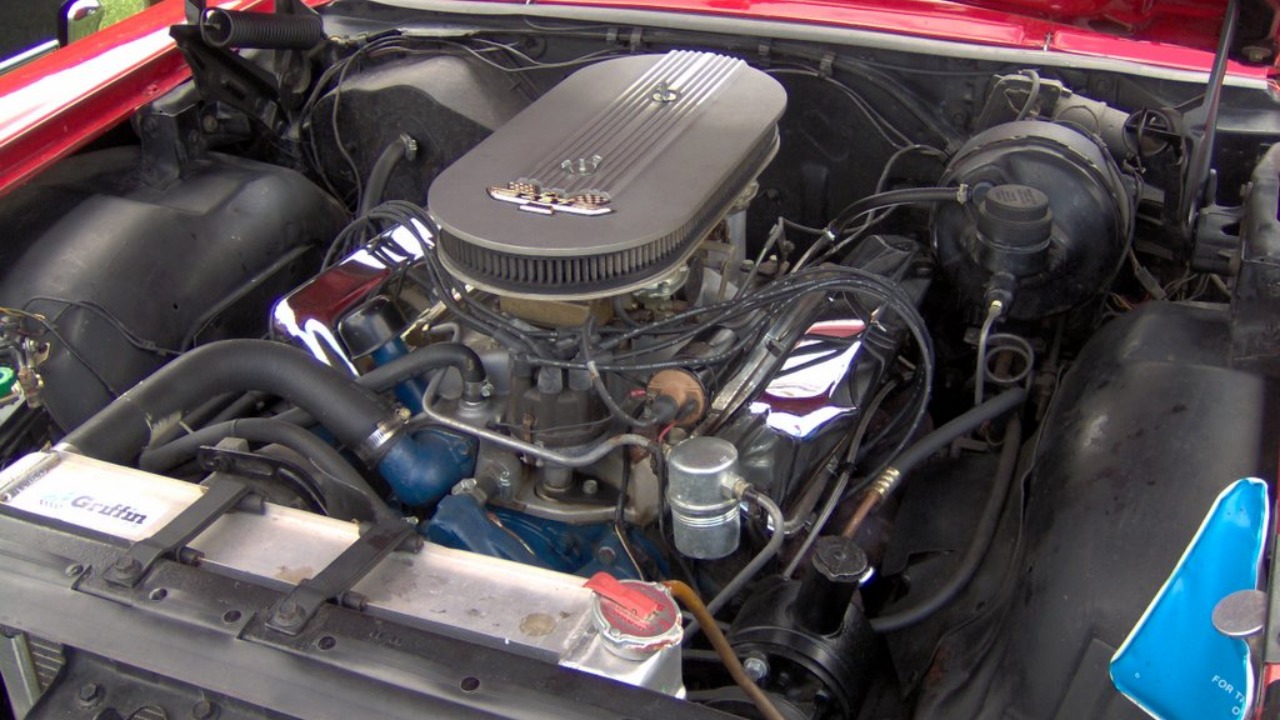

The Ford and Chevy 427 big blocks sit at the center of one of performance history’s fiercest rivalries, yet the two engines followed very different paths from the dyno cell to the winner’s circle. I want to unpack how these 427s truly compare in design, racing pedigree, street manners, and long‑term legacy, separating nostalgia from what the hardware and history actually show. By the end, the contrasts between Ford’s FE 427 and Chevrolet’s Mark IV 427 explain why both remain icons for very different reasons.
How the 427 rivalry really started
The story of the Ford 427 begins with racing, not showroom marketing. Ford developed its 427 cubic‑inch V8 specifically to go stock‑car racing, and in In 1964 the company created the engine to compete in NASCAR. That racing-first mindset shaped everything from the block’s strength to the valvetrain, and it is why the Ford 427 quickly became one of the most iconic big‑block V8s of the American muscle era, offered in both single and dual 4‑barrel carburetor configurations that were aimed squarely at high‑rpm power rather than everyday drivability.
Chevrolet’s 427 arrived from a different direction, evolving out of a big‑block family that had already been in service for years. The Chevrolet big block, often nicknamed the Rat Motor, had been around since 1958 and, like the Ford big block, it evolved through multiple displacements and applications. By the time Chevy reached 427 cubic inches, it was dropping that engine into everything from high‑end sports cars to full‑size sedans and trucks, which meant the same basic displacement had to serve drag racers, road racers, and family buyers at once.
Inside the Ford FE 427: race hardware in a production shell
Ford’s FE‑series 427 was engineered as a competition piece first, and its internal parts reflect that intent. Many 427s used a steel crankshaft, and all were balanced internally, a combination that favored durability at sustained high rpm. On the top end, Most 427s used solid valve lifters, again pointing to a design that prioritized precise valvetrain control and high‑speed stability over quiet operation or low‑maintenance street use.
That race‑bred hardware sat in a block that shared its basic architecture with other FE engines but was built to a far more demanding standard. Later analysis has highlighted that the Ford 427 FE and the closely related 428 FE V8s are part of the same line of engines and share a 4.63-inch bore center spacing, which helped Ford adapt the architecture across multiple displacements. As one detailed comparison of the 427 FE and 428 FE notes, at least the 427 FE and 428 FE V8s could share some core dimensions even as enthusiasts argue endlessly over which is the better engine, an argument that will likely rage on.
Chevy’s 427: from street workhorse to L88 legend
Chevrolet’s 427 had to be more of a chameleon, serving as both a production workhorse and a racing weapon. Enthusiasts still debate why the Chevrolet 427 cubic‑inch engine is sometimes perceived as less popular than its Ford counterpart, but one detailed discussion points out that it is “News” to some that the Chevy 427 was not widely used, since Chevy put the 427/454 in everything from Corvettes to Caprices to C‑10s. That breadth of applications meant Chevrolet’s 427 had to balance cost, emissions, and drivability in ways Ford’s more specialized racing 427 did not.
At the sharp end of Chevy’s 427 development sat the L88, a package that has become shorthand for the most extreme factory big block the company ever built. A detailed history of the L88 notes that its Continuing Legacy is that it became one of the great infamous racing engines of the 1960s, with the numbers speaking for themselves in competition. That same account, published on Aug 26, 2024, underscores how the L88 427 sits alongside other legendary racing engines of the era, cementing the Chevy 427’s reputation at the track even as more pedestrian versions quietly powered family cars.
Displacement games and the NASCAR rulebook
One of the more revealing differences between Ford’s and Chevy’s 427s lies in how the companies navigated racing regulations. When the 427 FE debuted in in 1963, NASCAR had a 427-cubic inch limit, so Ford apparently just called its 426 a “427” to fit the rulebook and the marketing story at the same time. That detail, reported on Nov 26, 2025, shows how advertised displacements were not always precise reflections of actual cubic inches in the 1960s, especially when sanctioning bodies set hard caps.
Chevrolet’s 427 did not have the same naming sleight of hand, but it still lived under the same competitive pressures. The broader context of the big‑block rivalry is that both companies were constantly stretching and reshaping their engines to meet changing racing and emissions rules. A wider look at the Ford versus Chevy big‑block battle notes that The Chevrolet big block, also known as the Rat Motor, had been around since since 1958, and, Like the Ford big block, it evolved over time. That long development arc meant Chevy could refine its 427 within a mature family, while Ford was pushing the FE 427 hard in a narrower racing window.
Block strength, head bolts, and durability
Under extreme race conditions, the details of block and head design often matter more than the advertised displacement, and here the Ford and Chevy 427s diverged in a crucial way. A detailed comparison shared on Jan 24, 2024, argues that the biggest advantage that the Big Block 427 Chevy and the 426 Hemi had over the 427 Ford was extra head bolts. That analysis notes that the Big Block Chevy and the Hemi used five head bolts per cylinder versus four for the Ford, which gave them an edge in clamping force and head gasket reliability at very high cylinder pressures.
That head‑bolt count is not just trivia, it helps explain why some racers gravitated toward Chevrolet and Chrysler blocks for the most extreme nitro and blown applications, while the Ford FE 427 found its sweet spot in naturally aspirated stock‑car and drag racing. The same Jan 24, 2024 discussion emphasizes that those extra Five head bolts per cylinder on the Chevy and Hemi side were a structural advantage that Ford’s FE casting simply did not share. When combined with the Ford’s steel crank and solid lifters, the result was an engine that was brutally effective within its design envelope but less forgiving when pushed far beyond it compared with the overbuilt Chevy and Chrysler race blocks.
Racing reputations: NASCAR ovals vs drag strips and road courses
On the track, the Ford and Chevy 427s built reputations in slightly different arenas, even as they occasionally met head‑to‑head. The Ford 427 engine is widely described as one of the most iconic big‑block V8s produced during the golden era of American performance, and a detailed profile shared on Aug 12, 2025, notes that the Ford 427 engine is one of the most iconic big‑block V8s produced during the golden era of American performance. That same account notes that it was Introduced with both single and dual 4‑barrel carburetor configurations, which helped it dominate in stock‑car racing and high‑end drag classes where airflow and top‑end power were king.
Chevy’s 427, by contrast, spread its racing success across drag strips, road courses, and endurance events. The L88 427 in particular carved out a fearsome reputation in sports‑car racing, where its brutal power and durability made it a favorite in long‑distance events. That same L88 history that highlights its Continuing Legacy places it alongside other great racing engines of the 1960s, underscoring that Chevy’s 427 was not just a straight‑line brute but a capable road‑racing powerplant as well. In practice, Ford’s 427 became synonymous with oval‑track and factory drag programs, while Chevy’s 427 built a broader, more varied competition résumé.
Street presence and production reach
On the street, the two 427s felt very different to live with, largely because of how widely each was deployed. The Ford 427 was built in relatively limited numbers and aimed squarely at homologation and high‑performance specials, which meant many buyers encountered it in stripped‑down Galaxies, Fairlanes, and specialty models that were barely tamed race cars. A detailed profile of the Ford 427’s origins in Jul 31, 2025, emphasizes that the engine was developed for Ford’s NASCAR ambitions, which helps explain why it never became a mainstream full‑line offering in the way some other big blocks did.
Chevrolet’s 427, by contrast, was intentionally woven into the fabric of everyday American motoring. As that detailed discussion of popularity points out, Ford’s 427 block may have been more exotic, but Chevy’s decision to put the 427/454 into Corvettes, Caprices, and C‑10s meant that far more drivers experienced big‑block torque in ordinary life. That ubiquity helped cement the Chevy 427’s reputation as a versatile, street‑friendly engine, even if the most extreme versions like the L88 were barely streetable at all.
Enthusiast debates and personal loyalties
Decades later, the Ford 427 versus Chevy 427 argument is kept alive as much by personal experience as by dyno sheets. In enthusiast circles, names and stories carry almost as much weight as compression ratios, and a lively comparison shared on Jan 8, 2025, captures that dynamic. In that discussion, Ronald Nies Sr and Larry Keil So trade views on how legendary tuner Bill Jenkins was “sent packing” by Jere Stall and just a street Hemi, a story that has circulated for 11 mos in that thread. Those kinds of anecdotes show how the Ford‑Chevy rivalry often spills over into Mopar territory and how individual races become part of the mythology around each engine.
What stands out in these debates is that hard data and personal loyalty are constantly intertwined. Some enthusiasts point to the Ford 427’s steel crank, solid lifters, and NASCAR pedigree as proof that it was the purer racing engine, while others counter with the Chevy 427’s broader production use, the L88’s track record, and structural advantages like the extra head bolts per cylinder. The Jan 8, 2025 discussion that name‑checks Bill Jenkins and Jere Stall illustrates how even legendary builders and drivers are drafted into the argument, with each camp using specific stories to bolster its case rather than relying solely on factory specifications.
Why both 427s still matter today
Looking across the hardware, the racing history, and the street experience, the Ford 427 and Chevy 427 occupy different but equally important corners of big‑block history. The Ford FE 427 was a purpose‑built competition engine that happened to be sold to the public in limited numbers, with features like steel crankshafts, internal balancing, and solid lifters that made it happiest at high rpm and under sustained load. Its development for NASCAR in the mid‑1960s and its close relationship to the 428 FE give it a unique place in Ford’s performance lineage, one that still fuels arguments about which FE variant is “best.”
Chevrolet’s 427, meanwhile, represents the high‑water mark of a big‑block family that had been evolving since 1958, with the Rat Motor architecture underpinning everything from mild street engines to the ferocious L88. Structural advantages like the extra head bolts per cylinder that the Big Block 427 Chevy shared with the 426 Hemi, combined with its widespread use in Chevy cars and trucks, helped it become both a racing hero and a familiar presence in everyday American life. In that sense, the Ford 427 and Chevy 427 are less direct competitors than complementary icons, each illustrating a different philosophy about how to build and deploy a big‑block V8.
More from MorningOverview