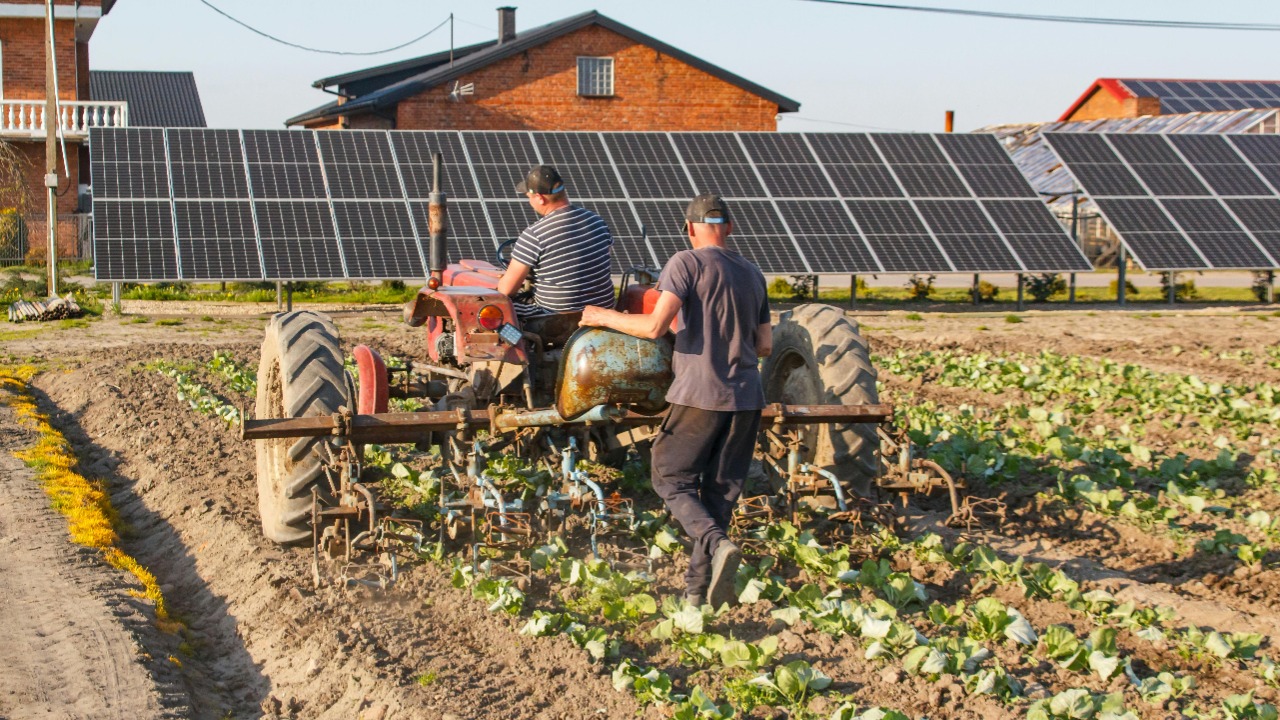

Across experimental plots from Oregon to Alaska, farmers are finding that the same acre of land can grow food and electricity at once. By lifting solar panels above fields instead of replacing them, they are uncovering surprising boosts in crop performance, new income streams, and a way to cool both plants and people as the climate heats up.
The approach, known as agrivoltaics, is turning a long running land use fight into a rare win for both clean energy and agriculture. Rather than forcing farmers to choose between panels or plants, the emerging data suggest that pairing the two can deliver the “shocking gains” implied in the headline, especially in hot and water stressed regions.
What agrivoltaics actually is, and why it is spreading so fast
At its core, agrivoltaics is the practice of installing solar arrays so that crops, livestock, or pollinator habitat continue to thrive underneath and between the rows. Instead of blanketing fields with low mounted modules, developers raise and space the structures so tractors can pass, animals can graze, and sunlight still reaches the soil. Advocates describe agrivoltaics as a way to turn a single parcel into a dual use asset, with electricity sales complementing harvest income.
Researchers and industry groups frame this as a logical evolution of rural solar, not a niche experiment. One analysis notes that agrivoltaics pairs solar in ways that can deliver “surprising economic and ecological benefits,” while another describes it as an innovative solution that combines agricultural production with solar energy to enable significant gains in efficiency and resilience. The concept has matured enough that dedicated programs now study economic and ecological at scale, signaling that this is no longer a fringe idea.
How shade, water, and light combine to boost yields
The counterintuitive heart of agrivoltaics is that partial shade can make crops more productive, not less. Once plants reach a certain light saturation point, extra radiation mostly turns into heat, which stresses leaves and evaporates precious moisture. Researchers at Oregon State University describe how, once that threshold is reached, any additional sunlight is essentially wasted, a point underscored in their AGRIVOLTAICS work on the nexus of food, water, and energy. By intercepting that surplus light with panels, farmers can cool the microclimate, reduce water loss, and still give crops the photons they need.
A recent systematic review of agrivoltaic systems, often abbreviated as AVS, found that these synergies are strongest in arid, semi arid, and hot regions that already face transient or chronic drought. The authors conclude that Such synergies can deliver five broad benefits, including higher land productivity and more resilient food production. Separate technical assessments echo that agrivoltaic layouts can cut irrigation needs, with one review of co located projects highlighting the potential for water alongside lower electricity costs.
From Alaska kale to Northwest hayfields, the field results are eye catching
The theory is now backed by real world harvests. In one project in Alaska, researchers were surprised to see leafy greens thriving under panels that many locals initially feared would block too much light. Vegetables like kale and spinach actually grew larger and healthier beneath the structures, while the solar installation itself helped households cut their power bills and save up to 10,000 dollars, according to reporting on the Alaska trials. That combination of bigger vegetables and lower energy costs is exactly the kind of “shocking gain” that is changing minds in cold climates where solar was once considered marginal.
In the American Northwest, federal climate hubs describe how crops can be grown beneath and between elevated arrays, with careful design allowing farmers to balance agricultural production and renewable energy goals. Their guidance notes that crops can be the panels while still meeting ambitious clean power targets. The same hub emphasizes that, although Though agrivoltaic systems require thoughtful design, in the right conditions they can reduce energy costs for producers and create habitat for native pollinators and honeybees, adding ecological value on top of farm income.
Why farmers see a financial lifeline, not a land grab
For many growers, the most immediate benefit is economic stability. American Farmers are under pressure from volatile commodity prices, extreme weather, and rising input costs, and many see solar leases or co owned projects as a way to keep family operations afloat. One analysis of rural projects notes that agrivoltaics on farms is a Promising Option for, in part because it can offset costly vegetation management like mowing while generating steady power revenue.
Solar advocates in Washington State make a similar case, arguing that, while it might seem like solar and farming are competing for the same land, combining them can create a Win for farmers by opening new revenue streams from their land. A separate overview of co located projects highlights that developers themselves benefit from Reduced installation and electricity costs when they work with, rather than against, existing agricultural operations. That alignment of incentives is one reason national labs like NLR now study agrivoltaics as a serious tool for meeting renewable energy goals without sacrificing rural livelihoods.
Designing systems that work for crops, animals, and grids
Getting these gains is not automatic. Arrays must be tailored to local crops, soils, and equipment, with careful attention to panel height, row spacing, and tracking angles. Technical guides stress that Reduce energy costs for producers is only one goal, alongside maintaining yields and creating habitat for native pollinators and honeybees. Some projects focus on grazing, with sheep or other small livestock keeping vegetation in check under the panels, while others prioritize vegetables, berries, or forage crops that tolerate shade.
Industry and research groups have started to codify best practices. One blog on Agrivoltaics describes how developers are “pushing agriculture and solar energy forward” by experimenting with different layouts and crop mixes, while another technical overview of What Are Agrivoltaics details how specialized glass and tracking systems can fine tune the spectrum and timing of light that reaches plants. A separate analysis of Economic Advantages emphasizes that well designed systems can foster growth in rural communities, not just on individual farms.
More from Morning Overview