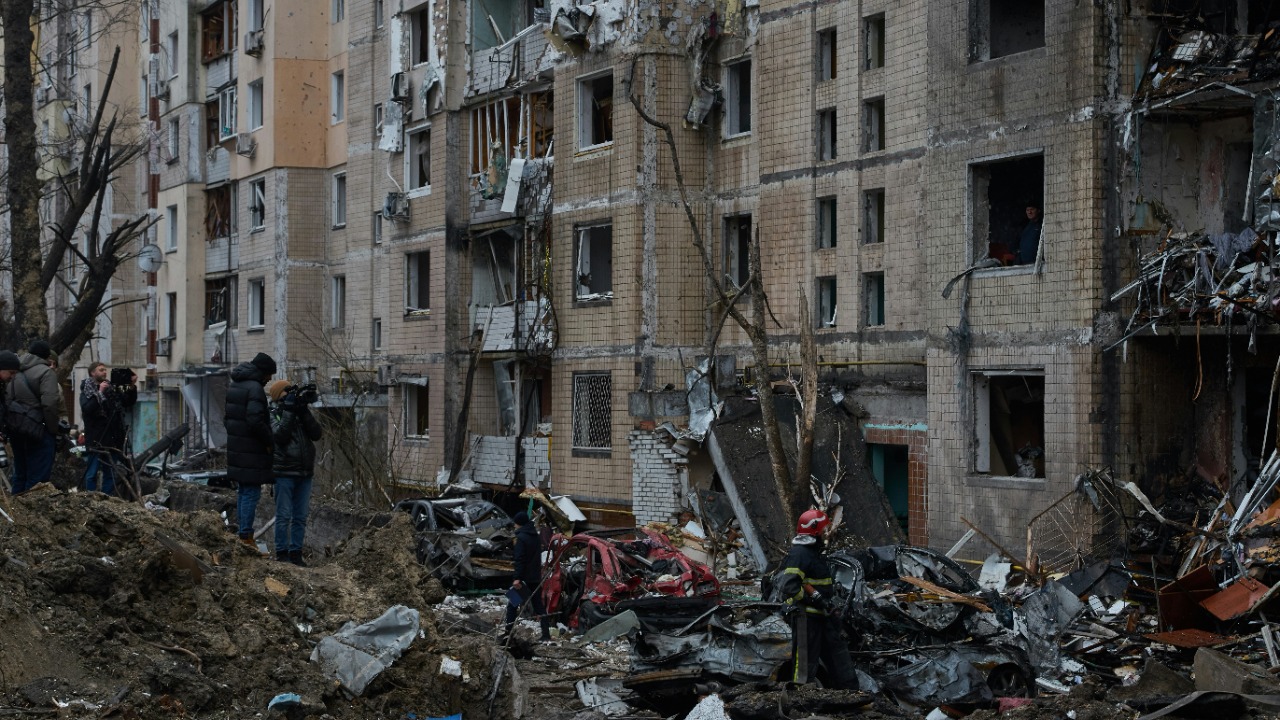

Ukraine’s latest grid breakdown has exposed just how fragile daily life has become for civilians who depend on a power system battered by war and winter. What looked at first like a technical malfunction quickly collided with a landscape where generation capacity is already gutted and outages can stretch for days. As an energy analyst, I see this shock not as an isolated glitch but as a warning about what the next weeks will mean for heat, water and basic safety across the country.
The immediate crisis is only part of the story. Years of targeted strikes, emergency repairs and improvised imports have left the system operating with almost no margin for error. That reality is now colliding with plunging temperatures, political maneuvering and a humanitarian response that is struggling to keep up.
The grid failure that pushed a fragile system over the edge
When Ukrainians woke to mass blackouts after a sudden grid failure, the disruption was not limited to a few neighborhoods. The outage cut across multiple regions and was serious enough that officials initially described it as a large scale technical malfunction, with power plants and transmission lines tripping offline in quick succession. Local reports described how the failure cascaded through the network, forcing operators to disconnect parts of the system to prevent wider damage and leaving households and businesses in the dark as engineers scrambled to stabilize the grid, a sequence captured in early accounts of the mass outages.
President Volodymyr Zelenskyy later pointed to a specific weak point that turned a routine disturbance into a national shock. He said the power grid breakdown began when two key lines, one connecting Romania and Moldova and another inside Ukraine, failed almost simultaneously, triggering automatic protections and widespread disconnections. In a system with ample spare capacity, such a fault might have been absorbed with little public notice. In today’s Ukraine, where every megawatt is contested, that kind of event instantly translates into hours without light, stalled electric transport and hospitals forced onto backup generators.
A power system degraded by systematic attacks
The reason a single failure can have such sweeping consequences is that the underlying system has already been hollowed out. Since October, Russian forces have renewed systematic large scale attacks on Ukraine’s energy infrastructure, targeting power plants, substations and high voltage lines. Humanitarian agencies describe this as a deliberate pattern, not sporadic damage, and warn that repeated strikes on the same nodes are eroding the grid’s ability to recover between waves. A separate humanitarian assessment characterizes these as a systematic cycle of attacks that must end if civilians are to have any semblance of reliable electricity.
Military analysts now estimate that months of Russian strikes have significantly degraded and damaged the Ukrainian energy grid, leaving it facing a prolonged crisis rather than a short term emergency. One detailed assessment concludes that Russia’s intensified long range strike campaign over Fall and Winter 2025 to 2026 degraded 202 energy facilities and left the grid operating with razor thin reserves. That same analysis notes that the campaign has focused on major urban centers, particularly Kyiv City, where the loss of generating units and substations has forced operators to rely on complex rerouting and imports to keep the lights on.
How much capacity Ukraine has really lost
Behind the headlines about blackouts lies a stark arithmetic problem. Earlier assessments found that some 90% of Ukraine’s thermal power generation had been destroyed by late spring last year, along with 50% of all hydropower installations. Those are the plants that normally provide steady baseload electricity and flexible peak capacity, so their loss forces the system to lean heavily on what remains of nuclear generation, small renewables and emergency imports. A broader war report card on Some of these metrics underscores how much of the pre war system has been physically removed from the grid.
Industry leaders have put a similarly stark figure on the current situation. The Ukrainian energy provider DTEK’s CEO says Ukraine has lost about 70% of its generation capacity, leaving many civilians with only 3 to 4 hours of electricity per day. A separate strategic review notes that the power grid has been degraded by roughly 70 to 80 per cent by Russian attacks, a figure that aligns with what operators are experiencing on the ground. Put simply, the country is trying to run a modern economy and sustain a war effort with less than a third of its original generating muscle.
Cold homes, dark streets and a mounting humanitarian toll
The human impact of that lost capacity is already visible in apartments, hospitals and shelters across the country. The UN human rights chief has warned that the renewed strikes have left hundreds of thousands of families without heating and plunged several areas, including major cities, into prolonged darkness, describing the Humanitarian consequences as severe. A related statement from Geneva stressed that these attacks on energy infrastructure are disrupting water supplies, hospital operations and schools, and argued that the pattern of targeting violates international humanitarian law, a point reinforced in a separate condemnation of the cold and dark conditions civilians now face.
Those warnings are colliding with a brutal weather forecast. Meteorologists say Bitter cold is forecast for Ukraine Forecasters, with Kyiv expected to endure a particularly harsh spell after already suffering severe power shortages. Residents of Ukraine’s major cities, including Residents of Ukraine and Kyiv, are described as struggling with outages that last hours or days, forcing families to crowd into the few heated rooms they can maintain. One account from the capital captures the mood bluntly, quoting a local who called the situation “extremely grim” as people line up at charging points and soup kitchens while watching the temperature fall.
Diplomacy, military calculus and what comes next for civilians
Into this bleak picture has stepped a new layer of geopolitical maneuvering. President Donald Trump has said that Vladimir Putin agreed to halt strikes on Ukraine’s energy grid after direct talks, a claim that surfaced just as Kyiv braced for the latest cold snap and as analysts tracked a temporary lull in large scale attacks. One report noted that Russia appeared to spare the grid from new massive barrages after that intervention, even as Russia spares continued to hit other targets. A broader strategic review of the conflict, however, cautions that Moscow has repeatedly adjusted its targeting patterns in response to battlefield needs and air defense performance, suggesting that any pause in energy strikes may reflect a mix of diplomatic pressure and military calculus rather than a stable new norm, a nuance highlighted in the latest Russia in Review.
For civilians, the key question is whether any reduction in attacks will translate into more predictable electricity at home. Military analysts tracking the front lines say that Russian forces still see Ukraine’s energy system as a strategic target and that the grid remains vulnerable, particularly in frontline regions and in Odesa oblasts, as summarized in the latest Toplines. Humanitarian planners are therefore working on the assumption that rolling outages will continue for months, even in the best case. That means more investment in local generators, neighborhood heating points and microgrids, as well as continued advocacy to end the systematic cycle of strikes that turned a single grid malfunction into a nationwide shock.
More from Morning Overview