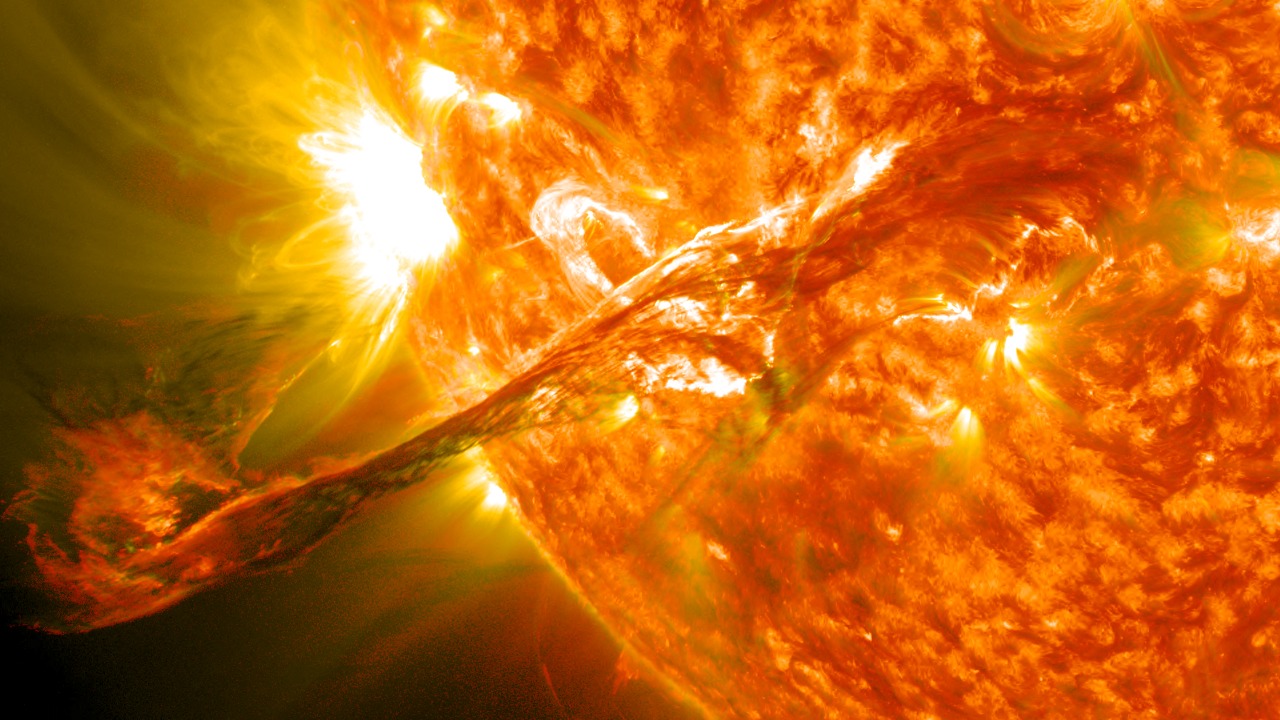

Earth is currently being bombarded by the most intense burst of solar radiation in more than two decades, a storm powerful enough to disrupt flights, satellites and radio links even as it paints the sky with rare auroras. Space weather agencies classify the event at the upper end of their scales, putting it in the same league as the notorious early‑2000s storms that became benchmarks for modern solar risk.
What is unfolding now is not a single flare but a chain of solar eruptions that has driven both a severe radiation storm and a major geomagnetic disturbance into the near‑Earth environment. Together, they are stress‑testing the systems that keep global aviation, navigation and power grids running, while giving scientists an unusually close look at how the Sun behaves near the peak of its activity cycle.
How this storm became the strongest in 20+ years
Forecasters first raised alarms when instruments detected an S4 level event on the standard five‑step radiation scale, a category labeled “Severe” that sits just below the maximum. The alert described an S4 Severe event in Solar Radiation Storm in Progress, with particle fluxes so high they can interfere with high‑frequency radio communications in polar regions. Space weather specialists note that 54 is the key metric used in that bulletin, underscoring just how extreme the particle environment has become around Earth.
Independent analyses converge on the same conclusion: this is the most powerful solar radiation storm to hit the planet in more than 20 years, and by some measures the strongest since 1991. One detailed assessment explains that Earth has just endured the most intense such event in over two decades, while another report notes that Earth was hit by the strongest solar radiation storm since 1991, a benchmark that predates the famous 2003 “Halloween” storms. A separate explainer framed the question bluntly and answered it just as bluntly: “Answer Yes,” adding that You probably cannot tell from the ground that Earth is being battered by one of the strongest storms in more than 20 years.
Radiation storm plus geomagnetic storm: a one‑two punch
What makes this episode especially significant is that the radiation storm is arriving alongside a powerful geomagnetic disturbance driven by the same burst of solar activity. Space weather monitors reported that G4 level Severe Geomagnetic Storm Levels Reached Jan 19, with NOAA, the NWS and the Space Weather Prediction Center warning that such conditions could persist. A follow‑up Update confirmed a G4 Severe Geomagnetic Storm Alert Issued on a Tuesday in UTC, with the notice time marked as 39 minutes past the hour.
Social media feeds that track space weather amplified the message, describing how Earth has been experiencing a severe G4 geomagnetic storm together with an S4 radiation storm, a combination that developed in just 25 hours, an exceptionally rapid escalation. Another widely shared clip labeled as Breaking Space News stressed that Earth is being hit by the largest solar storm since 2003 and that On January 19–20, 2026 the National Oceanic and Atmospheric Administration recorded the event as it unfolded. Together, these accounts paint a picture of a rare one‑two punch in which energetic particles and magnetic disturbances are arriving almost simultaneously.
What is driving the storm on the Sun itself
Behind the scenes, the culprit is a highly active region on the Sun that produced a powerful X‑class flare and a fast coronal mass ejection, hurling charged particles and magnetic fields toward our planet. European experts note that an X‑class solar flare was observed on 18 Jan 2026, and that the resulting high‑energy particle shower is now being tracked in detail by CET based space weather monitoring capabilities. The same overview explains that this high energy particle shower is exactly what is now enveloping Earth, providing a direct link between the flare and the radiation storm.
The timing also fits with the broader rhythm of the current solar cycle, which is approaching its peak and producing more frequent and intense eruptions. Teams at the Space Weather Prediction Center have been tracking Solar Cycle 25 and warning that as the Sun heats up, Earth can expect more episodes like this, with flares and coronal mass ejections that threaten communications, satellites and power systems. Their long‑range outlooks, hosted by NOAA’s The Space Weather Prediction Center, emphasize that the agency’s mission is to deliver space weather products and services that protect the environment from the Sun to the Earth, a mandate that is being tested in real time by this storm.
Impacts on aviation, satellites and power on the ground
For people on the surface, the immediate health risk from this storm remains low, but the same cannot be said for aircraft crews, satellites and high‑frequency radio users. The S4 classification means that polar‑route flights may need to be diverted or limited because of increased radiation exposure and the loss of reliable HF communications, a concern spelled out in the Severe radiation storm bulletin issued on a Monday in UTC. One regional report captured how the event is being framed for the public, noting that Earth is experiencing the largest solar radiation storm in over 20 years, even as local forecasts talk about 35 degrees and Cloudy skies in Kennewick, with Today’s Temps nearly steady and Winds light and variable into Tonight.
In orbit, operators are taking no chances. Analysts explain that Other earthly assets are protected in other ways, with Satellites put into safe mode so that only power, navigation and communication essentials remain active while sensitive electronics ride out the storm. The same Nexstar‑syndicated report by Addy Bink for NEXSTAR notes that Earth has already seen disruptions to radio communication and satellite TV as the storm intensifies. A separate Q&A aimed at general readers underscores that while the You in the street may not notice much, the effects on technology will continue to ripple out over the next few days.
Auroras, rare sights and what happens next
One of the most visible consequences of this storm is unfolding far from control rooms and satellite operations centers, in the night sky itself. As the G4 geomagnetic disturbance compresses and shakes Earth’s magnetic field, charged particles are funneled into the atmosphere, igniting auroras at latitudes that rarely see them. Observers report that Earth’s magnetic field was struck hard enough to trigger Northern Lights as far south as Southern California, a line that usually sits well outside the auroral oval. Another explainer notes that Ashley Strickland described how auroras could be visible from the continental United States to South Africa, with the piece marked as Updated Jan and Published Jan and labeled with the shorthand PUBL. Those accounts match what space weather models predict when a G4 storm couples strongly into the magnetosphere.
For now, forecasters expect elevated conditions to persist as the solar wind from this eruption continues to wash over the planet. A widely shared explainer on what to know about the biggest solar storm in over 20 years emphasizes that Satellites and other infrastructure are designed with such events in mind, even if this one is testing design margins. Another detailed breakdown from Earth focused analysts notes that the probability of catastrophic grid failure remains low, on the order of 0 or less according to NOAA, but that operators are on heightened alert. For anyone looking up, the advice is simple: if skies are clear and you live far from city lights, this is one of those rare nights when the biggest solar radiation storm in a generation might paint your local horizon green.
More from Morning Overview