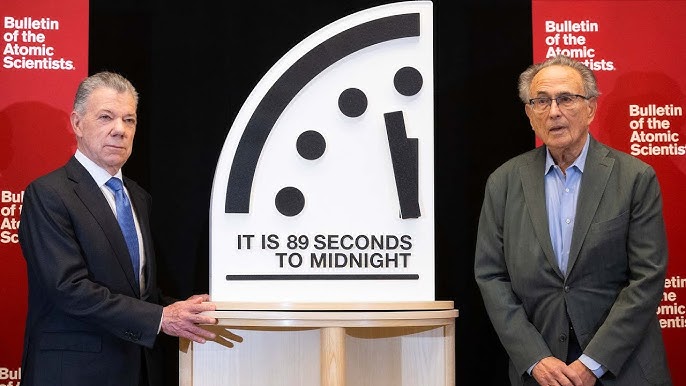

The symbolic clock that tracks humanity’s proximity to catastrophe has lurched forward again, and the margin for error is now measured in heartbeats. Scientists have set the Doomsday Clock to 85 seconds to midnight, the closest it has ever been to the moment meant to represent global self-destruction. The new setting is intended as a blunt warning that the world is drifting toward disaster faster than political leaders are willing to respond.
Behind the stark number is a judgment that nuclear tensions, climate disruption and emerging biological threats are converging into a single, volatile risk landscape. The scientists who maintain the clock are not predicting an inevitable apocalypse, but they are signaling that the window to pull back from the brink is narrowing, and that complacency is itself becoming dangerous.
What the Doomsday Clock actually measures
The Doomsday Clock is a metaphor, not a mechanical forecast, but it is built on concrete assessments of global risk. Created in the late 1940s by scientists who had worked on nuclear weapons, it was designed to translate complex security and technological threats into a simple image: how close humanity is to “midnight,” the point of irreversible catastrophe. Over the decades, the clock has moved backward and forward as experts weighed arms control treaties, wars, technological breakthroughs and environmental damage, and its current setting of 85 seconds to midnight is the tightest margin on record.
In practical terms, that figure is a way of compressing multiple crises into a single, memorable signal. The same panel that once focused almost exclusively on nuclear weapons now factors in climate change, disruptive technologies and biological dangers when it decides where to place the hands of the clock. By pushing the setting to 85 seconds, the scientists are saying that the combined effect of these threats has eroded the buffer that once separated everyday life from global emergency, and that the world is operating with less and less room for miscalculation.
Why scientists moved the clock to 85 seconds
The decision to move the clock so close to midnight reflects a judgment that the world’s most powerful states are not just failing to reduce risk, they are actively heightening it. In their latest assessment, experts pointed to a pattern in which major countries have become more aggressive, adversarial and nationalistic instead of using diplomacy to ease tensions. One scientist, identified as Holz, underscored that “rather than heed this warning, major countries became even more aggressive, adversarial and nationalistic,” a critique that captures how geopolitical rivalry is undermining efforts to stabilize nuclear arsenals and manage shared threats, as reported in a recent analysis.
The new setting also reflects a broader sense that the world is edging closer to a tipping point. In its latest announcement, the group behind the Doomsday Clock warned that Earth is now just 85 seconds from midnight, a phrase meant to convey that the risks are not abstract or distant. By framing the situation in seconds rather than minutes, the scientists are emphasizing how little time they believe remains for governments to reverse course on nuclear policy, climate action and emerging technologies before dangerous feedback loops become entrenched.
Nuclear weapons, climate change and biological threats
At the core of the clock’s latest move is the enduring danger posed by nuclear weapons. The original Doomsday Clock was created to track the threat of nuclear annihilation, and that risk has never fully receded. As one detailed examination of the clock’s history notes, the project began as a way to visualize the danger that nuclear arsenals could end civilization, and even today, the question of where the nuclear threat stands remains central to the clock’s setting. With arms control agreements fraying and nuclear-armed states modernizing their arsenals, the risk of miscalculation or escalation is once again a primary driver of the clock’s advance.
But nuclear weapons are no longer the only factor. Scientists now explicitly cite climate change and biological dangers as coequal threats that push the hands closer to midnight. In their 2026 update, they highlighted how nuclear weapons, climate change and biological risks together define how close humanity is to self-annihilation. Extreme weather, rising seas and the spread of dangerous pathogens are no longer hypothetical scenarios, they are unfolding in real time, and the scientists argue that these trends, combined with geopolitical instability, are eroding the safety margin that once separated local crises from global catastrophe.
A “failure of leadership” at the top
Behind the technical language of risk assessments lies a blunt political judgment: the people with the power to reduce these dangers are not doing enough. In its latest statement, the group responsible for the Doomsday Clock described a global “failure of leadership,” arguing that governments have not matched the scale of the threats with commensurate action. The announcement framed this as a breakdown in responsibility, noting that the world’s most influential leaders have not delivered the swift, coordinated responses that the moment demands, a criticism captured in a detailed account that highlighted this failure of leadership.
The scientists are careful to stress that the clock is not a prophecy, it is a call to action. By invoking a failure of leadership, they are placing responsibility squarely on those who control nuclear arsenals, set climate policy and regulate dangerous technologies. The message is that the risks driving the clock toward midnight are not acts of nature, they are the result of choices, and different choices could move the hands back. That framing is meant to galvanize public pressure on leaders who might otherwise treat the clock as a symbolic curiosity rather than a demand for concrete policy change.
How close is too close, and what happens next
For many people, the difference between 89 seconds and 85 seconds might sound like a technical adjustment, but within the logic of the Doomsday Clock it represents a meaningful shift. Earlier assessments had already placed the clock at 89 seconds to midnight, the closest it had ever been, reflecting a world in which nuclear tensions and climate disruption were already converging. Analysts noted that the clock, which started as a nuclear warning, had been pushed to that level because of a combination of arms race dynamics and environmental breakdown, a trend described in detail in a report on why the Doomsday Clock had already been so close to midnight.
Moving from 89 to 85 seconds is the scientists’ way of saying that the situation has deteriorated further, not improved. The latest setting signals that, in their view, the world has squandered another year of opportunity to reduce nuclear stockpiles, accelerate climate mitigation and strengthen safeguards against biological threats. It is also a reminder that the clock can move in both directions. Historical resets have pushed the hands back when arms control deals were signed or when global cooperation improved, and the current setting is meant to challenge leaders to create the conditions for another such reversal rather than accepting 85 seconds as the new normal.
More from Morning Overview