
Maglev bullet trains promise a future where steel wheels and clattering rails give way to smooth, floating speed. Yet the reality on today’s tracks is more nuanced, with some systems gliding entirely on magnetic force while others quietly keep a set of wheels for low-speed work and safety backup. Understanding when these trains ride on wheels, and when they truly levitate, is key to separating engineering fact from marketing gloss.
At the heart of the question is how different maglev designs handle the messy parts of a journey, from creeping through depots to surviving a power failure. I will walk through how the technology works, where wheels still matter, and why the answer changes depending on whether you are looking at Japan’s superconducting maglev, China’s high-speed prototypes, or the more modest airport shuttles that first brought levitation to passengers.
How maglev actually floats above the track
To understand whether maglev trains still need wheels, I first need to be clear about what “maglev” really means. In a true magnetic levitation system, the train is lifted and guided by magnetic forces so the vehicle body does not rest on steel rails during normal operation. The core idea is that powerful magnets in the train and in the guideway create either attraction or repulsion, generating a lifting force that overcomes gravity and keeps the vehicle suspended a small distance above the track, as described in technical overviews of maglev technology.
There are two main families of maglev. Electromagnetic suspension uses conventional electromagnets on the train that pull it upward toward ferromagnetic rails, constantly adjusted by control systems to maintain a narrow air gap. Electrodynamic suspension relies on superconducting magnets or strong permanent magnets that induce currents in coils or conductive plates in the guideway, creating repulsive forces that stabilize the train once it reaches a certain speed. In both cases, the lack of physical contact eliminates rolling resistance and most mechanical friction, which is why reference guides on how maglev trains work emphasize their potential for very high speeds and low wear on infrastructure.
Why some maglev systems still carry wheels
Even with full magnetic levitation, engineers still have to solve the problem of what happens at very low speeds and in abnormal situations. Many designs include retractable or fixed auxiliary wheels that support the train when it is stopped, moving slowly, or when the levitation system is not energized. These wheels are not meant for high-speed running, but they give operators a way to move vehicles in depots, position them in maintenance bays, or bring a train to a safe halt if there is a power interruption before the magnets can keep it suspended, a point that is often highlighted in technical summaries of maglev train engineering.
In practice, this means a maglev train can behave a bit like an aircraft on the ground, rolling on wheels at walking pace before “lifting off” onto its magnetic cushion as speed increases. Some airport shuttles and early commercial lines use this hybrid approach, with the vehicle resting on small wheels in stations and then transitioning to levitation once it accelerates past a threshold. That design choice reflects a trade-off: keeping wheels simplifies low-speed operations and emergency procedures, even if the marketing focuses on the frictionless glide that only appears once the train is fully levitating, a nuance that becomes clear when comparing maglev and traditional rail on safety and comfort.
Japan’s superconducting maglev and its backup gear
Japan’s most ambitious project, the Chuo Shinkansen using the L0 Series superconducting maglev, is designed to run without wheels at operating speed, relying on powerful superconducting magnets to both lift and propel the train. When the train accelerates, the induced currents in the guideway coils create a stable levitation force, and at cruising speed the vehicle rides several centimeters above the track with no physical contact. Reporting on the L0 Series notes that this system targets speeds well beyond conventional Shinkansen, with test runs exceeding 500 kilometers per hour, and that the levitation is continuous once the train is up to speed, as explained in guides to Japan’s superconducting maglev.
Even so, the Japanese design does not entirely abandon wheels. The L0 Series uses retractable rubber tires at low speeds, which support the train as it leaves the station and before the magnetic forces are strong enough to lift it. Once the train reaches the levitation threshold, those wheels retract and the vehicle transitions to full maglev mode, only deploying the tires again as it slows back into a station or in an emergency. This dual-mode behavior is part of why overviews of fast and maglev trains in Japan stress that the futuristic floating ride is paired with very practical backup systems that keep passengers safe if anything interrupts the superconducting magnets.
China’s high-speed maglev prototypes and the “wheel-free” image
China has aggressively promoted its own high-speed maglev prototypes as symbols of technological leadership, often highlighting the image of a train that appears to float cleanly above the guideway. One widely shared demonstration video shows a sleek blue and white prototype accelerating along an elevated track, with the narrative focusing on its claimed top speed of 600 kilometers per hour and the promise of cutting travel times between major cities to a fraction of current journeys. Social media posts about China’s latest high-speed maglev reveal lean heavily on that visual of frictionless motion, reinforcing the idea that the train has left wheels behind.
Closer looks at the engineering, however, show that even these headline-grabbing prototypes incorporate auxiliary wheelsets for low-speed handling and safety. The levitation system is designed to carry the load at operating speed, but the wheels remain available for yard movements, station approaches, and contingency scenarios. Coverage of China’s 600 kilometer per hour concept train notes that the vehicle uses advanced electromagnetic suspension and linear motors for propulsion, yet still relies on conventional hardware when it is not in full maglev mode, a detail that surfaces in more technical descriptions of the country’s maglev bullet train prototype.
Airport shuttles and low-speed maglev lines
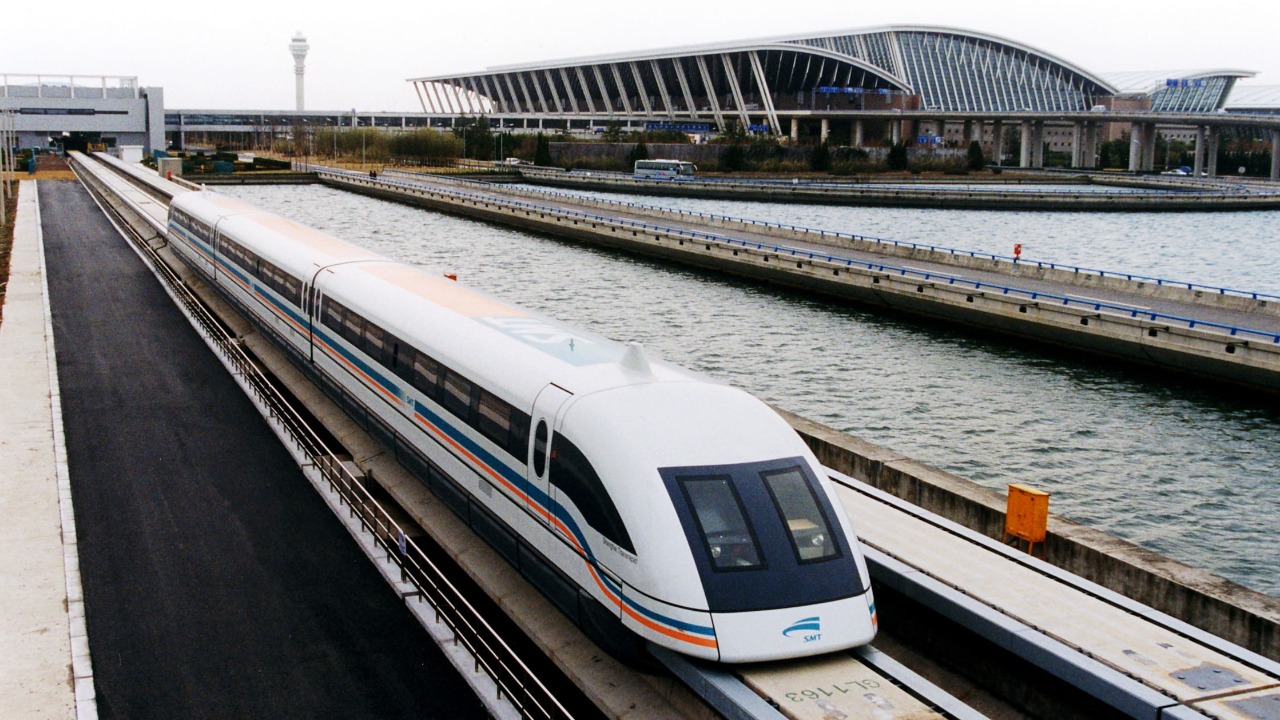
Not all maglev systems chase record-breaking speeds. Some of the earliest commercial applications were short airport connectors and urban shuttles that operate at more modest velocities but still benefit from low maintenance and smooth rides. These lines often use electromagnetic suspension with relatively small air gaps, and they are typically designed so the train levitates even at lower speeds than the high-speed intercity projects. In many of these systems, the vehicles still carry small wheels for depot operations, but passengers experience levitation for most of the journey, a pattern that aligns with general descriptions of commercial maglev deployments.
Because these routes are shorter and more controlled, operators can fine-tune the transition between wheel-supported and levitated modes. Some airport maglevs begin levitating almost immediately after departure, so the time spent on wheels is brief and limited to the platform area. Others may use wheels only inside maintenance facilities, with the guideway itself designed for continuous magnetic support. The key point is that even when passengers never see or feel wheels, the vehicles often retain them as hidden hardware, a detail that becomes clearer when watching behind-the-scenes footage of maglev train operations that show how these systems are maneuvered off the main line.
How maglev compares with traditional high-speed rail
When I compare maglev with conventional high-speed rail, the role of wheels becomes a defining difference rather than a mere technical detail. Traditional bullet trains like the Shinkansen or TGV rely on steel wheels on steel rails at all times, which means they face rolling resistance, wheel and track wear, and noise from contact, even though they use sophisticated suspension and track design to manage those issues. Maglev removes that contact during normal running, which reduces mechanical wear and allows higher peak speeds, a contrast that is central to analyses of maglev versus traditional rail on speed and safety.
However, the fact that many maglev trains still carry wheels for low-speed and emergency use shows that the technology has not completely severed ties with conventional rail hardware. Instead, it has redefined where and how wheels are used. In a maglev system, wheels are a backup and a ground-handling tool, not the primary means of support at speed. That distinction matters for maintenance planning, infrastructure costs, and passenger expectations, and it explains why technical explainers on maglev engineering spend so much time on levitation and guidance systems while still acknowledging the presence of auxiliary running gear.
Inside the ride: comfort, noise, and the feel of levitation
From a passenger’s perspective, the question of wheels versus levitation often shows up as a question of ride quality. When a maglev train is fully floating, the absence of wheel-rail contact reduces vibration and structure-borne noise, so the cabin can feel quieter and smoother than a comparable wheeled train at the same speed. Riders describe a sensation closer to flying than rolling, with fewer jolts from track joints or minor imperfections, a difference that is frequently highlighted in promotional material for Japan’s maglev experience.
The brief periods when a maglev vehicle is on wheels, such as during station approaches or departures, can feel more like a conventional train, with a bit more rumble and vibration. That contrast can actually make the transition to levitation more noticeable, as the cabin suddenly quiets and the motion smooths out once the magnets take over. Short clips shared on social platforms, including a widely viewed maglev ride reel, capture that moment when the train seems to lift and the soundscape changes, even if the underlying engineering is more gradual than the videos suggest.
Energy use, maintenance, and why wheels still matter behind the scenes
Maglev’s lack of rolling resistance at speed can translate into lower mechanical wear and potentially lower maintenance on the guideway compared with heavily loaded steel rails, but the levitation and propulsion systems themselves are complex and energy intensive. High-speed maglev lines must power long stretches of coils or conductive plates in the guideway, and superconducting systems require cryogenic cooling, so the energy savings from reduced friction are balanced against these demands. Technical references on maglev infrastructure note that the overall efficiency picture depends heavily on design choices, operating speeds, and how often trains run.
In this context, keeping wheels for low-speed operations can actually simplify some aspects of maintenance and energy management. Using wheels in depots and yards means operators do not need to energize long sections of guideway just to move trains a short distance for servicing. It also allows conventional lifting and jacking equipment to support the vehicle when technicians need to access the underside. That is one reason why even advanced systems described in overviews of Japan’s fastest trains still integrate auxiliary running gear, even if passengers never see it during a normal trip.
Public perception versus engineering reality
Public fascination with maglev often centers on dramatic visuals and bold speed claims, which can blur the line between perception and engineering reality. Viral posts about China’s latest prototypes, for example, tend to focus on sleek exterior shots and animated graphics of trains floating above the track, with little mention of the wheels tucked away underneath. A widely shared social media breakdown of a Chinese maglev concept leans heavily on the idea of frictionless travel, reinforcing the impression that wheels are a relic of the past rather than a quiet part of the present design.
When I compare those narratives with more detailed reporting on prototypes and test runs, a more grounded picture emerges. Engineering-focused coverage of China’s 600 kilometer per hour concept train, such as the profile of its maglev bullet train, acknowledges both the levitation system and the presence of conventional hardware for low-speed and emergency use. The same pattern appears in Japanese and European projects: the marketing celebrates the floating ride, while the technical documents quietly specify auxiliary wheels, braking systems, and other conventional components that keep the futuristic vision practical and safe.
More from MorningOverview