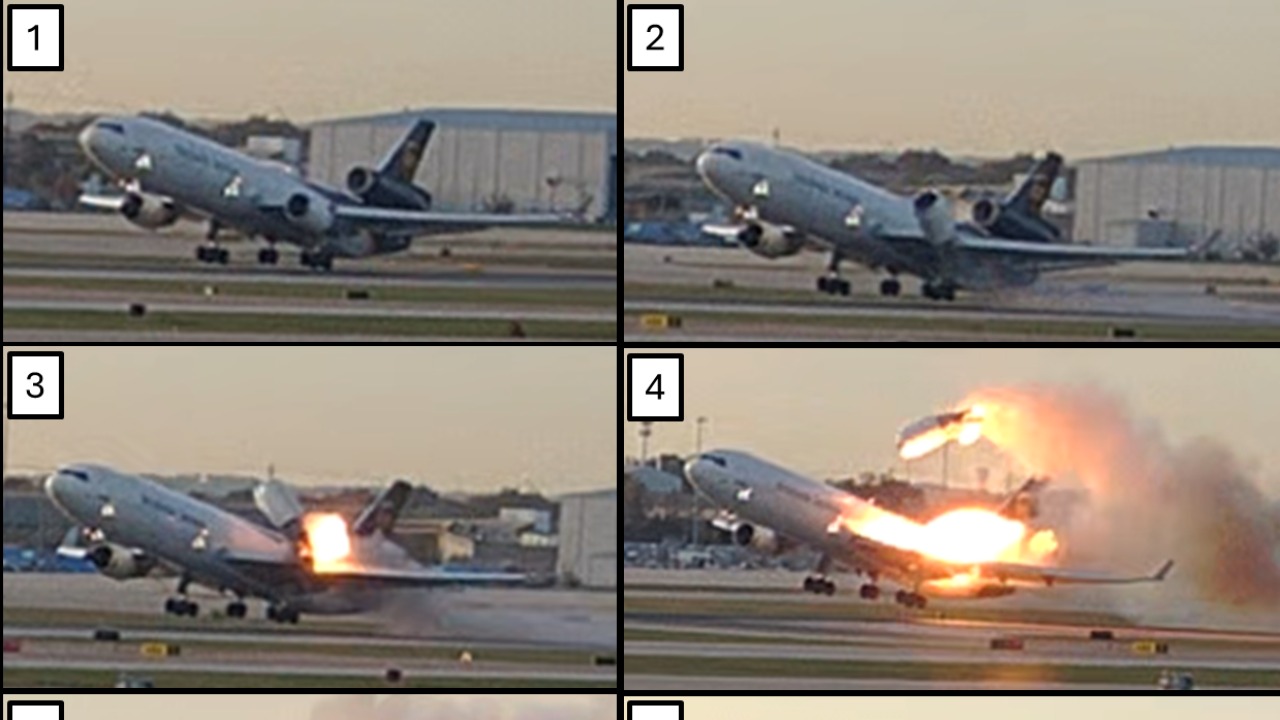

The crash of a UPS MD-11 freighter during takeoff from Louisville has rapidly shifted from a mystery to a focused hunt for answers inside the left engine and the hardware that held it to the wing. Investigators now say the disaster, which killed people on the ground and has since claimed a 15th victim, appears to have unfolded after critical mounting structures failed and allowed the engine to tear free in a shower of fire and debris. As they reconstruct those final seconds, the inquiry is widening into how a modern cargo jet could be brought down by metal fatigue in a part that was supposed to be among the strongest on the aircraft.
The moment the UPS MD-11 went from routine to catastrophe
The UPS cargo jet was accelerating for a long overnight flight to Honolulu when what should have been a routine departure from Louisville Muhammad Ali International Airport turned into a catastrophe. The aircraft, identified as UPS Airlines Flight 2976, was operating from the company’s massive UPS Worldport hub with a full load of fuel for the roughly nine hour trip, a standard long-haul assignment for the three engine MD-11 freighter that had become a workhorse in the company’s fleet. Within moments of liftoff, witnesses saw flames near the left wing and engine as the jet struggled to climb away from the runway and the airport perimeter.
Instead of climbing safely, the aircraft lost control and crashed into an area just south of the airport, striking structures and a recycling facility near the runway and igniting an intense fire that spread quickly through the impact zone. The scale of the destruction was captured in an Aerial view of the Accident that later circulated among investigators, showing debris scattered across a wide swath of industrial property. What began as a standard cargo departure had, in less than a minute, become one of the deadliest aviation disasters Louisville has ever seen.
Engine separation in focus as investigators trace the chain of failure
From the earliest hours of the investigation, specialists homed in on the left engine and the structures that attached it to the wing as the likely starting point of the disaster. A newly released preliminary investigation describes how hardware meant to hold the left engine to the UPS cargo jet failed during takeoff, allowing the powerplant to break away from the pylon that links it to the wing. According to that early technical narrative, the separation occurred near the runway as the aircraft was still low and fast, a combination that left the crew with almost no margin to recover once the engine tore free and the wing was damaged.
The same preliminary account notes that the left engine then crashed onto the ground, where a fire ignited near the left pylon attachment to the wing and continued to burn as the airplane cleared the blast fence at the end of the runway. Investigators describe the engine ripping through forward and aft mounts before departing the aircraft, a sequence that is consistent with overstress in components that were already weakened. The description of the hardware failure and the engine’s path comes through in detail in the early UPS crash report, which frames the separation as the pivotal event that doomed the flight.
Metal fatigue cracks and overstress: what the photos and lab work show
As investigators moved from the runway to the lab, the story of how that engine mount failed began to sharpen around metal fatigue. Federal investigators released a series of six photos that show the rear of the engine starting to detach before it flew up and over the wing, with flames already licking at the structure as the MD-11 tried to climb away from Louisville. Those images, captured from airport cameras, reveal the left engine pivoting and then separating in a way that suggests the supporting structure was already compromised before the final overload. The same sequence is described as a “4 disaster in Louisville, Kentucky” in the technical notes that accompany the dramatic photos of cracks in the engine mount.
Metallurgical examinations have since highlighted fatigue cracks around the engine pylon and mount, along with signs of overstress failure where the structure finally gave way under loads that should have been well within design limits. A preliminary NTSB report describes “fatigue cracks” and “overstress failure” in the left engine hardware, language that points to a long running deterioration that ended in a sudden break. That same report notes that the fire in the area of the left pylon attachment to the wing continued as the airplane cleared the blast fence, underscoring how the structural failure and the post separation fire were intertwined. The focus on fatigue cracks around the engine is reinforced in frame by frame images and analysis highlighted in a report that details the engine separating from the wing.
Inside the NTSB’s preliminary findings and what they still do not know
The National Transportation Safety Board has now laid out its early view of the accident in a formal docket, identifying the left engine separation and the cracked mounting hardware as central to the sequence of events. In its preliminary summary, the NTSB describes how the left engine of the UPS plane detached and caught fire shortly after takeoff, with the structural failure traced to fatigue cracks in key components that connect the engine to the wing. The agency’s investigators have cataloged the damage patterns on the wing, pylon, and engine remains, and they are using that physical evidence to reconstruct the loads that acted on the structure in the seconds before it failed. Those early conclusions are captured in the NTSB investigation docket for the case, which will eventually expand to include full analysis and recommendations.
At the same time, the NTSB is careful to label its current work as a Preliminary Report Analysis rather than a final verdict on what went wrong. Investigators still need to determine why the fatigue cracks were not detected earlier, whether inspection intervals or procedures were adequate, and if any design or maintenance issues contributed to the overstress failure. The agency’s own research methods, described as Structural Failure Findings in a detailed UPS Plane Crash Louisville NTSB Preliminary Report Analysis, emphasize that the current focus is on understanding the mechanics of the failure before turning fully to questions of accountability and systemic change.
What the cockpit recorders reveal about the crew’s final seconds
While the structural story is written in metal and broken mounts, the human story is captured in the flight data and cockpit voice recorders that were recovered from the wreckage. According to summaries of the black box data, the left engine failure and separation occurred under what should have been normal stress, with no indication that the crew had mishandled the aircraft or pushed it beyond its certified limits. The data show a sudden loss of thrust and a rapid onset of control problems as the engine departed the wing, consistent with the aerodynamic and structural disruption that would follow such a violent event. That timeline is echoed in descriptions of how the engine ripped through forward and aft mounts before leaving the aircraft, as detailed in a technical account of how the engine ripped off the wing.
The cockpit voice recorder, according to investigators, captured a crew that was reacting rapidly to a sudden emergency rather than one that had any prior warning of a developing structural problem. There is no indication in the available summaries that the pilots reported unusual vibrations or anomalies before the failure, which reinforces the view that the fatigue cracks progressed silently until the final overstress event. That lack of warning is a critical part of why regulators and airlines are now scrutinizing inspection regimes for engine mounts and pylons, since crews cannot be expected to manage a failure they have no way of detecting in advance. The emphasis on the black box data showing the crew losing control after the separation is a reminder that, in this case, human performance was overwhelmed by a catastrophic mechanical break.
New images and local reporting sharpen the picture of the crash
Beyond the official documents, a growing body of imagery and local reporting has helped the public understand how the accident unfolded in real time. Newly released images show the UPS plane with fire already visible near the left wing as it roared down the runway, then a sequence of frames in which the engine appears to shift, detach, and arc over the wing before falling away. Those visuals align closely with the NTSB’s description of the engine separation and the subsequent fire at the left pylon attachment, and they have become a central part of how the story is being told in Louisville and beyond. The focus on these frame by frame images is reflected in coverage that highlights how new images show the UPS plane moments before the crash, underscoring the role of visual evidence in modern accident investigations.
Local outlets have also zeroed in on the technical language of the Preliminary NTSB report, explaining to residents what it means for an engine to show “fatigue cracks” and “overstress failure” and why those terms matter for safety. One detailed account of the deadly UPS plane crash in Louisville notes that the engine hardware showed both long term fatigue and signs that it failed under loads that should have been survivable, a combination that points to a hidden weakness that only became visible in the worst possible moment. That same reporting emphasizes that the crash site lay just south of the airport, near a recycling facility, a detail that has shaped how the community understands the risk to people and businesses around the flight path. The emphasis on fatigue cracks and overstress in the Preliminary NTSB findings from Louisville has helped translate complex engineering into terms that residents can grasp.
The human toll: 15 victims and a community in mourning
Behind every technical term in the investigation is a human cost that continues to rise. The crash initially killed 14 people, most of them on the ground in the industrial area just beyond the airport perimeter, and injured 23 others who were caught in the blast, fire, and collapsing structures. In the weeks that followed, a 15th victim died of injuries sustained in the crash, a development that Kentucky officials confirmed as families prepared for the holidays. That additional death underscored how the impact of the accident extended well beyond the immediate fireball and smoke plume that residents saw from miles away. The updated toll is reflected in a report that notes a 15th victim of the UPS plane crash in Kentucky, a stark reminder that the casualty count is not just a statistic but a roster of lives cut short.
Local reporting has put names and stories to those numbers, including Megan Washburn, 35, who was identified among the dead as investigators continued their work. The plane’s status as a fully loaded long haul freighter, carrying fuel for the nine hour flight to Honolulu from UPS Worldport at Louisville Muhammad Ali International Airport, meant that the post impact fire was especially intense and difficult to control, complicating rescue efforts and increasing the likelihood of severe burns and smoke inhalation. Community coverage that describes how the 15th victim of the deadly UPS plane crash in Louisville was identified has made clear that the investigation is not an abstract exercise, but a search for answers that grieving families and neighbors are watching closely.
Regulators, safety lessons, and what could change for cargo fleets
As the investigation advances, attention is turning to what regulators and airlines will do to prevent another engine separation like the one that destroyed UPS Airlines Flight 2976. The Federal Aviation Administration is already under pressure to review inspection requirements for engine mounts and pylons on MD-11 freighters and potentially other widebody types, particularly where aging fleets and high cycle operations might accelerate fatigue. Any changes could include new inspection intervals, revised non destructive testing methods, or even design modifications to strengthen critical hardware. The FAA’s broader role in certifying and overseeing these aircraft is central to the discussion, and the agency’s authority over airworthiness directives and maintenance standards is laid out on its own Federal aviation safety portal, which will likely host any future directives tied to this crash.
Safety analysts are also looking at how lessons from this accident might ripple across the global cargo industry, where older tri jet freighters like the MD-11 remain in service alongside newer twin engine types. The UPS Plane Crash Louisville 2025 Preliminary Report Analysis notes that the National Transportation Safety Board’s Structural Failure Findings could lead to recommendations affecting not just UPS but other operators that rely on similar engine mounting designs. Those recommendations might include enhanced training for maintenance crews, more aggressive retirement of high time components, or targeted inspections of aircraft that share the same pylon architecture. The idea that a hidden crack in a key wing attachment could bring down a heavily loaded freighter is already prompting calls for a more conservative approach to structural life limits, a debate that will likely intensify once the NTSB issues its final report.
How local and national media are translating technical findings
One striking feature of the public response to the crash has been the way local and national media have worked to translate dense engineering language into accessible explanations. A televised segment titled “Report on UPS plane crash reveals cracks found in key wing” walks viewers through the meaning of fatigue cracks in an engine mount, using graphics and expert commentary to show how a small flaw can grow into a catastrophic break. That coverage, available through a News video on the UPS crash, reflects a broader effort to help residents understand why investigators are so focused on the left pylon and what it means for the safety of flights that pass over their homes and workplaces every day.
At the same time, national outlets have used the dramatic airport camera images and technical excerpts from the Preliminary NTSB report to frame the crash as a case study in how modern aviation accidents are increasingly about rare structural failures rather than more familiar causes like weather or pilot error. By highlighting specific phrases such as “fatigue cracks” and “overstress failure” and pairing them with visuals of the engine separating from the wing, these reports have made the stakes of the investigation clear without oversimplifying the science. That blend of local detail and national context has helped keep the story in the public eye, ensuring that the push for answers about the UPS Plane Crash Louisville 2025 does not fade even as the NTSB’s work moves from the runway to the laboratory and, eventually, to the regulatory arena.
Why this MD-11 disaster resonates beyond Louisville
For people who follow aviation safety, the UPS MD-11 crash in Louisville resonates because it touches on several long running concerns about aging aircraft, cargo operations, and the limits of inspection regimes. The MD-11, a derivative of the earlier DC-10, has a complex history that includes previous incidents involving stability and landing performance, and the idea that one of these aircraft could now suffer a catastrophic engine mount failure during takeoff raises fresh questions about how its structural systems are monitored over time. The fact that the accident involved UPS Airlines Flight 2976, operating from a major cargo hub like UPS Worldport, underscores that this was not a marginal operation but a core part of the global logistics network. When a jet like that fails so dramatically, it challenges assumptions about redundancy and robustness that underpin public confidence in air freight.
More broadly, the crash is a reminder that even in an era of historically low accident rates, aviation safety is still vulnerable to rare but devastating mechanical failures that can slip through layers of oversight. The NTSB’s focus on fatigue cracks in the engine mount, the FAA’s looming role in potential airworthiness directives, and the intense scrutiny from local and national media all reflect a system that is trying to learn from a tragedy that killed 15 people and injured 23 others. As I look at the emerging record, from the NTSB investigation docket to the Preliminary NTSB findings and the community’s own reporting, the throughline is clear: the deadly separation of a single engine has forced regulators, airlines, and the public to confront how much depends on a few inches of metal holding firm at the edge of a wing.
More from MorningOverview