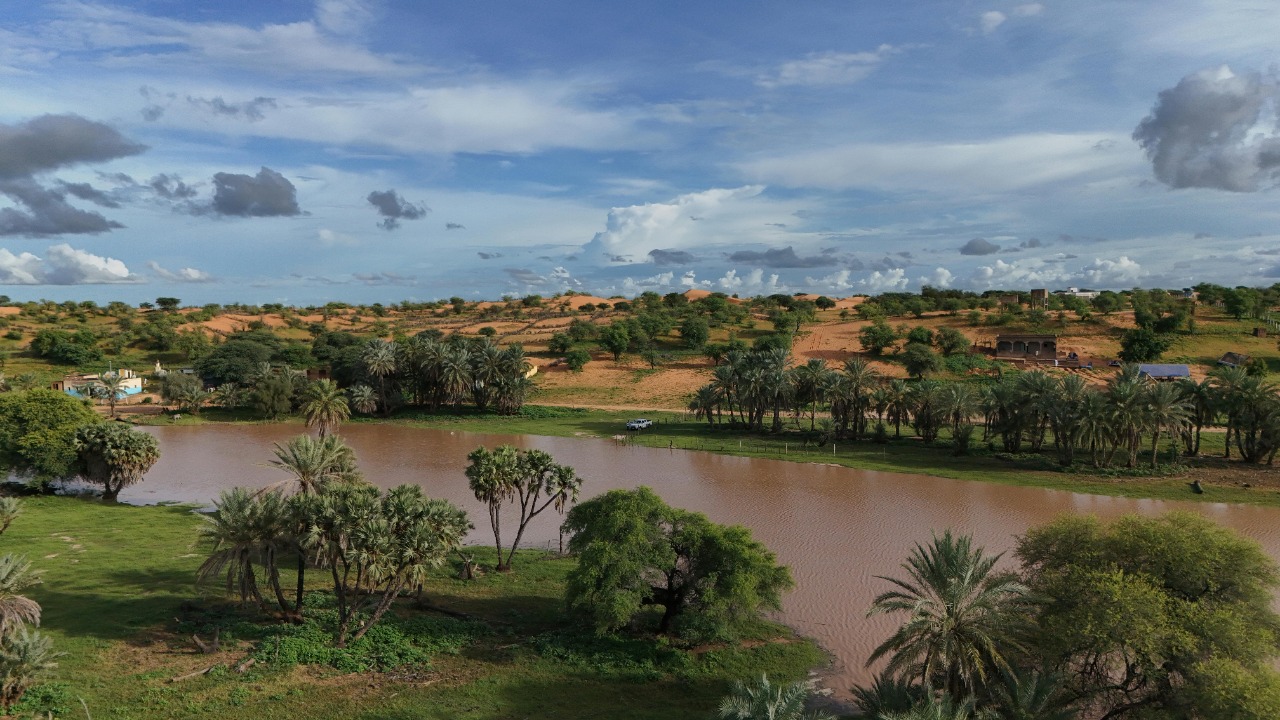

The Sahara today is shorthand for desolation, a vast belt of sand and rock that helps define the climate of an entire hemisphere. Yet geological records show that this same region has repeatedly supported lakes, rivers and grasslands rich with wildlife. The question is no longer whether the Sahara can ever be green, but how, when and under what conditions it might shift back toward a savannah-like landscape.
To understand whether the desert could realistically bloom again, I need to look at three intertwined forces: slow orbital cycles that have transformed the Sahara in the past, rapid human-driven climate change that is already reshaping rainfall, and deliberate efforts to “green” drylands at local and regional scales. Together, they sketch a future in which parts of the Sahara may well become wetter and more vegetated, but in ways that are far more complicated than a simple return to a lost Eden.
From ancient lakes to orbital cycles: why the Sahara is not fixed
Archaeology and sediment cores make it clear that the Sahara has not always been the hyper-arid expanse we know today. Sometime between 11,000 and 5,000 years ago, large areas were covered by grasslands, wetlands and lakes that supported hippos, crocodiles and human settlements, a period researchers often describe as a Green Sahara. Geological evidence shows that this was not a one-off anomaly but part of a repeating pattern in which the region oscillates between humid and arid states.
Those swings are tied to subtle changes in Earth’s orbit, particularly a phenomenon known as precession that alters how solar energy is distributed between seasons. One line of research suggests that roughly every 21,000 years the Sahara Desert shifts from desert to a savannah teeming with lakes, rivers and wildlife, then back again, as monsoon rains move northward and retreat. According to work summarized for the Sahara, this long-term rhythm is also influenced by a 41,000-year cycle in which the tilt of the planet changes between 22° and 24.5°, altering how much summer sunlight reaches North Africa.
How climate change could tilt the odds toward a wetter desert
Right now, the Sahara is in a dry phase of that natural cycle, and one summary notes that it is expected to become green again in about 15,000 years if orbital forcing alone is considered. Yet Today, human-driven warming is adding a new layer of complexity. Climate scientists argue that rising greenhouse gases could interact with those orbital tendencies, potentially bringing forward or amplifying the next humid episode, so that a future Green Sahara event remains highly likely in the distant future even if the exact timing shifts. Analyses shared through UCI ESS and other channels stress that the physics of monsoon systems make them sensitive both to orbital geometry and to global temperature.
New modeling work goes further, suggesting that the Sahara Desert could see a substantial increase in rainfall within this century, long before orbital cycles alone would turn the region green. Researchers at UIC project that parts of the Sahara Desert may receive up to 75% more precipitation than their historical average by the end of the century as global temperatures rise. A separate synthesis that invites readers to Cite This Page emphasizes that such a shift would represent a dramatic rebalancing of regional water cycles, with implications for ecosystems, dust transport and even Atlantic hurricane formation.
Early signals: greener patches, stronger monsoons and satellite clues
Hints of this wetter future are already visible. Satellite imagery has captured parts of the Sahara Desert, long known as one of the driest and most inhospitable places on Earth, showing more vegetation cover than in previous decades, a trend highlighted in new images. Climate scientists have also documented unusual seasons when storms tracked farther north than usual, bringing bursts of rain that temporarily turned normally barren areas green. One report notes that There is not much green in the Sahara Desert in an average year, but an unusual shift in the weather pattern recently allowed storms to move where they typically would not, a change visible from space as vegetation crept into parts of the desert while the West African Monsoon kicked into gear, as described in Sep coverage.
These anomalies line up with broader projections that a warmer world will alter the balance between dry Saharan air and moist tropical systems. One analysis framed as Dec commentary explains that Without the same volume of dust plumes streaming off North Africa, storms over the Atlantic could flourish, while more moisture falls on the desert itself. Another summary of New research notes that the Sahara Desert, one of the driest places on Earth, could see up to 75% more rainfall by the end of the century, even as that extra moisture might feed more frequent and destructive hurricanes, a trade-off highlighted in later analysis. In parallel, popular science explainers shared on social media describe how, During these wetter phases, the Sahara Desert can transform into a savannah teeming with lakes, rivers and wildlife, a pattern that Scientists link directly to orbital precession.
Human experiments in “greening” the desert
While planetary mechanics and greenhouse gases set the broad backdrop, people on the ground are already testing how far deliberate intervention can push arid landscapes toward productivity. In Egypt, the Egyptian Sekem Initiative, founded by Ibrahim Abouleish and now represented by Helmy Abouleish and Buthaina Elhoseiny, has spent decades converting desert sands into biodynamic farms that also host schools, clinics and even painting classes to strengthen social cohesion. Their work shows that with careful water management, organic practices and community institutions, pockets of green can thrive even in harsh conditions.
Other projects push the idea further using unconventional water sources. In the Egyptian desert, scientists have used recycled sewage water to grow the 500-acre Serapium Forest, part of a program to combat desertification that some observers on Futurology describe as a hypothetical model for reversing land degradation at scale. The main difference here is that the change is initiated through artificial means rather than waiting for orbital cycles, raising both hope and hard questions about how much water, energy and governance would be required to replicate such forests across the wider Sahara.
From the Sahel’s Great Green Wall to global climate stakes
On the southern fringe of the Sahara, governments are attempting something even more ambitious: a continent-spanning belt of restored land known as The Great Green Wall. The initiative, endorsed by the African Union, aims to slow the Sahara’s advance by restoring degraded Sahelian ecosystems, a vision described in GAR 2023 material as a response to the climate crisis and unsustainable agricultural practices. Yet financing remains a major bottleneck: At the end of 2020, the project had received just $1 billion compared to the roughly $33 billion needed according to UNCCD, a shortfall highlighted in a Dec assessment that also notes how, In Se, political commitments have not always translated into on-the-ground progress.
Even if funding and governance challenges are overcome, a greener Sahara would not be a purely local story. Climate modelers exploring a hypothetical Green Sahara scenario find that replacing bright desert with darker vegetation would alter how much sunlight the region reflects, reshaping atmospheric circulation far beyond North Africa. One recent synthesis explains that a shift from a lush, vibrant landscape to the arid expanse of the Sahara Desert, and potentially back again, would influence rainfall patterns, temperature gradients and even monsoon behavior on other continents, as outlined in a Jan overview. That same work underscores that any return to a savannah-like Sahara would bring a plethora of wildlife and new land-use pressures, forcing difficult choices about conservation, agriculture and settlement.
More from Morning Overview