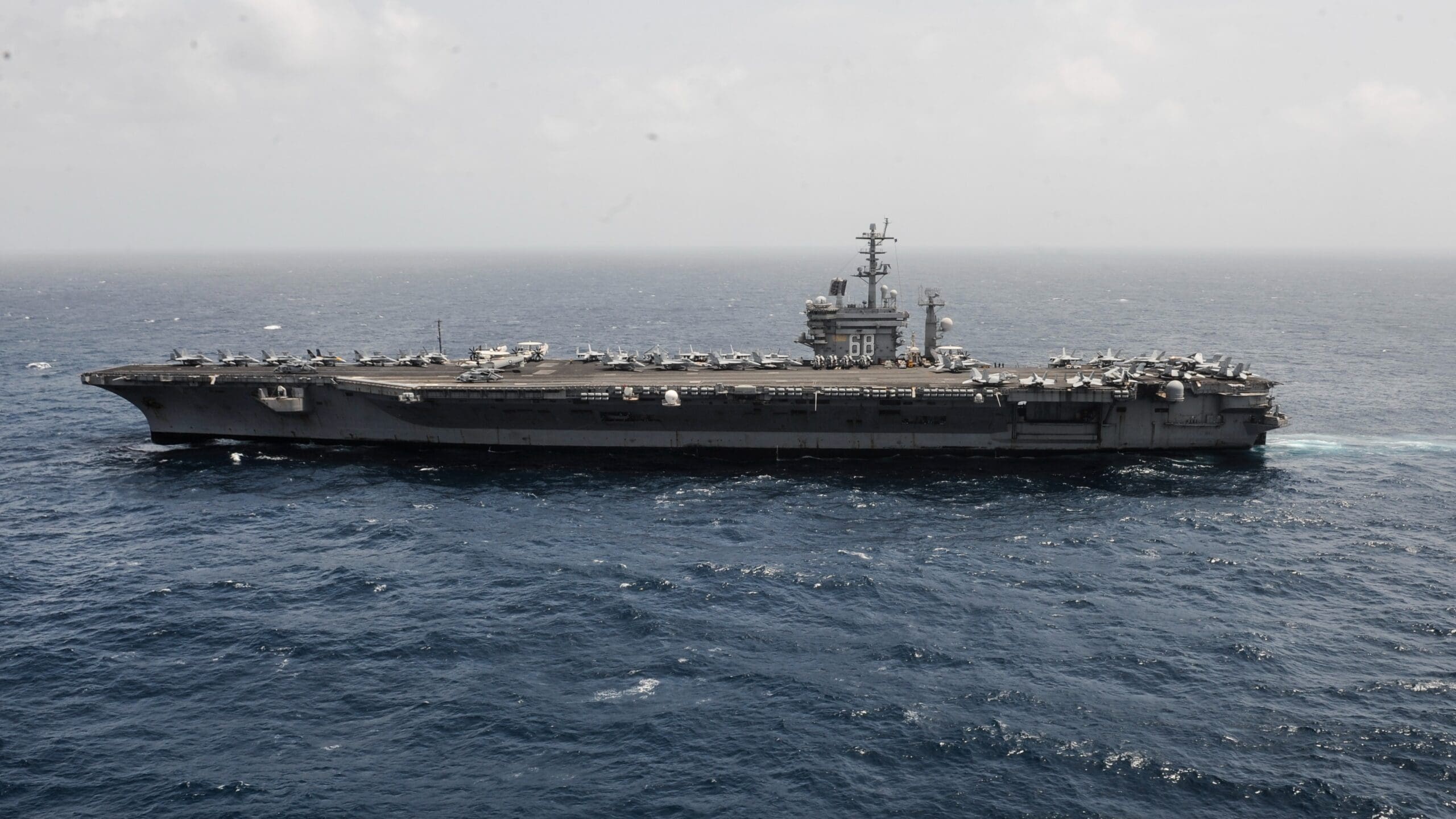

The United States is again leaning on its carrier fleet to manage a volatile standoff with Iran, even as its most famous flattop edges toward the scrapyard. As tensions around Israel and Tehran sharpen, the USS Nimitz is simultaneously being sent back into the Middle East and steered toward retirement, a dual track that captures the strain on U.S. naval power. I see the central question less as whether a mothballed ship could be resurrected, and more as how long Washington can keep stretching an aging icon before the bill comes due.
The Nimitz is back in the fight, not on the sidelines
Any discussion of a “return” for the USS Nimitz has to start with the fact that the carrier is already back in the region at the heart of the Iran crisis. The United States has deployed a USS Nimitz strike group to the Middle East, positioning it to lead any American military response if the confrontation between Israel and Iran worsens, a move that underscores how central the ship remains to U.S. options in the area around Israel and the wider Gulf. That presence fills a gap that existed after the Nimitz left the theater in the autumn, when no U.S. carrier was on station in the Middle East and planners were forced to rely more heavily on land based warplanes already in the region, a posture that limited flexibility until a new deployment could be arranged.
The fresh arrival is not just symbolic, it is a surge of combat power tailored to the current standoff. The aircraft carrier now in the Middle East hosts multiple squadrons of aircraft, including F-35 Lightning II fighter jets and F/A-18 Super Hornet fighters, giving the White House and the Pentagon a mix of stealth strike and high volume conventional sorties if they decide to escalate pressure on Iran. Earlier reporting noted that no U.S. aircraft carrier had been in the Middle East since October, when the USS Nimitz departed the region and The USS Gerald R. Ford was operating elsewhere, but that gap has now been closed by sending the Nimitz back into the same waters it left only months ago.
A “final” deployment that keeps stretching
The irony is that this renewed front line role comes just as the Navy insists the ship is nearing the end of its service life. The USS Nimitz (CVN-68) is the lead vessel of its class, and it began what was billed as its final deployment in March and then returned to its homeport at Naval Base Kitsap with the expectation that its operational career was winding down, even though it still carries F/A-18E/F Super Hornet squadrons that remain central to U.S. air power at sea. That tension between ceremonial “farewell” cruises and real world tasking is what makes the current Iran crisis so revealing, because it shows how hard it is to retire a ship that policymakers still reach for whenever a flashpoint erupts.
Inside the Pentagon, the Nimitz is treated as both a legacy asset and a risk factor. Analysts have described the USS Nimitz’s Legacy and asked What Happens After the Iconic Carrier reaches Retirement, warning that keeping such an old nuclear ship in heavy rotation could put newer systems like CVN-78 at risk if maintenance and modernization budgets are stretched too thin. Yet the same legacy that makes the carrier a sentimental favorite also makes it a political tool, since presidents can point to its presence off a hostile coast as proof that the United States is still willing to project power far from home.
Retirement plans collide with a carrier shortfall
On paper, the Navy’s plan is straightforward: retire the Nimitz and replace it with newer Ford class ships. In practice, that transition is already running into turbulence. New Ford class carriers, such as USS John F. Kennedy, are facing delays, which could create a gap in available carriers if the Nimitz leaves service on schedule and other hulls are in maintenance or still working through technical issues with systems like EMALS and other Ford class innovations. That is why some naval strategists argue that the service is walking into an “aircraft carrier crunch” just as demands in the Middle East and Indo Pacific are rising in parallel.
The knock on effects are visible across the fleet. Both the Advanced Arresting Gear and the Advanced Weapons Elevator work are systems that were incorporated into the Ford design, and problems with those technologies have already contributed to a slower than expected ramp up of the new class, raising the prospect of a temporary reduction in the carrier fleet around 2027 if new ships are not ready on time. Against that backdrop, the Nimitz looks less like a museum piece and more like a stopgap that planners may feel compelled to keep in the rotation, especially if Iran tensions require a sustained presence in the Gulf while other regions still demand their own carrier coverage.
The risks of pushing an old nuclear carrier harder
Keeping the Nimitz in the line of fire is not just a budget question, it is an engineering gamble. Naval engineers have warned that Extending their lifetime beyond what they were designed for is asking for trouble, because the original calculations for stress, fatigue and reactor operations were based on a finite number of years and deployment cycles. When a ship that old is sent back into a high tempo environment like the Middle East, every extra month at sea compounds the maintenance backlog and the risk of a serious failure at the worst possible moment.
There is also a strategic cost to treating the Nimitz as an endlessly reusable asset. One detailed assessment of the Nuclear Aircraft Carrier USS Nimitz Will Be Retired Next Year framed the decision as It Might Be a Big Mistake, arguing in its Key Points and Summary that removing the ship from service would end a 50 year career that has repeatedly provided reassurance during crises, but it also acknowledged that nuclear decommissioning is a long, complex process that cannot be postponed indefinitely without consequences. After the current deployment, Nimitz is expected to be handed over to Huntington Ingalls Industries at Newport News to begin the long process of defueling and dismantling, a sequence that will take years and cannot easily be reversed once it starts.
Why Washington may still choose to let Nimitz go
For all the emotion around the ship, there is a hard headed case for sticking to the retirement timeline even as Iran tensions spike. One recent Summary and Key Points by analyst Andrew Latham on the Nimitz Class Aircraft Carrier argued that, Despite anxiety over the scheduled 2026 retirement of the ship, the Navy’s broader modernization plan makes total sense if the United States wants carriers that can survive in more contested environments than the Middle East. From that perspective, leaning on the Nimitz one more time in the Gulf is a bridge strategy, not a reason to keep an aging hull in service indefinitely.
In my view, that is the crux of the current moment. The Nimitz has already been “dragged back” into the Iran confrontation, proving that even a ship on the cusp of retirement can still anchor U.S. strategy when a crisis flares. The real test will come when the deployment ends and the carrier heads into its final yard period, because at that point the choice will be stark: either accept a leaner fleet for a few years while New Ford class ships like USS John F. Kennedy work through their growing pains, or once again delay the farewell of a vessel that has become a habit as much as a tool. The fact that the United States has already sent the Nimitz back to the Middle East suggests that, when push comes to shove, strategic necessity still trumps the calendar, but it does not erase the structural pressures that are pushing the Navy to finally let its most storied carrier rest.
More from Morning Overview