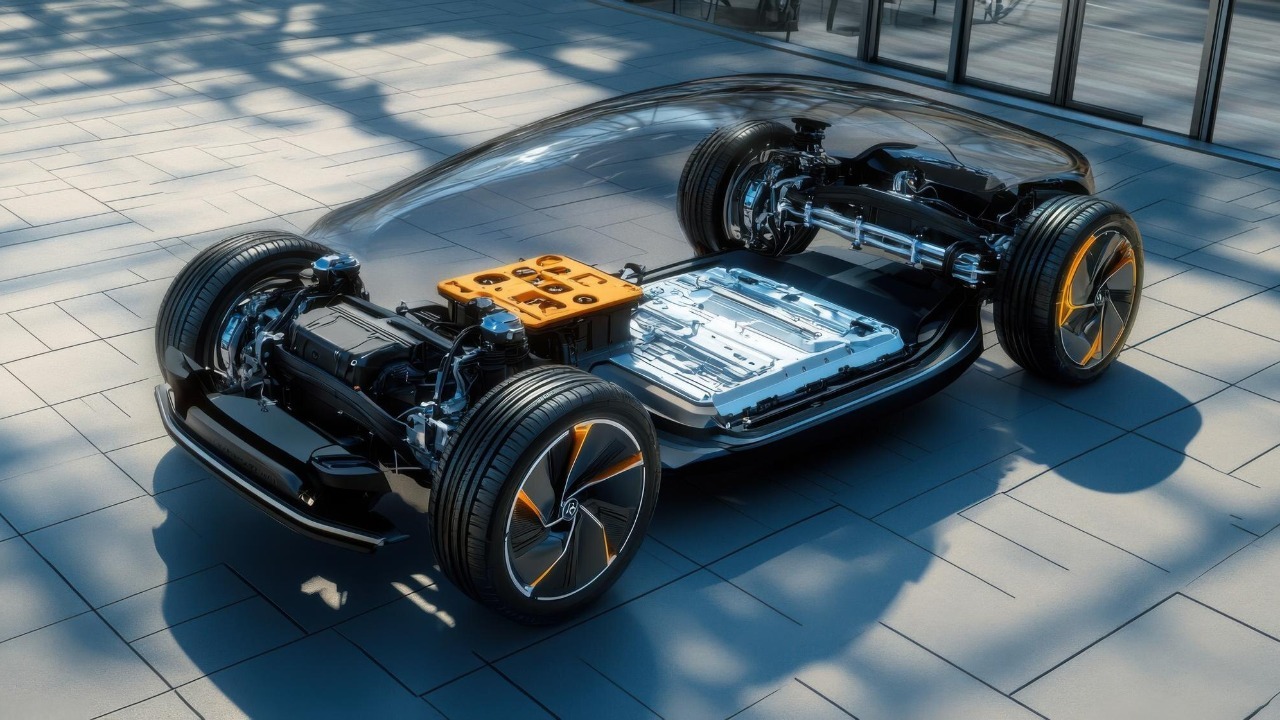

China’s latest advance in thermal batteries is not just another incremental tweak to energy storage. By redesigning how ions move inside high temperature cells, researchers have attacked the core weakness that has long kept this powerful technology confined to missiles and niche military hardware, opening the door to grid storage, fast charging and safer electric vehicles almost overnight.
At the same time, parallel work on graphene, sodium and solid state designs shows a broader strategy: use materials science to make batteries faster to charge, harder to ignite and cheaper to build at scale. Taken together, these breakthroughs suggest that the country is positioning itself to set the terms of the next energy era rather than simply supplying its hardware.
Inside China’s new thermal battery: fixing the shuttle effect
The starting point for the current breakthrough is a problem that has haunted thermal batteries for decades, known in the literature as the shuttle effect. In these high temperature cells, active ions tend to drift back and forth uncontrollably between electrodes, which gradually drains capacity and slashes charge efficiency over repeated cycles, as detailed in reporting on the shuttle effect. That instability has made it difficult to use these cells for anything that needs long term reliability, from grid storage to civilian aerospace.
A team led by Professor Wang Song and Zhu Yongping at the Institute of Process Engineering of the Chinese Academy of Sciences has now reengineered the cathode so that ions are no longer free to wander. Their approach relies on what the researchers describe as selective confinement of ions, carving out passageways about 0.54 nanometers across inside the cathode material so that charge carriers move in a controlled way instead of shuttling randomly, a strategy explained in detail in coverage of Selective confinement. By turning the cathode into a kind of atomic scale turnstile, the group led by Professor Wang Song and Zhu Yongping at the Institute of Process has created a thermal cell that behaves more like a precision instrument than a disposable power source.
From lab curiosity to “Unique class” of high performance cells
Thermal batteries have always been a Unique class of electrochemical cells, designed to sit inert for years and then deliver a burst of power in extreme environments when heated to operating temperature. Reports on this latest work stress that the new cathode design allows them to deliver instantaneous energy while withstanding conditions that would destroy conventional lithium ion packs, a capability highlighted in analysis of this Unique class. By solving the shuttle effect, the researchers have effectively removed the main reason these cells were treated as single use components rather than rechargeable workhorses.
What makes this moment feel like a pivot rather than a footnote is how closely it tracks with other efforts to tame heat inside batteries. One separate Chinese design integrates a built in thermal regulator that keeps the system below 60°C even under extreme fast charging conditions, a threshold that dramatically reduces the risk of runaway reactions and fires, according to descriptions of the new 60°C architecture. Taken together, these advances suggest that thermal management, once an afterthought, is now central to how Chinese labs design next generation cells.
How “Selective” ion control rewrites battery chemistry
At the heart of the new thermal cathode is a simple but powerful idea: if you can control where ions go, you can control how a battery ages. The research team describes Their breakthrough as a form of selective confinement of ions, using nanoscale channels to guide charge carriers along preferred routes and block the parasitic reactions that cause capacity fade, a concept unpacked in coverage of Their work. That level of structural control is closer to semiconductor engineering than to the slurry coated foils that dominate today’s battery factories.
The approach also echoes earlier academic work on covalent organic frameworks, where Wang et al. [ 123] demonstrated that highly crystalline COFs could serve as cathode materials with improved thermal and chemical stability, as detailed in a review of Wang and colleagues’ work. By bringing that kind of ordered, porous structure into a high temperature system, the Chinese team is effectively turning thermal batteries into a test bed for some of the most advanced ideas in solid state chemistry.
Safety first: solid state, fire suppressants and thermal regulators
While the thermal cathode work targets performance and longevity, a parallel push is focused squarely on safety. Chinese researchers have developed a lithium metal solid state battery with a built in fire suppressant that prevents explosions and flames even when the cell is damaged, a design described as a next generation EV battery tech in reporting on Chinese advances. By embedding the suppressant directly into the electrolyte, the pack can self extinguish before a minor fault turns into a catastrophic failure.
Another Chinese concept goes further by integrating a thermal regulator that keeps the entire system below 60°C even during extreme fast charging, effectively eliminating the temperature ranges where most lithium ion fires begin, according to descriptions of this never overheats design for cities. For dense urban areas that have been wary of large scale battery installations, from high rise parking garages to neighborhood level grid storage, that kind of built in temperature ceiling could be the difference between cautious pilots and mass deployment.
Graphene and five minute charging reshape expectations
Speed is the other axis where Chinese labs are trying to redraw the map. China has developed a graphene battery that charges in just five minutes and lasts four times longer than traditional lithium packs, a combination that would upend how drivers think about range and refueling, according to reports on how China is using graphene. Because graphene is a one atom thick layer of carbon with remarkable electrical conductivity, flexibility and strength, it can move charge far more quickly than the graphite used in today’s anodes, a property highlighted in technical explainers on Graphene.
One demonstration of this concept is a graphene based battery pitched with the slogan “Five minute charge. Decades of power,” which, if scaled, could transform electric vehicles, smartphones, renewable energy storage and power grids by pairing ultra fast charging with long cycle life, as described in coverage of the new ultra durable cells. Another report notes that China has unveiled a graphene battery that charges in five minutes, lasts four times longer than lithium and never catches fire, underscoring how safety and speed are being pursued together in these graphene based designs.
More from Morning Overview