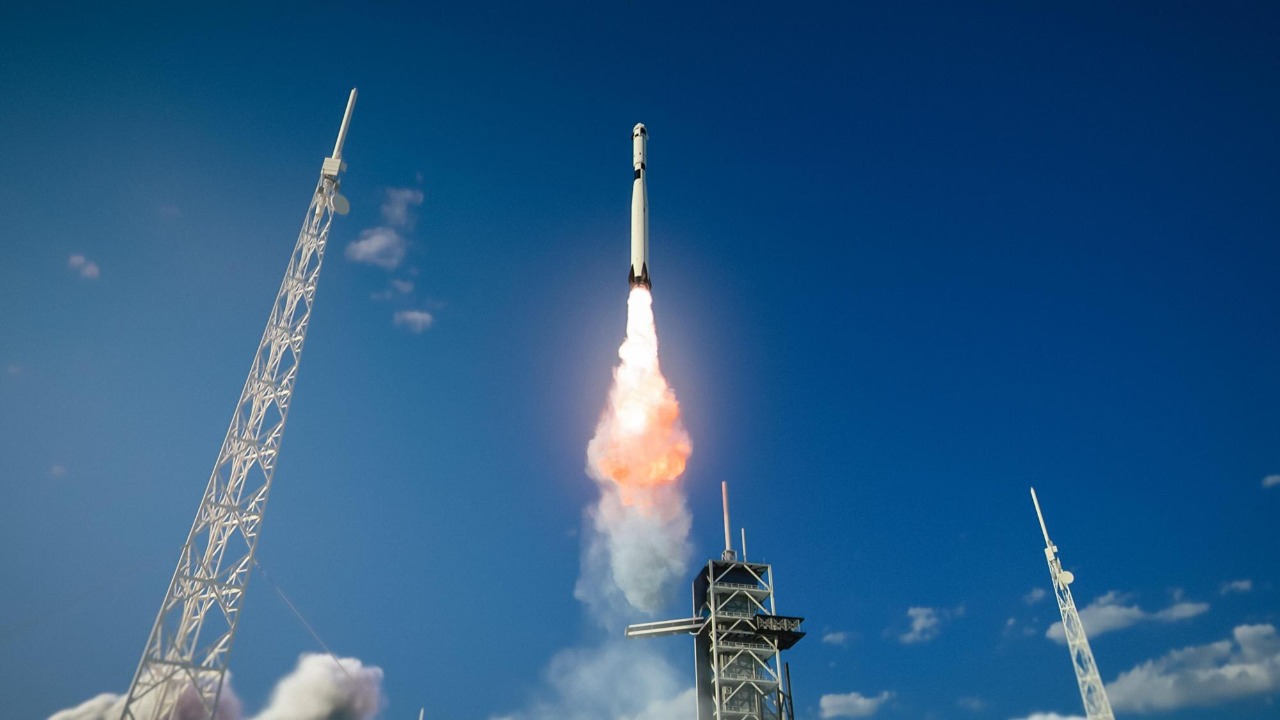

China has placed a new meteorological satellite into orbit that is designed to sharpen early warnings for extreme weather and hazardous space conditions, reinforcing the country’s fast‑expanding climate monitoring network. The spacecraft, part of the Fengyun series, is built to capture rapid, high‑resolution views of storms, clouds and solar activity, giving forecasters more time and better data to protect lives, infrastructure and critical services.
By extending coverage further over the Pacific and upgrading the quality and speed of environmental observations, the launch signals how seriously Beijing is treating the rising risks from typhoons, heat waves, torrential rain and geomagnetic disturbances. I see this mission as both a technical milestone and a strategic statement about how China intends to manage climate volatility at home while competing in the global market for weather and disaster‑risk information.
What China’s new launch actually put into orbit
China’s latest mission lifted off from the XICHANG Satellite Launch Center in the country’s southwest, adding a new member to its long‑running Fengyun family of weather spacecraft. Officials described the payload as a next‑generation geostationary meteorological platform that will sit high above the equator and continuously scan a wide swath of the Eastern Hemisphere, building on earlier Fengyun models that already feed data into global forecasting systems. The launch from XICHANG was presented as a major upgrade to China’s meteorological observation capabilities, with the new satellite expected to deliver more detailed imagery and faster data relay than its predecessors.
From a technical standpoint, the satellite is designed to integrate multiple instruments for cloud imaging, atmospheric sounding and space environment monitoring in a single, stabilized platform. Chinese authorities framed the mission as a way to boost both routine weather services and emergency response, highlighting that the spacecraft will support disaster prevention, agriculture and transportation planning as well as climate research. In official accounts, the launch was described as an update to China’s meteorological observation capabilities, underscoring its role in a broader push to modernize environmental monitoring.
Fengyun-4C and the focus on extreme weather
The new spacecraft is part of the Fengyun‑4 series, and reporting identifies it specifically as the Fengyun‑4C satellite, a model tailored to track severe storms and volatile atmospheric patterns. By operating in geostationary orbit, Fengyun‑4C can stare continuously at the same region, which is crucial for catching the rapid intensification of typhoons, explosive thunderstorm growth and the evolution of heavy rainfall systems that can trigger flash floods. The satellite’s imaging and sounding instruments are configured to detect subtle changes in cloud top temperatures, moisture profiles and storm structure that often precede dangerous weather.
Chinese space officials have been explicit that Fengyun‑4C is meant to strengthen early detection of extreme events and improve monitoring of the space environment around Earth. The mission has been described as a way for China to launch its Fengyun satellite to improve extreme weather detection, with a particular emphasis on integrating space weather data into the same operational stream as traditional meteorology. In practice, that means the satellite will not only watch for typhoons and torrential rain, but also for solar eruptions and charged particle events that can disrupt communications, navigation and power grids.
How the satellite changes China’s warning lead times
The core promise of the new mission is more time and more precision for forecasters who must decide when to issue alerts and how strongly to word them. According to Chinese engineers, the satellite can perform routine observations every hour and then switch to intensified scans every 15 minutes over areas of interest, a cadence that allows meteorologists to follow storm cells as they form, merge and decay. That high‑frequency coverage is particularly valuable for nowcasting, the short‑term prediction window of a few hours when decisions about evacuations, flight rerouting or dam management often hinge on the latest radar and satellite imagery.
The spacecraft’s design also emphasizes stability and sensitivity, which should reduce noise in the data and make it easier to detect early signatures of dangerous phenomena. Reporting notes that the satellite offers high stability observation and can monitor space weather events such as solar proton events, giving operators a better handle on when to warn airlines, satellite operators and grid managers about heightened risk. One account highlights that it offers high stability observation and can track solar proton events, a capability that directly feeds into early warnings for both atmospheric and space‑based hazards.
Extending China’s reach over the Pacific
Orbit placement is as strategic as the satellite’s instruments, and Chinese planners have chosen a slot that significantly widens the country’s view over the Pacific. The new Fengyun‑4 series satellite is expected to be positioned at 133 degrees east longitude, a location that allows it to monitor weather systems forming far out over the ocean before they approach East Asia. By anchoring the spacecraft at 133 degrees east longitude, China is effectively extending its monitoring range into the central Pacific, where many of the typhoons that eventually strike its coastlines are born.
This expanded field of view has practical implications for both domestic and regional forecasting. Earlier detection of tropical disturbances and their intensification paths can give coastal provinces, shipping routes and neighboring countries more time to prepare. It also positions China as a more significant provider of satellite data for Pacific island states and other partners that rely on external sources for high‑quality weather imagery. In that sense, the orbital slot is not just a technical choice but a diplomatic one, signaling Beijing’s intent to be a key player in the environmental information infrastructure of the wider Asia‑Pacific.
Inside the upgraded observation system
Beyond its orbit, the satellite’s architecture reflects a broader modernization of China’s meteorological technology stack. Engineers have emphasized improvements in imaging resolution, spectral coverage and data transmission efficiency, all of which feed into more sophisticated numerical weather prediction models. Official descriptions of the program, framed under the banner of Xi’s Time and China Focus, highlight how the new platform enhances the range of observable parameters, from cloud microphysics to atmospheric temperature and humidity profiles, while also speeding up the relay of that information to ground stations.
These upgrades are not happening in isolation. They are part of a coordinated effort to integrate space‑based sensors with ground‑based radar, automatic weather stations and ocean buoys into a unified data ecosystem. The goal is to shorten the time between observation, model assimilation and forecast dissemination, which is where gains in early warning actually materialize for end users. Chinese reporting on China Focus and Xi’s Time stresses that the satellite’s enhanced parameters and data transmission efficiency are central to this integration, effectively turning the spacecraft into a high‑throughput node in a much larger environmental observation network.
From Sichuan Province to global data streams
The launch itself took place from southwestern Sichuan Province, underscoring how inland regions have become hubs for China’s space ambitions. The mission profile involved sending the satellite into a transfer orbit before maneuvering it into its final geostationary slot, a standard but technically demanding sequence that reflects the maturity of China’s launch and control infrastructure. Reports from ISTANBUL noted that China carried out the mission on a Saturday, describing it as the deployment of a new meteorological satellite from Sichuan Province and identifying the spacecraft as part of The Fengyu series, a transliteration that points back to the Fengyun program.
Once in orbit, the satellite’s data will not be confined to domestic use. China already shares some Fengyun observations with international partners through mechanisms such as the World Meteorological Organization’s data exchange frameworks, and the new platform is expected to feed into those global streams as well. The description of how China launched a new meteorological satellite from Sichuan Province also highlights its role in climate and ecological‑environment observation, suggesting that its products will be relevant for international climate assessments and regional environmental monitoring initiatives.
Designing for users on the ground
For all the orbital complexity, the satellite’s success will ultimately be judged by how well it serves people on the ground, from national meteorological agencies to farmers and city planners. Chinese designers have repeatedly stressed that the new Fengyun‑4 series spacecraft is meant to deliver more accessible and actionable information, not just prettier images. Lu Feng, the chief designer of the Fengyun 4 series satellites’ optical ground system, has been quoted explaining that once operational, the new satellite will provide more accurate early warnings for all users, a phrase that captures the program’s ambition to democratize high‑end weather intelligence across sectors and regions.
That user focus is reflected in the way ground systems are being upgraded alongside the satellite. Optical receiving stations, processing centers and distribution platforms are being tuned to handle higher data volumes and to push tailored products to different audiences, whether that is a provincial emergency management bureau or a smartphone app used by commuters. The emphasis on serving “all users” is not just rhetorical; it is backed by investments in the optical ground system that Lu Feng, chief designer of the Fengyun 4 series satellites’ optical ground system, has linked directly to the satellite’s ability to translate raw observations into timely, localized alerts.
Why China is betting big on space-based climate security
Behind the technical details lies a clear strategic calculation: China is betting that better space‑based observation is essential to managing the economic and social risks of a warming, more volatile climate. The country has endured deadly floods, record heat and powerful typhoons in recent years, events that have disrupted factories, transport corridors and power supplies. By investing in satellites like Fengyun‑4C, Beijing is trying to move from reactive disaster response to proactive risk management, where high‑resolution, rapid‑refresh data can inform everything from reservoir operations to urban drainage design and crop insurance pricing.
There is also a geopolitical dimension to this bet. As more countries seek reliable climate and weather services, those that control advanced observation systems gain influence and soft power. China’s decision to frame the new satellite as part of a broader effort to strengthen early extreme weather detection and space weather monitoring signals that it wants to be seen as a provider of global public goods in this domain. One detailed account of how China launches a satellite to aid in early extreme weather detection makes clear that the mission is not just about national resilience, but also about positioning the country within the international ecosystem of space‑based environmental observation systems.
What comes next for China’s weather satellite fleet
With the new Fengyun‑4 series satellite now on orbit, attention is already turning to how it will be integrated with existing platforms and what future upgrades might look like. China has steadily built a layered constellation that includes both geostationary and polar‑orbiting meteorological satellites, and the latest launch fits into a roadmap that envisions even higher resolution, more spectral channels and smarter onboard processing in the years ahead. The experience gained from operating Fengyun‑4C will likely inform the design of follow‑on models, particularly in terms of instrument calibration, data compression and real‑time event detection algorithms.
In the near term, the priority will be commissioning the satellite, validating its instruments and folding its data into operational forecasts without disrupting existing services. That process will involve close coordination between satellite engineers, meteorologists and end‑user communities, as well as continued refinement of ground‑based systems to handle the increased data flow. As I see it, the launch marks a significant step in China’s long‑term effort to build a comprehensive, space‑enabled climate security architecture, one that treats extreme weather alerts not as isolated warnings but as part of a continuous, data‑driven shield around society and the economy.
More from MorningOverview