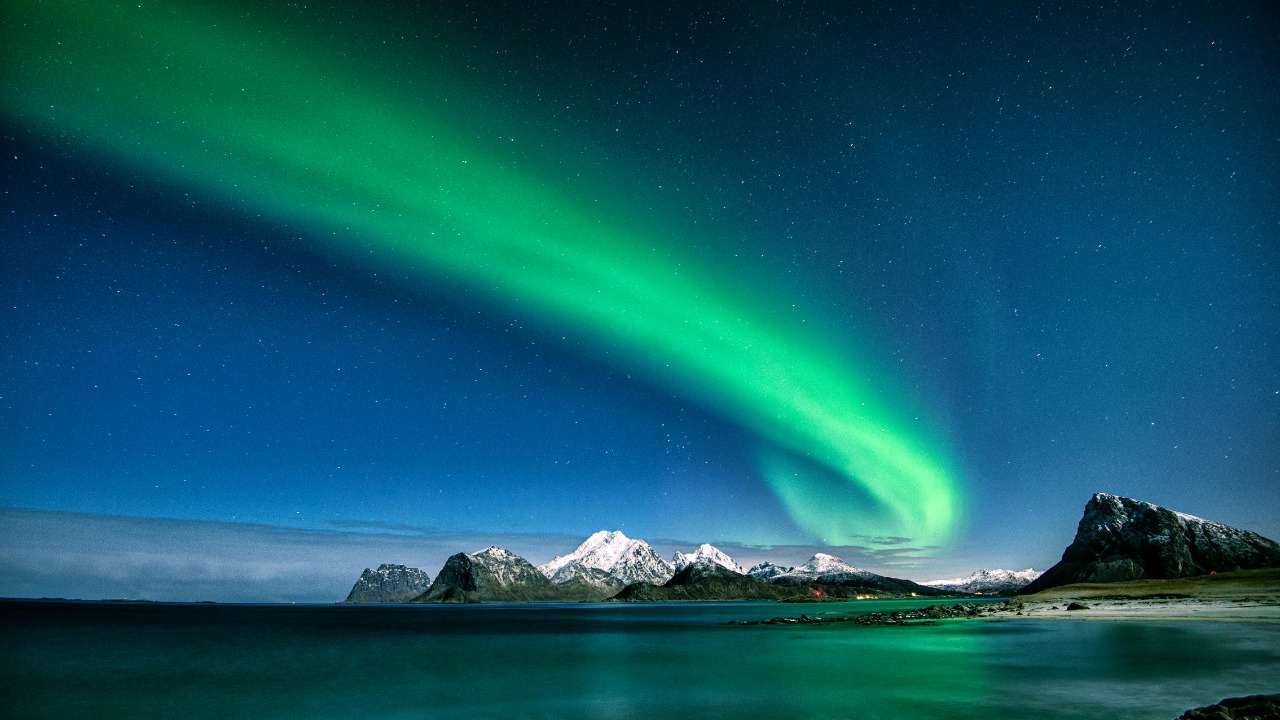

Strong solar activity is setting the stage for a rare spectacle in American skies, with forecasters warning that auroras could spill far beyond their usual Arctic haunts and into the northern United States. A severe geomagnetic storm, driven by an intense burst of energy from the sun, is poised to push shimmering curtains of green and red light over regions that almost never see them.
Instead of traveling to Alaska or Scandinavia, people from the Great Lakes to the northern Plains may only need to step outside and look up. The same solar eruption that is energizing this display is also drawing close scrutiny from scientists who track its effects on technology, navigation and power grids.
How a powerful solar storm set up this rare aurora event
The current aurora forecast traces back to a major solar eruption that hurled a cloud of charged particles directly toward Earth. Earlier this week, an X1.9-class solar flare on Jan. 18 was followed by what scientists describe as a “full halo” coronal mass ejection, or CME, meaning the blast was aimed squarely at the planet. As that cloud slams into Earth’s magnetic field, it distorts and energizes the field lines, funneling particles toward the poles where they collide with atoms high in the atmosphere and release light.
Space weather monitors say this is part of a broader upswing in solar activity as the sun approaches the peak of its roughly 11 year cycle. One analysis describes the current disturbance as the strongest solar radiation storm in roughly two decades, with experts noting that the further north you are, the better your chances to see the aurora borealis, which can appear in green, pink and red hues during a severe event Monday. Another report notes that the same eruption is already sparking auroras in “unexpected places,” including areas with some light pollution that would normally wash out the sky.
How far south the lights could reach in the United States
Forecasts suggest this storm could push the auroral oval deep into the continental United States, lighting up skies far beyond the usual northern tier. One detailed outlook says the aurora could be visible from New York to Washington State and as far south as Alab, a remarkable reach that would put parts of the Mid Atlantic and interior South under the glow if clouds cooperate United States. Another forecast frames it even more starkly, saying Northern lights are possible “as far south as Alabama,” a reminder that this is not a routine display but the product of an unusually energized sun Alabama.
Several outlooks converge on a band of states stretching across the northern tier as the likeliest zone for vivid color. One analysis of the view line for Monday notes that the aurora could be visible from U.S. states along the Canadian border down to the northeastern tip of Utah, part of a footprint that covers up to 28 states when conditions are ideal Where Could The. Another severe storm alert says The Northern Lights may be seen from as many as 24 U.S. states down to mid latitudes such as Oregon, Illinois and Pennsylvania, underscoring how far the auroral oval could sag toward the central United States if the storm holds its strength Oregon, Illinois and.
States on aurora watch and what forecasters are saying
For residents across the northern tier, the message from forecasters is simple: be ready. One briefing notes that Skywatchers across the United States will have their chances to view the northern lights this week as a geomagnetic storm reaches into the Plains and Great Lakes region, with the display already spotted across the U.S. during earlier peaks of activity Northern. Another forecast aimed at The Brief audience stresses that Skywatchers in the United States should pay attention to updated maps as the storm evolves, since small shifts in the magnetic field can move the viewing line by hundreds of miles in a matter of hours Skywatchers.
Specific state lists vary slightly by model, but one compilation of photos and forecasts says parts of approximately 27 states are at least partially under the auroral oval, including northern tier locations such as Minnesota, Montana, North Dakota, Wyoming, Washington and Wisconsin, along with other regions closer to the Canadian border Which. Another alert focused on a severe storm notes that Northern Lights May Be Visible in 24 U.S. States Tonight as a Severe Solar Storm Hits Earth, a phrasing that captures both the breadth of the potential viewing area and the intensity of the underlying space weather Northern Lights May.
Best time and conditions to see the aurora
Even with a powerful storm in play, catching the aurora still depends on timing and local weather. Space weather specialists advise that When skies are clear, the best time to look for the northern lights is typically from early evening through the overnight hours, with the most intense bursts often clustering around local midnight as the geomagnetic disturbance peaks on the night side of Earth When. Another forecast aimed at casual observers puts it more simply, urging people to Look up in the middle of winter and brave the cold, since even a brief clearing in the clouds can reveal a sudden burst of color rippling across the sky Look.
Local cloud cover and light pollution can still make or break the experience. A regional forecast for Missouri and Illinois notes that it is possible the Aurora may be visible over much of the United States Monday night, but not a guarantee, especially in cities where skyglow from streetlights can drown out faint arcs near the horizon Aurora. Another advisory aimed at a national audience stresses that Always check local weather forecasts and, crucially, space weather predictions, pointing readers to Resources like NOAA and its Space Weather Prediction tools that track real time geomagnetic storm alerts and solar activity Always.
Why this storm matters beyond the spectacle
Behind the social media feeds full of glowing skies, scientists are treating this storm as a serious space weather event with implications for technology and infrastructure. Analysts describe it as part of a pattern of heightened solar activity that can disturb satellite operations, radio communications and even power grids when a CME interacts with Earth’s magnetic field. One detailed breakdown notes that the CME, a cloud of charged particles launched on Jan. 18, 2026, is interacting with the planet’s magnetic field in ways that both fuel the aurora and raise the risk of minor disruptions to systems that depend on precise signals CME. Another overview of the strongest solar radiation storm in years underscores that the same conditions that delight photographers can also trigger “possible tech issues,” a reminder that auroras are the visible face of a much larger geophysical disturbance strongest solar storm.
For researchers and operators of critical systems, events like this are also a chance to refine models and response plans. One analysis aimed at the geospatial community argues that Staying informed is the first step, highlighting how Organizations such as NOAA, its Space Weather Prediction Center and the European Space Agency’s Spac environment programs coordinate alerts, data collection and mitigation strategies around heightened solar activity Staying. For the rest of us, the same infrastructure that guards satellites and power lines also delivers the maps and alerts that tell us when to step outside and watch the sky.
More from Morning Overview