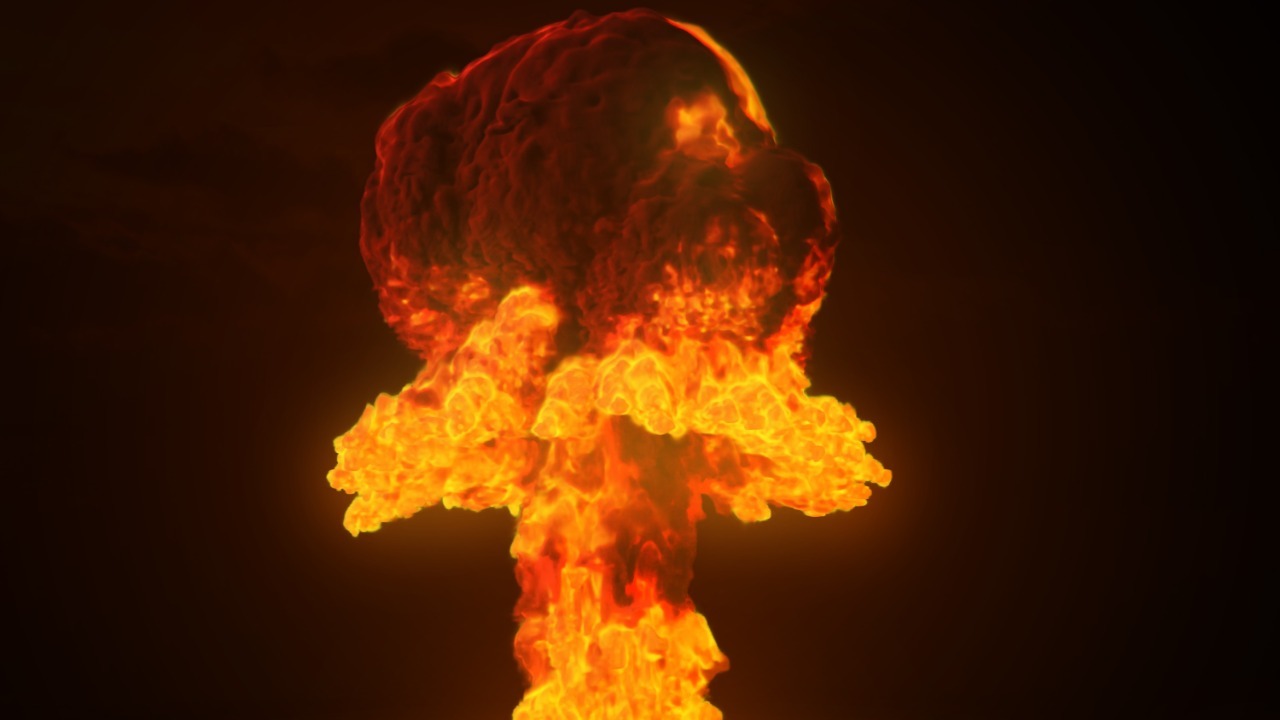

For decades, the idea of saving Earth from an incoming asteroid with nuclear weapons lived mostly in popcorn cinema, a fantasy of oil drillers and last‑minute heroics. Now a new generation of physics models and lab experiments is forcing planetary defense experts to take that scenario seriously, not as spectacle but as a last‑ditch engineering option. The same devices built to flatten cities might, in a carefully controlled scenario, nudge a mountain of rock just enough to miss our world.
The shift is not about embracing apocalypse, it is about confronting it with math. Researchers are building detailed simulations, firing nuclear‑intensity X‑rays at asteroid stand‑ins, and even sketching out real mission concepts for dangerous objects in our neighborhood. The result is a strange twist worthy of Armageddon’s tagline: the science is finally catching up to the movie, just not in the way Hollywood imagined.
From Armageddon myth to nuclear math
When people picture nuclear planetary defense, they still tend to see Bruce Willis on a drilling rig. The film Armageddon turned asteroid deflection into a blue‑collar space Western, but scientists have spent years pointing out how little of it matches reality. Analyses of the movie’s plot and physics have highlighted everything from impossible drilling timelines to the wildly unsafe idea of splitting a large asteroid in half, a plan that would likely shower Earth with debris rather than save it, according to detailed breakdowns of its scientific inaccuracies.
The new research wave flips that script. Instead of sending crews to bury bombs inside a rock, physicists are asking how radiation from a standoff nuclear detonation would interact with an asteroid’s surface. A recent paper in Nature Physics models how intense X‑rays from a nuclear device could vaporize material on one side of an asteroid, turning that side into a kind of thruster. The goal is not to blow the object apart but to change its velocity by a tiny fraction, enough to make it miss Earth by a comfortable margin years down the line.
Inside the Z machine: turning X‑rays into a rocket push
The most striking evidence that this approach might work comes from a series of experiments that use nuclear‑like X‑ray bursts instead of actual warheads. At a facility known as the Z machine, researchers suspended small asteroid analogs in a vacuum chamber and blasted them with pulses of radiation. The X‑ray pulses generated vapor plumes from each target and accelerated each one to about 155 m, 250 per hour, a speed change that, scaled up and applied years before impact, could be the difference between a direct hit and a harmless flyby.
Those tests are part of a broader campaign at Sandia National Laboratories to understand how nuclear‑intensity radiation couples energy into rock. In free‑floating trials at the Z machine, X‑ray “scissors” momentarily bathe targets in a series of nuclear‑intensity explosions, letting scientists measure how much momentum each burst imparts and how the material fractures or holds together. The Free‑floating experiments are designed to mimic a real standoff detonation in space, where there is no air to carry a blast wave and only radiation and vaporized rock do the work.
Simulations, shockwaves and the risk of shrapnel
Lab shots are only part of the story. To scale those results up to kilometer‑wide asteroids, researchers lean heavily on high‑resolution simulation. Previous models of nuclear deflection have tracked how a shockwave from a bomb would travel through an asteroid’s interior and how much of that energy would translate into a change in trajectory. According to one summary of this work, Previous simulations have shown that the shockwave made by a nuclear bomb could provide enough force to successfully deflect an oncoming asteroid, but they also highlight a serious concern: breaking the target into dangerous fragments that still hurtle toward Earth.
That fragmentation risk is one reason many experts favor standoff detonations that rely on X‑rays rather than direct contact blasts. In the new X‑ray studies, the focus is on vaporizing only a thin surface layer, turning it into a jet that nudges the asteroid without shattering it. A recent overview of planetary defense notes that this kind of nuclear option would be reserved for the largest or most urgent threats, with larger asteroids potentially requiring such extreme measures when slower, non‑nuclear techniques are no longer viable.
From theory to targets: NASA’s evolving playbook
Planetary defense is no longer a purely academic exercise. NASA is responsible for leading the detection and mitigation of hazardous near‑Earth objects, and its strategy now explicitly includes nuclear options as a contingency. A recent paper by scientists, including NASA researchers, suggests using a nuclear explosion to alter the trajectory of a threatening asteroid, calculating how different “heights of burst” and device yields would translate into real‑world deflection.
That thinking is already being applied to specific objects. One scenario that has drawn attention involves asteroid 2024 YR4, a so‑called City Killer that could threaten the Moon and the infrastructure around it. Analysts have described NASA’s drastic plan to use Nuclear devices against this City Killer Asteroid if conventional kinetic impactors cannot provide enough push to protect satellites and human spaceflight in lunar orbit.
The Moon as test case and the ethics of last‑resort nukes
The Moon is emerging as a kind of proving ground for these ideas. Astronomers studying 2024 YR4 have floated several mitigation options, and Another proposed option includes detonating 2024 YR4 using “nuclear explosive devices” if its path threatens a direct lunar strike. Researchers note that this nuclear scenario is being considered seriously, with some analyses suggesting it could reduce the impact probability by a significant per cent if executed with enough warning.
Other teams have gone further, calculating how a carefully chosen “height of burst” above the lunar surface could maximize deflection while minimizing debris. One analysis notes that such a mission is Known as a height‑of‑burst optimization problem. But the same work cautions that we would still need reconnaissance to tailor the explosion, and that we might not find out whether 2024 YR4 is truly on a collision course until years closer to the potential impact, a delay that would compress decision‑making into an uncomfortable window.
More from Morning Overview