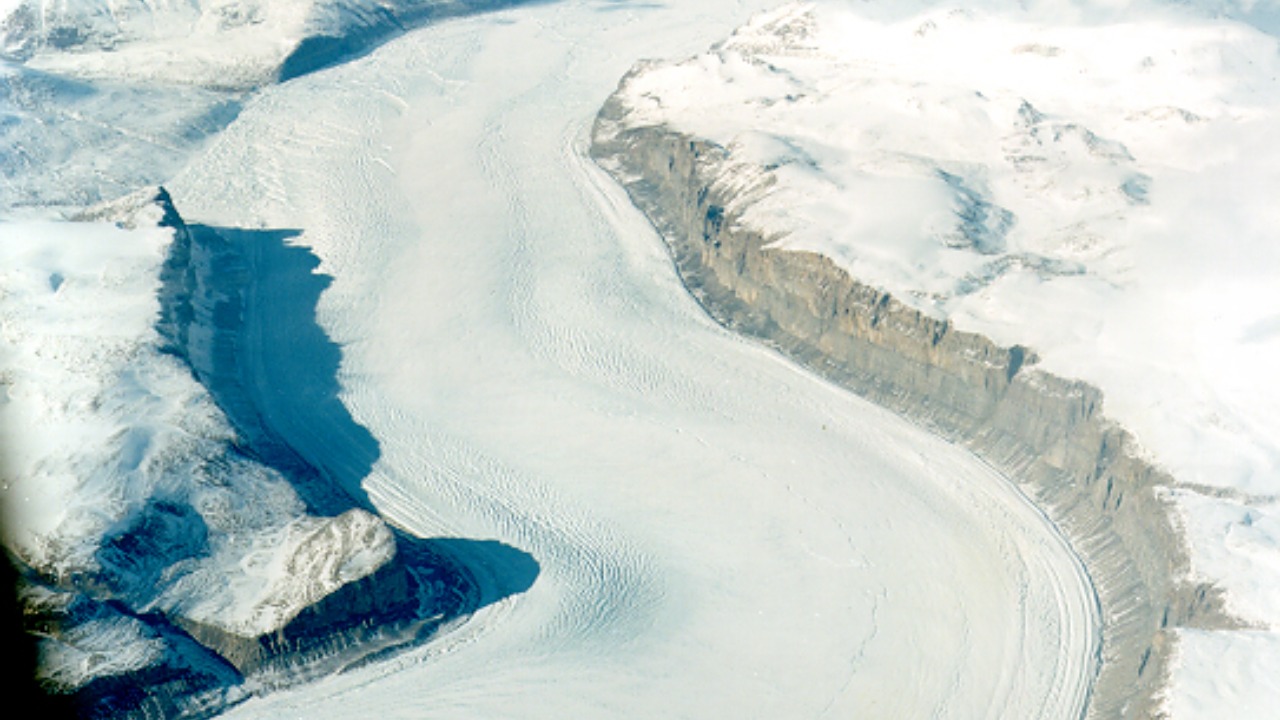

On the surface of Greenland’s vast ice sheet, the people who know it best say the place no longer feels stable. What once seemed like a frozen constant in Earth’s climate system is now shifting so quickly that many researchers describe their working conditions as frightening rather than merely challenging. I see that fear reflected in the data as much as in their words, from strange melt events to discoveries that suggest the ice has vanished before under levels of carbon dioxide lower than today’s.
The stakes reach far beyond the Arctic. The future of coastal cities, global weather patterns, and even long-buried microbes depends on what happens atop and beneath this ice. When scientists in Greenland say conditions feel terrifying, they are not talking about personal discomfort in the cold, but about watching a planetary safety net unravel in real time.
Greenland’s ice is losing its grip on stability
Greenland’s ice sheet is so large that it covers most of the island and rises into a high, white plateau visible from space. For decades it was treated as a slow-moving giant, but the latest field campaigns show a system far more fragile than textbooks suggested. Teams working on projects like GreenDrill have bored through the ice to bedrock, using the rocks beneath to reconstruct past climates and test how close the ice sheet might be to a tipping point, and their findings point to a history of collapse that is uncomfortably relevant to the present. Those cores, combined with satellite records that track the changing mass of the Greenland Ice Sheet, reveal that the ice is already contributing significantly to global sea level rise.
In one widely discussed expedition, researchers described huddling Inside a tent fastened to the surface of the ice, monitoring a drilling rig as it chewed downward through layers that had survived thousands of years of climate swings. The project, part of the GreenDrill effort in Greenland, underscored how thin the margin for error has become. Another member of the same research network, climate geochemist Schaefer at the Lamont Doherty Earth Observatory and the lead investigator for GreenDrill, put it bluntly, saying the timing of what they are seeing “feels completely wrong,” a scientist’s way of admitting that the system is changing faster than their models had prepared them for.
Alarming discoveries under the ice and in the climate record
New drilling results are rewriting what I thought I knew about Greenland’s past. A research team working at Prudhoe Dome in northern Greenland drilled more than 1,600 feet through ice at Prudhoe Dome, a towering bulge of ice, and found evidence that the area had been ice free during a warm period in the distant past. That result dovetails with separate work showing that Scientists have unearthed proof Greenland’s entire ice sheet disappeared more recently than expected, leaving dry rocky tundra in northwest Greenland. Crucially, that earlier collapse appears to have happened at carbon dioxide levels lower than today’s, a warning that the current climate may already be in the danger zone for large scale ice loss.
Those geological clues are backed by modern measurements that show the ice sheet is shedding mass at an accelerating pace. The new research suggests that the Greenland Ice Sheet may lose ice more rapidly in the near future than previously thought, according to work highlighted in a Science and Technology briefing. That conclusion aligns with satellite based assessments that track how much mass the ice sheet is losing each year and how much that loss is raising global seas. When I connect these dots, the picture that emerges is not of a distant, theoretical risk, but of a system already sliding toward a new state.
On the surface, strange new phenomena and “zombie” ice
For scientists working on the surface, the transformation is visible in the color and texture of the ice itself. In recent summers, dark patches have spread across areas that were once bright white, as meltwater, dust, and algae combine to lower the ice’s reflectivity and speed up melting. Field teams have documented how every summer the ice, which is usually bright white, turns much darker, a pattern captured in video reports about how something strange is happening in Greenland. Those darker surfaces absorb more sunlight, creating a feedback loop that makes the ice sheet more vulnerable to warm spells and rain events that would once have been rare at high elevations.
Researchers are also grappling with the concept of “Zombie” ice, a term used for parts of the ice sheet that are still attached but are effectively doomed to melt because they are no longer being replenished by snowfall. A detailed explainer described how this zombie ice in Aug signals locked in sea level rise, even if emissions were to fall sharply. When I talk to glaciologists, they describe this as one of the most unsettling aspects of their work in Greenland: knowing that some of the damage is already baked into the system, and that the ice they are walking on is, in a sense, already committed to the ocean.
A rapidly warming Arctic that feels unfamiliar even to experts
The changes in Greenland are part of a broader pattern across the Arctic, where warming is proceeding at roughly four times the global average. Long term assessments like the annual Arctic Report Card have documented how sea ice, snow cover, and permafrost are all shifting in ways that would have been hard to imagine a generation ago. One recent installment described how the region now looks dramatically different than it did 20 years ago, noting that it is the continuation of a long term pattern and that the Arctic has shifted into a new state of being. That new state includes more rain on snow, more open water in autumn, and more frequent episodes of extreme warmth.
Some of those extremes have stunned even veteran researchers. Earlier this month, temperatures near the North Pole spiked more than 36°F above average, briefly pushing conditions above the melting point in the heart of winter. Scientists who work in Svalbard, Norway, in the high Arctic have described how the signs of rapid climate change are unmistakable, as documented in a detailed Transcript of their observations. When I hear glaciologists and sea ice experts say that the Arctic they study today barely resembles the one they first encountered in their careers, it becomes clear why the word “terrifying” is no longer considered hyperbole.
Permafrost, “zombie viruses,” and the risks beneath the thaw
The ice sheet is only one part of the Arctic system that is destabilizing. Vast areas of permafrost, the frozen ground that underlies much of Siberia and northern North America, are starting to thaw, releasing long stored greenhouse gases. Scientists have long described this permafrost as a “Carbon” freezer, because it holds nearly twice as much carbon as is currently in the atmosphere, and field measurements show that emissions from thawing ground have increased several fold from 1984 to 2013, according to detailed work on Feb permafrost emissions. That extra carbon dioxide and methane feeds back into the climate system, amplifying the very warming that triggered the thaw.
Thawing ground also raises more exotic risks. In Siberia, researchers have warned that ancient microbes, sometimes dubbed Arctic zombie viruses, could be revived as long frozen soils and sediments warm. One report on Arctic zombie viruses in Siberia noted that scientists in the Health community are concerned these pathogens could, in a worst case scenario, spark a terrifying new pandemic. While that outcome is not guaranteed, the fact that it is even on the table illustrates how the Arctic’s thaw is exposing layers of risk that extend far beyond sea level rise.
More from Morning Overview