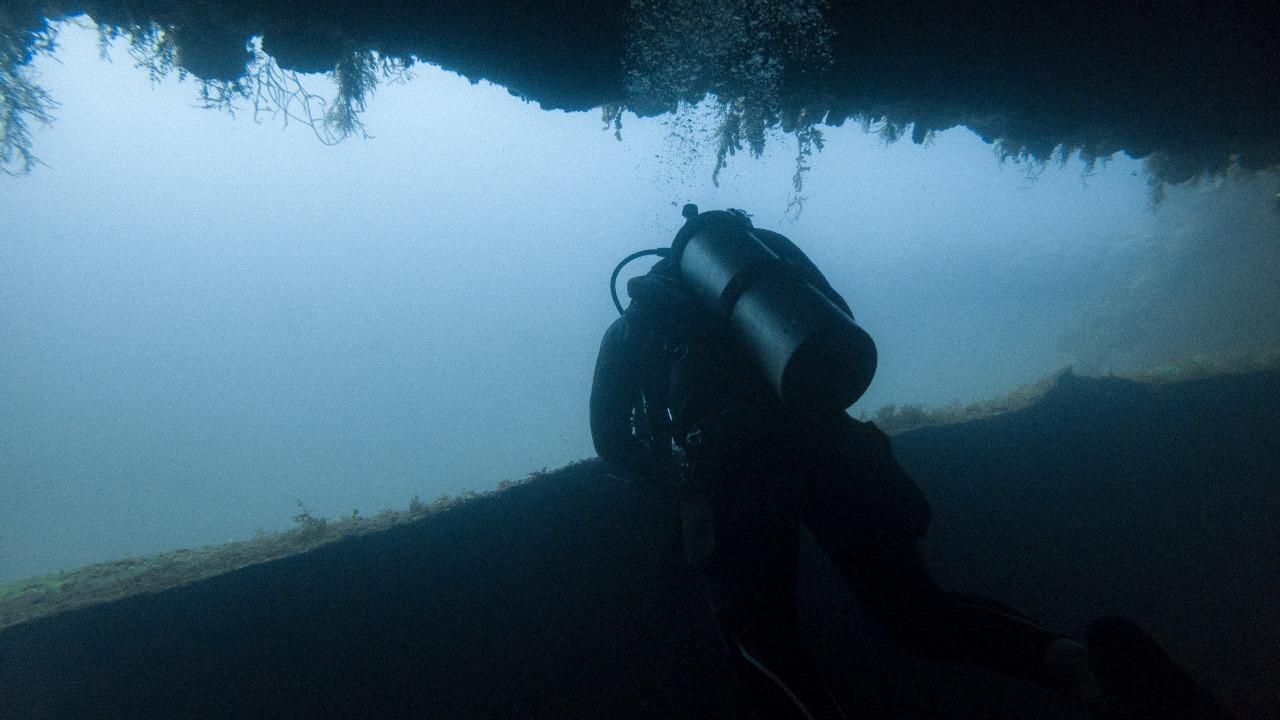

Far below the waves off western France, divers have mapped a vast Stone Age wall that has survived since around 5000 BC, a 7,000-year-old structure that turns a stretch of seabed into a frozen prehistoric landscape. Rather than being the single oldest underwater wall on Earth, it now sits within a growing family of submerged “megastructures” that are forcing archaeologists to redraw maps of early engineering. I see this French discovery as a crucial Atlantic counterpart to an even older barrier in the Baltic, together revealing how hunter gatherers reshaped coasts long before the sea reclaimed them.
The newly documented French wall is remarkable not only for its age but for its ambition, stretching hundreds of feet across what was once dry land and hinting at a vanished community that understood tides, animal behavior, and stone construction with startling sophistication. Set alongside the Baltic’s Blinkerwall, which specialists identify as the World’s oldest submerged stone wall, it shows that complex infrastructure was not the sole preserve of later farmers but part of a broader Stone Age toolkit.
The 7,000-year-old Atlantic wall that rewrites France’s Stone Age coast
The structure off the far western tip of France first came into focus when Divers reported a long, low wall lying under about 9 meters of water, some 1.9 kilometers offshore, on a stretch of seabed that would have been coastal plain when sea levels were lower. Subsequent surveys describe a 7,000-Year-Old barrier roughly 400 feet long, built from aligned boulders that rise to about 7 feet tall on average and run parallel to the modern shoreline, a layout that immediately suggested deliberate planning rather than random geology. Marine specialists now see it as part of a broader Stone Age landscape that once extended across what is today open water off France.
French teams have used sonar, diver transects, and Light Detection and Ranging to trace the wall’s footprint and identify clusters of smaller stones that may have formed pens or guiding arms for animals, a pattern that echoes other prehistoric hunting systems. Reports describe how Marine archaeologists linked the main barrier to nearby features that appear to be the remains of a sunken stone age city, with some accounts suggesting the complex may have inspired later stories of Atlantis, a claim that has helped propel the site into popular culture even as researchers stress the need for cautious interpretation. For now, the consensus is that this Huge undersea wall, discovered off BREST, FRANCE, represents one of the most extensive 7,000-year-old coastal constructions yet found in the Atlantic.
How hunter gatherers turned rising seas into underwater archives
Archaeologists now argue that the French wall was almost certainly built by hunter gatherers who understood that stone alignments could steer animals into traps, much as fences and corrals do today. In interviews, Experts have described the 7,000-year-old structure as something that “Must have left a lasting impression” on people who watched fish or perhaps larger game funnel along its length as the tide retreated, a reminder that sophisticated landscape engineering did not begin with agriculture. The idea that such communities could organize labor, source heavy stones, and maintain a complex installation over generations challenges older stereotypes of small, mobile bands leaving only scattered campsites.
Evidence from elsewhere in Europe strengthens that case. In the Baltic Sea, researchers led by Geersen and colleagues documented the Blinkerwall, a low stone line that runs for nearly a kilometer along an ancient lakeshore and was built by people who lived 10,000 to 11,000 years ago, making it, in their words, the World’s oldest submerged stone wall. Detailed analysis published in PNAS argues that this megastructure was used to corral reindeer into kill zones, a function supported by its position between former water and higher ground, and by the way it channels movement. A separate study in PNAS on an 11,000-year-old submerged stone wall off Germany, also interpreted as a reindeer drive, reinforces the view that such constructions were part of a wider northern European tradition of large scale hunting architecture.
From Blinkerwall to “Atlantis”: why submerged walls capture the imagination
When I compare the French wall with the Blinkerwall, what stands out is not competition over which is oldest but the shared logic behind them: both are long, carefully placed barriers that turn animal behavior and shoreline topography into a kind of technology. Video explainers on the Blinkerwall emphasize how its discovery has redefined assumptions about prehistoric human capabilities, showing that people who lacked metal tools could still coordinate projects on the scale of modern field boundaries. The French site, by contrast, has been framed as a Huge 7000-year-old undersea wall linked to a sunken stone age city and even to Atlantis, a narrative that may overshoot the evidence but reflects how powerfully submerged ruins tap into collective mythmaking.
More from Morning Overview