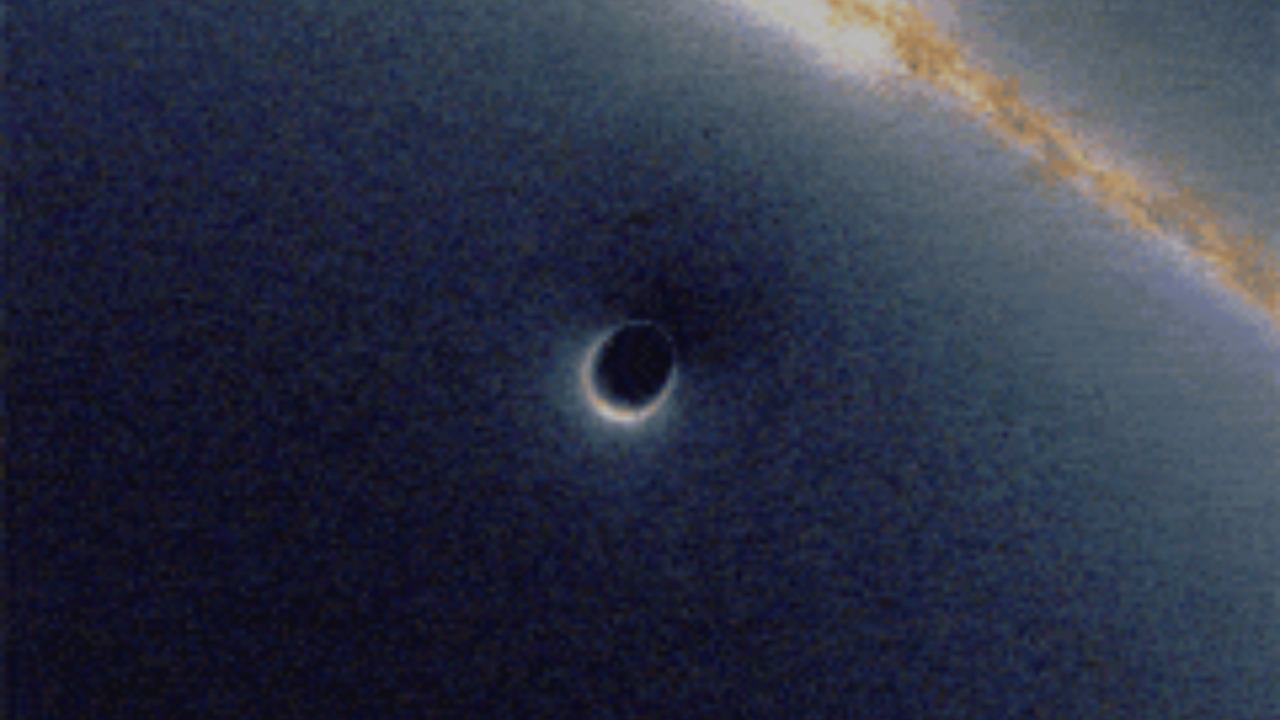

Black holes are usually framed as the ultimate dead ends of the universe, but a new mathematical proposal suggests they might instead be raw material for building shortcuts through spacetime. In this picture, the extreme geometry around two black holes is carefully sliced, rearranged and reattached so that a tunnel, a wormhole, links their horizons. The idea does not claim engineers are about to sculpt cosmic portals, but it does argue that the equations of general relativity leave more room for such structures than many physicists once assumed.
As a reporter, I see this model as part of a broader shift in how theorists think about black holes, information and quantum gravity. Rather than treating wormholes as pure science fiction, researchers are now using them as precise tools to probe how gravity and quantum mechanics fit together, and the new “cut and paste” approach pushes that trend to a provocative extreme.
From sci‑fi trope to solvable equation
For most readers, wormholes live in the same mental folder as warp drives and time machines, a narrative device rather than a serious scientific object. In the mathematics of general relativity, however, a wormhole is simply a particular way spacetime can be curved, a tunnel that connects two distant regions that might otherwise be separated by light‑years. The new model starts from that sober definition and asks a blunt question: if black holes already represent extreme warps in spacetime, can their geometries be rearranged so that two of them share a common throat instead of remaining isolated pits?
That question is not being posed in a vacuum. On Nov 4, 2025, a detailed theoretical construction was presented in which researchers explicitly asked what happens “if the black hole geometry changes” and what follows “when we join two of them together to form a wormhole,” building a full spacetime solution that tracks how the event horizon radius is pushed outward as the configuration is altered, a result laid out in a mathematical model. In parallel, a Nov 4, 2025 overview framed the same work as a bridge between abstract equations and long‑standing science fiction imagery, emphasizing how the Mathematician behind the construction used a carefully tuned energy density to keep the tunnel stable, a point highlighted in a summary of how the Katz team’s Model Brings Sci ideas about Wormholes Closer to Reality Could be made precise.
What “cut and paste” really means
The phrase “cut and paste” sounds almost playful, but in this context it refers to a rigorous operation on spacetime geometry. In the new proposal, I understand the mathematician as taking two idealized black hole solutions, slicing each along a chosen surface and then gluing the exposed boundaries together so that the resulting manifold is smooth and satisfies Einstein’s equations. The trick is to choose the cut surfaces and the intervening matter fields so that the stitched spacetime does not immediately collapse back into a single, more massive black hole.
Reporting on Nov 25, 2025 described how this construction yields a wormhole that, at least in the equations, links two black hole regions in a way that could in principle allow something to traverse from one side to the other, provided the energy conditions are carefully managed, a scenario laid out in detail in a feature explaining how a mathematician thinks black holes could be reconfigured. That same account stressed that the “cut and paste” language is shorthand for a highly constrained set of boundary conditions and continuity requirements, not a suggestion that anyone is literally carving up astrophysical objects with cosmic scissors.
Black holes as building blocks, not endpoints
One of the most striking shifts in this line of work is the way it reframes black holes from final destinations to modular components. In the traditional picture, once matter crosses an event horizon, its fate is sealed and the surrounding spacetime is essentially static apart from slow evaporation. The new model instead treats each black hole as a patch of curved geometry that can, in principle, be re‑embedded into a larger spacetime with a different global structure, so long as the local curvature and stress‑energy still satisfy the field equations.
That perspective dovetails with the Nov 4, 2025 Katz analysis, which explicitly tracked how the event horizon radius responds when the surrounding geometry is altered and showed that, under the right conditions, the radius is “pushed outward” rather than destroyed when two regions are joined into a wormhole, a behavior captured in the same black hole geometry calculations. The Nov 4, 2025 Katz School summary of the Mathematician’s work likewise emphasized that the Model Brings Sci ideas about Wormholes Closer to Reality Could only by carefully tracking how energy density and stability change as the black holes are treated as adjustable building blocks, a point that underscores how far this is from the old “cosmic trash compactor” view of black holes.
Why exotic energy still matters
Even the most elegant cut‑and‑paste construction runs into a familiar obstacle: the need for unusual forms of energy to keep a wormhole open. In standard general relativity, matter and energy tend to make spacetime curve inward, which is why gravity pulls objects together. A traversable wormhole, by contrast, requires spacetime to curve in a way that counteracts that collapse at the throat, which in turn demands negative or at least highly unconventional energy densities that violate the so‑called energy conditions built into many textbook theorems.
The Nov 4, 2025 Katz School account made that tension explicit, noting that the Mathematician’s Model Brings Sci wormholes closer to viability only by allowing the energy density and stability to change in ways that depart from ordinary astrophysical matter, a trade‑off spelled out in the Katz overview. The Nov 25, 2025 report on the cut‑and‑paste idea similarly stressed that the wormhole emerging from two black holes is only stable in the equations because the model allows for carefully tuned, nonstandard energy around the throat, a reminder that the mathematics is still several steps removed from any known astrophysical process.
Connecting to the black hole information paradox
Beyond the engineering fantasy, the deeper motivation for wormhole models is to probe how information behaves in extreme gravitational fields. The black hole information paradox asks whether quantum information that falls into a black hole is truly lost when the hole evaporates, a prospect that clashes with the basic rules of quantum mechanics. Wormholes offer a way to reframe that puzzle, by suggesting that what looks like information loss from one perspective might be information taking a hidden shortcut through spacetime.
Earlier work on Mar 9, 2022 argued that, while “there’s nothing in quantum mechanics that would allow” a simple reversal of black hole evaporation, introducing wormholes into the picture can change how information is counted, an idea explored in detail in a study of how wormholes could help resolve the paradox. The new cut‑and‑paste model slots into that broader effort by providing a concrete spacetime in which two black holes are not isolated sinks but parts of a connected geometry, which in turn gives theorists a new playground for testing whether information can be preserved globally even when it appears trapped locally.
Quantum chaos and the “caterpillar” wormhole
Another strand of recent work has focused on how chaotic quantum dynamics inside black holes might be encoded in the shape of a wormhole connecting them. In these models, the more chaotic the quantum system, the longer and more convoluted the wormhole becomes, a relationship that turns an abstract measure of randomness into a geometric length. The cut‑and‑paste proposal does not directly simulate that chaos, but it does assume that the internal structure of each black hole can be reshaped without losing track of the underlying quantum correlations.
On Nov 5, 2025, researchers described a “long, bumpy caterpillar‑like” wormhole that connects two black holes and showed that this structure reveals a direct mathematical link between quantum chaos and the size of the wormhole, with the more random the quantum behavior, the longer the tunnel becomes, a result tied to the ER=EPR conjecture and detailed in a report on a bumpy caterpillar wormhole. By treating black holes as nodes that can be joined into such extended structures, the cut‑and‑paste model implicitly leans on the same intuition, that the geometry of the wormhole is a kind of map of the quantum entanglement between the two sides.
What a wormhole would actually look like
Even if the mathematics checks out, the visual picture many of us carry around for wormholes is badly outdated. Popular illustrations tend to show a flat sheet of spacetime bent into a funnel, with a neat circular opening that looks like a drain in a sink. In a realistic three‑dimensional universe, however, the entrance to a wormhole would not be a flat ring but a spherical surface, and to a distant observer it might be almost indistinguishable from a black hole, at least in silhouette.
Work published on Jul 31, 2025 laid out these Key Takeaways on Wormholes, noting that in some ways a wormhole might look like a black hole and that the wormhole would look like a sphere rather than a literal hole, with gravitational lensing around it that could mimic a familiar shadow. That same analysis emphasized that, in certain models, a specific configuration of mass and curvature would result in a wormhole instead of a standard black hole, a point that dovetails with the cut‑and‑paste idea that two black holes could be reconfigured into a single, spherical portal whose appearance would challenge even the most advanced telescopes.
How this differs from earlier wormhole fantasies
It is tempting to lump every wormhole story into the same category, but the new model differs from earlier fantasies in several important ways. Classic science fiction often imagines wormholes as arbitrary tunnels that can be opened anywhere, at any time, with the right gadget. The cut‑and‑paste construction, by contrast, is tightly constrained by the existing geometry of black holes and by the requirement that the resulting spacetime satisfy Einstein’s equations everywhere, which sharply limits where and how such a tunnel could exist even on paper.
Earlier theoretical work, including the Mar 9, 2022 analysis of wormholes and the information paradox, typically treated the wormhole as a pre‑existing feature of spacetime and then asked what quantum fields would do in that background, as in the information paradox study. The Nov 4, 2025 Katz work and the Nov 25, 2025 cut‑and‑paste report instead start from realistic black hole solutions and build the wormhole out of them, which makes the scenario more grounded in known astrophysical objects even as it still relies on exotic energy to keep the tunnel open.
Why the timelines and names matter
In a field as speculative as wormhole physics, it is easy to lose track of who did what and when, yet the chronology and the specific players shape how seriously the work is taken. The clustering of key results around Nov 4, 2025, Nov 5, 2025 and Nov 25, 2025 is not an accident, it reflects a moment when several groups converged on the idea that wormholes are not just curiosities but practical tools for thinking about black holes, quantum chaos and information. The repeated appearance of names like Katz, the Mathematician behind the Model Brings Sci approach, and the references to Wormholes Closer to Reality Could in institutional summaries signal that major research centers are willing to put their reputations behind these calculations.
At the same time, the inclusion of specific labels such as Nov and Jul in the reporting, and the way entities like Usin and Here are woven into the Nov 4, 2025 and Nov 25, 2025 accounts, underscores that these are not anonymous speculations but traceable contributions to a live scientific conversation, as seen in the detailed Nov 25, 2025 feature. For readers trying to gauge how far the field has moved from pure speculation, those names and dates are a reminder that the “cut and paste” wormhole is not a lone thought experiment but part of a coordinated push to test the limits of general relativity with as much mathematical rigor as the subject allows.
More from MorningOverview