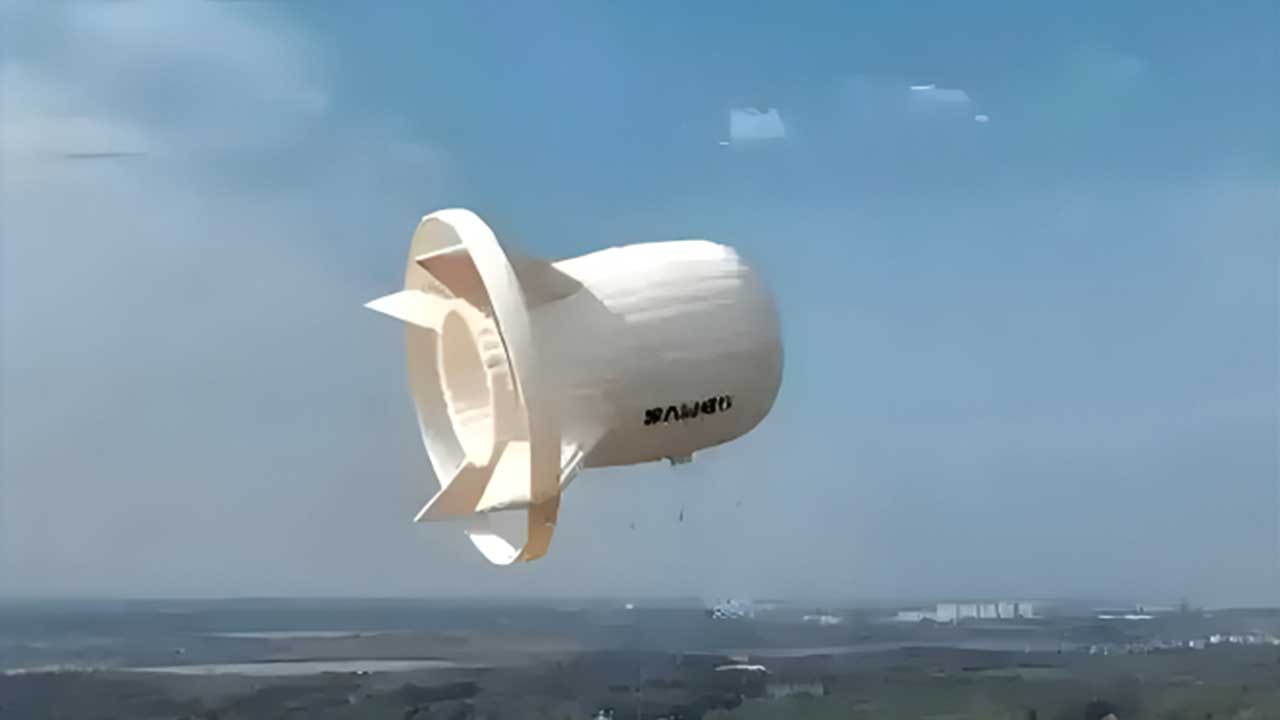

High above the streets of Yibin City in southwest China, a helium-filled airship shaped like a streamlined Zeppelin has quietly become a functioning power plant. The S1500 system, described by its developers as a megawatt-class “flying power plant,” has now completed a grid-connected test that turns a long-running engineering experiment into a live piece of energy infrastructure. What once sounded like science fiction, a floating wind turbine feeding electricity into urban cables, is now a working prototype in Sichuan Province.
The project is more than a visual spectacle. By lifting turbines into stronger, steadier winds thousands of feet above the ground, Chinese engineers are trying to sidestep some of the biggest constraints on conventional wind farms and to push their country’s already formidable renewable sector into a new phase of technological leadership.
How China’s skyborne turbine actually works
At the heart of the project is the S1500, a helium-filled airship that carries a wind turbine inside its hull and tethers to the ground with power and data cables. The craft is described as megwatt-class, with the turbine blades mounted in a central opening so that high-altitude winds drive a generator that sends electricity down the tether. Engineers shaped the envelope like The Zeppelin to maximize lift and stability while minimizing drag, a design that allows the platform to hover at altitude for extended periods without burning fuel.
Developers say the S1500 is part of a broader airborne wind program that has already tested smaller helium blimps such as the S500. In October, the S500 ascended to 500 meters above ground in Hubei Province in central China, generating power and demonstrating that buoyant turbines could cut electricity cost by 30 percent compared with some ground-based systems. The S1500 scales that concept up, targeting winds at several thousand feet where speeds are higher and more consistent, and where the airship’s “Windmill” configuration can harvest energy with fewer interruptions than a tower-bound turbine.
From remote test ranges to an urban skyline
The path to Yibin City’s airborne plant runs through a series of increasingly ambitious trials across western and central China. Earlier tests of the S1500 in the Xinjiang region in western China showed that the platform could operate as the world’s largest airborne wind turbine, a milestone that local officials framed as a major renewable energy breakthrough for China. Separate reporting described the system as a Gigantic gliding “power bank” that could help communities cut off from the grid during blackouts and cement China’s role in green technology.
The latest phase moves that concept into an urban setting. Over Sichuan Province, China, images show the S1500 hovering above Yibin’s riverside skyline, its tether running down to a ground station that synchronizes with the local grid. One account described it as the world’s first urban airborne wind turbine going live Sichuan Province, China, while another called the craft “Absolutely massive” and highlighted how it loomed over the city during a test flight, as captured in “Behold This Massive Airborne Wind Turbine Hovering Over China,” which was Published Jan with commentary by Li Zexin.
A grid-connected “floating power station”
The technical milestone that has grabbed global attention is not just that the airship can fly, but that it has now delivered electricity into a live network. Reports from Jan describe how China’s flying wind turbine completed a grid-connected test, effectively operating as a floating power station that taps strong winds high above the ground. A parallel account emphasizes that China has completed a test flight that synchronized the S1500’s output with the local grid, a crucial step toward any commercial deployment.
Developers and officials have been quick to frame the achievement as part of a national push to dominate next-generation renewables. One video presentation describes how the world’s first megawatt-class “flying power plant” has taken flight in Yibin City, southwest China’s Sichuan Province, and notes that the airship is Shaped like a streamlined balloon with an internal turbine. Another clip shared by front-line reporters underscores that China launches the world’s first megawatt-class floating wind power system, presenting the sky itself as a new energy resource.
Why high-altitude wind matters
High-altitude wind has long tempted engineers because it is stronger and more consistent than the breezes that spin conventional turbines. The S1500’s developers argue that by rising thousands of feet, the airship can access a steadier flow that boosts capacity factors and reduces the need for backup power. Earlier prototypes like the S500 in Hubei Province showed that buoyant turbines could cut electricity cost by 30 percent, according to In October tests in central China, and the S1500 aims to extend those gains at megawatt scale.
Advocates also see airborne systems as a way to reach places where traditional towers are impractical. Reports on the S1500 describe how the Zeppelin-like “Windmill” could supply remote deserts, islands, and mining sites that lack robust grids, with one analysis noting that Windmill tests have already demonstrated lower land use compared with traditional turbines. Another overview of the technology notes that China has built a new type of wind turbine that floats in the air, suggesting that wind farms are, quite literally, moving into the clouds.
From experimental niche to national strategy
What makes the S1500 especially significant is how tightly it fits into Beijing’s broader industrial and climate ambitions. The country has already become a dominant force in solar panels, batteries, and conventional wind, and it is now investing heavily in airborne systems as a way to stay ahead of competitors. A search for China’s energy strategy shows a pattern of using large demonstration projects to accelerate new technologies from lab to market, and the S1500 fits that template.
Domestic coverage has highlighted how Chinese scientists expect to soon make a breakthrough in airborne wind turbine technology, with the world’s first megawatt-class system already in the sky. One social media post described the technology as “Extremely cool” and stressed that Chinese researchers see it as a way to reshape how renewable power is deployed across the grid. Another commentary framed the S1500 as proof that China is taking renewable energy innovation to new heights, literally and figuratively.
More from Morning Overview