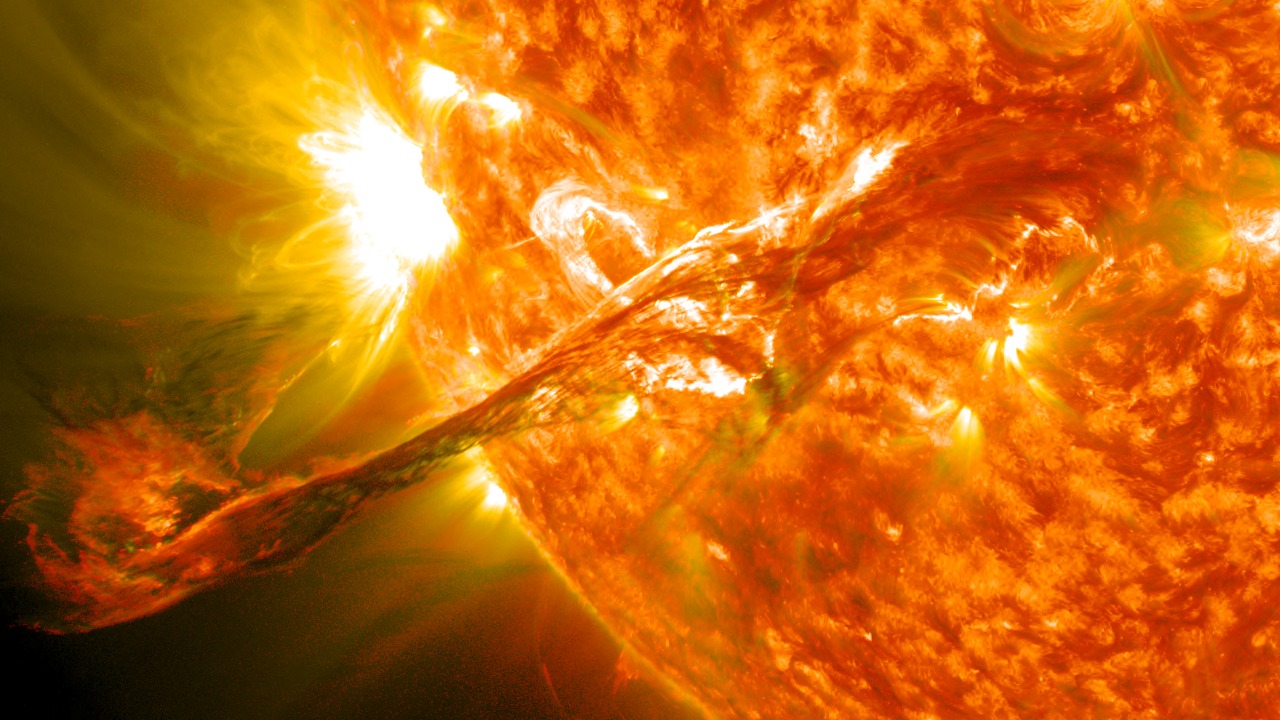

The Sun has just unleashed an M5-class solar flare, a powerful burst of radiation that signals a clear uptick in solar activity as the current cycle heads toward its peak. While this event is not the most extreme category of flare, it is strong enough to disturb radio communications, energize Earth’s magnetic environment, and potentially set the stage for vivid auroral displays at higher latitudes. I see this flare as part of a broader pattern of intensifying space weather that is beginning to touch everyday technologies, from aviation to GPS.
What an M5 flare actually means
Solar flares are classified by their X-ray brightness, with classes A, B, C, M, and X marking increasing power, and each step up representing a tenfold jump in intensity. An M5 flare sits in the upper half of the medium-strength range, roughly fifty times stronger than a baseline C1 event and capable of causing measurable disruptions in the upper atmosphere. When I describe this flare as “high M,” I am pointing to the fact that it sits close to the threshold where effects on radio communications and navigation systems become noticeable for operators who watch the Sun for a living.
In practical terms, an M5 event can trigger shortwave radio blackouts on the sunlit side of Earth, disturb high-frequency communications used by long-haul flights, and inject extra energy into the ionosphere that can degrade GPS accuracy. The recent M5.1 flare was recorded in soft X-rays and cataloged as a significant event by space weather monitors, which track these bursts in near real time through dedicated satellites and ground-based instruments. That level of attention reflects how a single flare, even short-lived, can ripple through the technological systems that depend on a stable near-Earth space environment.
The new active region behind the blast
The flare did not erupt from a quiet patch of the Sun, but from a New Active Region that has rotated into view with a complex magnetic structure. Active regions are areas where the Sun’s magnetic field is twisted and concentrated, often appearing as dark sunspots in visible light and as bright knots in ultraviolet and X-ray images. When I look at the pattern of recent events, this New Active Region stands out as a fresh engine for flares, emerging just as the solar cycle is already running hot.
According to an official event report, the M5.1 flare from this New Active Region peaked at 27/0150 UTC, with the timing and classification logged in detail as part of routine monitoring of the solar disk. The same report on the M5.1 Flare from New Active Region notes that forecasters are watching this area closely for further eruptions, a sign that its magnetic configuration is far from settled. When a region like this first appears, it often goes through a growth phase in which the likelihood of additional M-class or even X-class flares rises, so this is unlikely to be a one-off event.
How the flare unfolded in real time
From a timing perspective, the flare built up and peaked in the early hours of the day in Coordinated Universal Time, when the New Active Region was well placed on the solar disk for clear observation. X-ray flux readings show a sharp rise to the M5.1 level, followed by a gradual decay as the magnetic field reconfigured and the energy release tapered off. I find that these light curves tell a story of a sudden magnetic snap, followed by a cooling period in which the Sun’s atmosphere settles into a new, slightly less stressed state.
A six hour video sequence, spanning from 00:00 to 06:00 UTC on Dec. 27, 2025, captures the flare’s evolution in dramatic detail, with the brightening clearly originating from the same New Active Region that produced the M5.1 peak at 27/0150 UTC. In that footage, the event appears as a sudden flash followed by expanding loops of hot plasma, a visual signature that matches the timing reported for the high M-flare. The clip, shared in a community focused on striking space imagery, notes that the video spans 6 hours from 00:00 UTC and that the event appears to have originated from a new, magnetically active patch, reinforcing the official classification.
Evidence that solar activity is ramping up
The M5.1 flare is not an isolated spike, but part of a broader pattern of heightened solar activity that has been building over recent days. X-ray archives show a sequence of C-class and low M-class flares, with one event reaching C9.9, which is effectively an “almost M1” flare in terms of intensity. When I see a day where a C9.9 event is described as topping an active period, followed soon after by a confirmed M5.1, it signals that the Sun is entering a phase where moderate to strong flares are becoming routine rather than exceptional.
Daily summaries of Sun news for Dec, including updates on flares and coronal mass ejections, describe an active solar disk with multiple bright regions and a notable event near the Sun’s north pole that nearly crossed into the M-class threshold. One report highlights that Sun news for December 27-28, 2025 included a C9.9 (almost M1) flare, underscoring how close the Sun has been running to higher levels of activity even before the M5.1 burst. Taken together, these events fit the expected rise toward solar maximum, when the number and intensity of active regions typically peak.
What the flare means for Earth and technology
For people on the ground, the most immediate impact of an M5.1 flare is usually felt in radio communications and navigation systems rather than in any visible change in the sky. The burst of X-rays and extreme ultraviolet light can temporarily increase ionization in the upper atmosphere on the dayside of Earth, leading to shortwave radio blackouts and degraded high-frequency links used by aviation, maritime operators, and amateur radio enthusiasts. I see these disruptions as a reminder that our communication infrastructure is still tightly coupled to the variable conditions of near-Earth space.
Space weather forecasters track these effects using real-time data feeds and models that translate solar X-ray flux into expected radio blackout levels, geomagnetic disturbances, and potential impacts on satellites. The primary hub for this operational monitoring is the official space weather prediction center, which posts alerts, watches, and detailed event analyses whenever a significant flare like this occurs. Anyone who needs to understand the current risk environment, from satellite operators to power grid managers, can consult the space weather prediction center to see how an event such as the M5.1 flare is expected to affect Earth’s upper atmosphere and magnetic field over the following hours.
How this flare fits into the recent flare sequence
When I place the M5.1 event alongside other recent flares, a clear sequence emerges that shows the Sun steadily stepping up its output. Earlier in the same stretch of days, the solar disk produced a C9.9 flare that nearly crossed into M-class territory, followed by additional C-class bursts that kept X-ray levels elevated. This pattern of frequent, moderate flares is typical of an active phase, where the Sun’s magnetic field is reorganizing itself on large scales and releasing energy in repeated bursts rather than in isolated explosions.
Archived X-ray data for Sunday, 28 December 2025, catalog a series of Solar flares that illustrate how the background level of activity has risen, with multiple events recorded across the day. The same archive, labeled as Solar flares for Sunday, 28 December 2025, sits alongside a “Latest news” section that notes an M8.1 solar flare earlier in the month, showing that the current cycle has already produced even stronger events. By reviewing the Solar flares – Sunday, 28 December 2025 record, it becomes clear that the M5.1 flare is part of a sustained run of significant flaring rather than a solitary spike.
Why forecasters are watching the coming days closely
Once a New Active Region has produced an M5.1 flare, the odds of further eruptions from the same area rise, at least in the short term. The magnetic fields that power such a flare rarely unwind completely in a single event, and instead tend to reconfigure and build up stress again as the region evolves. I expect forecasters to pay close attention to this region as it continues to rotate across the solar disk, since its position relative to Earth will determine how directly any future flares or coronal mass ejections are aimed at our planet.
Operational centers use a combination of magnetograms, ultraviolet imagery, and X-ray flux measurements to assess whether an active region is growing more complex or beginning to decay. The detailed event bulletin on the M5.1 flare from the New Active Region explicitly notes that further information concerning this region and event will be provided as it becomes available, a standard phrasing that signals ongoing monitoring. In parallel, the broader SWPC portal aggregates alerts, forecasts, and model outputs that help translate the raw solar data into practical guidance for industries that depend on stable space weather conditions.
What this means for aurora watchers
For people far from the technical world of radio propagation and satellite operations, the most exciting consequence of heightened solar activity is the potential for stronger and more frequent auroras. An M5.1 flare by itself does not guarantee a geomagnetic storm, since the most important factor for auroras is whether the flare is accompanied by a coronal mass ejection that is directed toward Earth. However, a run of high M-class events from an active region increases the odds that at least one eruption will hurl a cloud of charged particles into the solar wind in a way that can interact strongly with Earth’s magnetic field.
When such a cloud arrives, it can trigger geomagnetic storms that light up the sky with curtains and arcs of green, red, and purple, sometimes pushing the auroral oval far enough south for people in cities like Edinburgh, Minneapolis, or Hamburg to see the northern lights. To make the most of these opportunities, I recommend that enthusiasts Check the aurora forecast regularly, using services that provide real-time alerts and visibility estimates. Guides to the northern lights explain that you can stay up to date with significant aurora alerts and geomagnetic storm warnings, and that platforms such as SpaceWeatherLive and AuroraWatch UK provide real-time alerts to help you decide when to head outside. One detailed overview notes that you can Check the aurora forecast: You can stay informed about significant aurora alerts and geomagnetic storm warnings, which is especially useful during periods when the Sun is firing off M-class flares.
How to follow the next wave of solar fireworks
As the solar cycle continues to climb, I expect more days when M-class flares, and occasionally X-class events, dominate the space weather conversation. For anyone whose work or curiosity depends on understanding these changes, the key is to build a habit of checking reliable, real-time sources rather than relying on scattered social media posts. The official space weather prediction center, specialized flare archives, and curated Sun news updates together provide a layered view of what the Sun is doing and how it might affect Earth over the next few hours and days.
For a quick operational snapshot, the main SWPC homepage offers current solar wind conditions, flare alerts, and geomagnetic indices, while detailed Sun news digests for Dec compile the most important flares and coronal events into a narrative of the solar cycle’s progression. By pairing those tools with visual resources like the six hour flare video that spans from 00:00 to 06:00 UTC, I can track not just the numbers but the dynamic behavior of the New Active Region that produced the M5.1 flare. The Sun’s latest outburst is a reminder that our star is entering a restless phase, and that paying attention now will help us navigate both the risks and the rare sky shows that come with a more active star.
More from MorningOverview