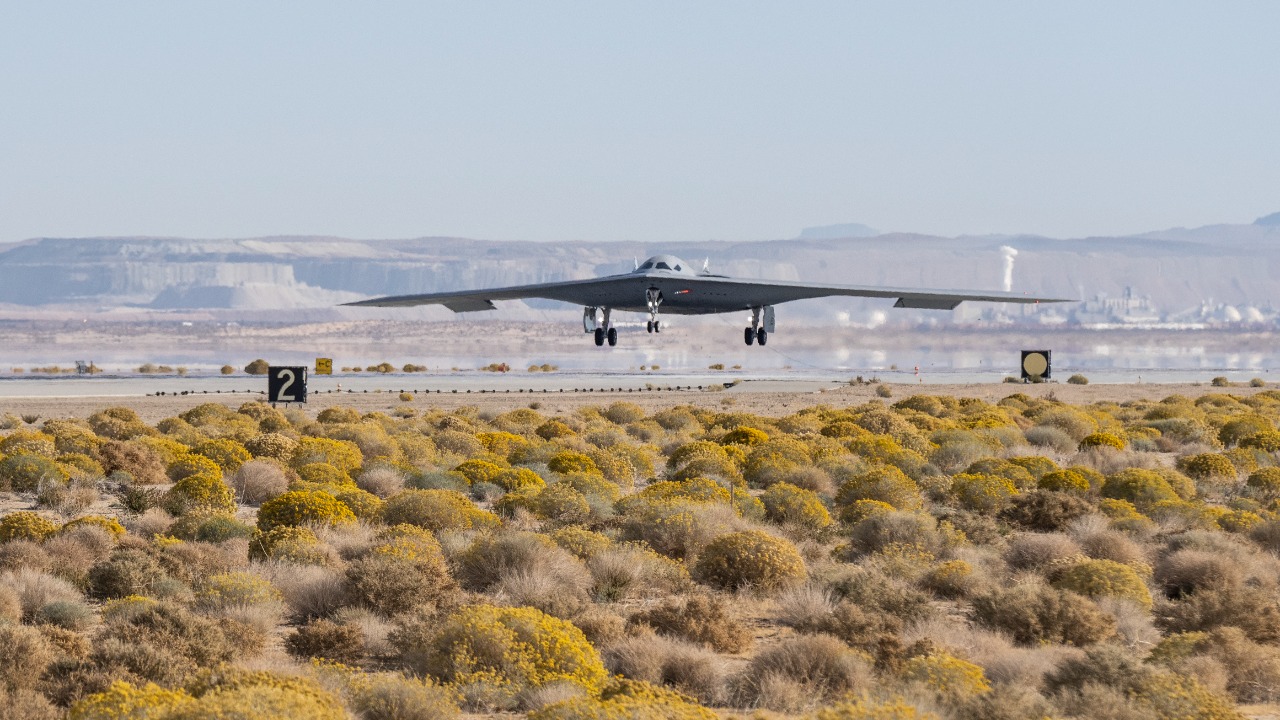

The B-21 Raider is being framed as the centerpiece of a new kind of air war, one where a single stealth aircraft quietly orchestrates swarms of drones, fuses data from across the battlespace, and can even fly without a crew if commanders choose. Rather than a niche replacement for aging bombers, it is being built as a digital command hub that happens to carry weapons. The design choices, from its cockpit to its software, point to an aircraft optimized to manage unmanned systems as much as to drop bombs.
From bomber to battle network brain
The United States Air Force describes the B-21 Raider’s Mission in terms that already go beyond classic bombing runs, presenting it as a dual-capable penetrating strike platform that will sit inside a broader family of systems. Official material stresses that the Raider will be a component of a larger strike architecture, not a lone silver bullet, which is a subtle but important shift from earlier generations of bombers that were designed primarily around payload and range. By defining the aircraft in relation to a network, planners are signaling that its value will lie in how it connects sensors, shooters, and decision makers as much as in the munitions it carries, a role that naturally lends itself to controlling drones and other autonomous assets as extensions of its own reach.
That network-centric framing is reinforced by the way senior leaders talk about the aircraft’s future missions, repeatedly emphasizing sensing, command, and control alongside traditional strike. The official fact sheet notes that the Raider Mission will support both conventional and nuclear roles while integrating with other platforms, which implies a heavy reliance on secure data links, advanced processing, and software-defined capabilities. In practice, that means the B-21 is being engineered as a flying node that can ingest information from satellites, surface forces, and unmanned aircraft, then push targeting data and tasking orders back out, effectively turning it into a command post that happens to be stealthy enough to sit inside an adversary’s air defenses.
Single-pilot hints of advanced AI and autonomy
One of the clearest clues that the B-21 is meant to manage more than its own weapons is the way leaders describe its crew concept. General Thomas A. Bussiere, who leads Air Force Global Strike Command, has discussed the possibility of single-pilot B-21 Raider operations, a striking departure from the two-person crews that have long been standard for complex bombers. The idea that a lone aviator could safely manage a penetrating stealth mission, while also supervising offboard drones, only makes sense if much of the routine workload is being handled by advanced onboard automation and artificial intelligence, which is exactly what Bussiere’s comments about the aircraft’s future capabilities suggest.
Those remarks underscore that the Raider is far more than just a bomber, a point that has been highlighted repeatedly in analysis of its emerging concept of operations. By hinting that a single pilot could oversee the aircraft while software handles navigation, threat avoidance, and sensor fusion, Bussiere is effectively telegraphing that the B-21’s computers will be sophisticated enough to coordinate additional unmanned systems as well. The discussion of Bussiere’s comments makes clear that this level of automation is central to the design, not an afterthought layered on later.
The B-21 as “Sky Sensor” and intelligence node
Air Force weapons developers have been unusually explicit that the B-21 is meant to function as a high-end sensor platform and intelligence node, not just a delivery vehicle for bombs. Senior leaders have described the aircraft as a kind of “Sky Sensor,” a term that captures the idea of a stealthy aircraft quietly collecting and integrating data from across the battlespace. In this vision, the B-21’s radar, electronic support measures, and other classified systems would feed a real-time picture of enemy air defenses, surface forces, and communications into its onboard computers, which then share that picture with other aircraft and ground units.
That same concept extends naturally to drone control, because an aircraft that already acts as an information hub is well positioned to direct unmanned systems as forward scouts or additional sensor apertures. Reporting on how the B-21 will Stealth Bomber Will Control Drones, Operate, Sky Sensor, Intelligence Node and Drones, Beyond describes a platform that can push targeting data to collaborative combat aircraft, receive their feeds, and then refine its own strike plan accordingly. In practice, that would allow a Raider to send unmanned escorts ahead to probe for emitters, map radar coverage, or even carry decoys, all while the bomber itself remains electronically quiet and focused on orchestrating the engagement.
“Mothership” bomber and the CCA escort vision
The idea of the B-21 as a “mothership” bomber has gained traction as the Air Force refines its plans for collaborative combat aircraft, or CCAs, that will fly alongside manned platforms. Analysts have argued that the Raider could assume roles once envisioned for the Next Generation Air Dominance program, particularly in terms of managing autonomous and remotely piloted technologies from inside contested airspace. In this construct, the B-21 would not simply be one more shooter in a formation, but the central node that assigns tasks to a constellation of drones, from electronic attack and decoy operations to precision strikes and battle damage assessment.
That vision aligns closely with discussions that frame the B-21 Raider as a What You Need, Know, Next step in integrating autonomous and remotely piloted technologies into long-range strike. It also dovetails with operational concepts in which CCAs act as loyal wingmen for both fighters and bombers, providing extra weapons, sensors, and decoys without putting additional pilots at risk. By treating the Raider as the mothership for these escorts, the Air Force can leverage its stealth and processing power to coordinate complex multi-axis attacks, while the unmanned aircraft absorb much of the risk of flying closest to enemy defenses.
CCAs May Escort Bombers After Concept Matures
Air Force leaders have already started sketching out how CCAs might pair with bombers once the technology matures in the fighter force. General Thomas A. Bussiere, in his role as commander of Air Force Global Strike Command, has discussed a future in which autonomous escorts accompany long-range aircraft, providing both additional firepower and a buffer against enemy fighters and surface-to-air missiles. The idea is that once the CCA concept is proven with fighters, the same architecture can be extended to bombers, where the benefits of extra sensors and decoys are arguably even greater given the stakes of penetrating deep into hostile territory.
Reporting on how CCAs May Escort Bombers After Concept Matures, Fighter Force, Air Force, Raid has already depicted artist’s impressions of a B-21 Raider flying with a constellation of unmanned escorts. In those concepts, the drones act as both scouts and shields, flying ahead to trigger enemy radars, jam communications, or launch stand-in weapons, while the Raider hangs back in a more survivable position. This approach would turn each B-21 sortie into a small strike package in its own right, with the bomber as the command node and the CCAs as modular tools that can be tailored to the mission.
Integration with drone technology and potential unmanned flight
The push to integrate the B-21 with drone technology is not limited to external escorts; it also extends to the possibility of the aircraft itself flying without a crew. Air Force weapons developers have made clear that the Raider is being designed with the option to operate without pilots on board, even if it initially flies with humans in the cockpit. That flexibility reflects a recognition that future high-end conflicts may demand missions that are too risky for manned crews, or that require endurance and maneuvering profiles better suited to unmanned operations, especially when coordinating large numbers of autonomous systems.
Analysts have framed the B-21 Raider as Raider, The Stealth Bomber That Doesn, Need, Pilot, Air Force, emphasizing that the Air Force wants the option to remove the crew if operational conditions demand it. Separate reporting on whether the B-21 can fly without crew highlights the Integration of its systems with drone technology and notes that Another interesting, and seemingly likely, possibility is for the Raider to act as a central controller for unmanned aircraft carriers as a result. In that analysis, the B-21 is positioned behind a layered defense, using its stealth and processing power to manage a web of unmanned platforms that push deeper into contested airspace, a concept that would be far easier to execute if the bomber itself can operate autonomously when needed.
Those same discussions of whether the B-21 can fly without crew stress that Dec, Integration, Another layer of automation will be needed to safely manage both the bomber and its unmanned partners. That requirement loops back to Bussiere’s comments about advanced AI and single-pilot operations, suggesting a continuum in which the Raider moves from two-person crews, to one, and eventually to none, as software matures and commanders grow more comfortable with handing over more tasks to machines.
Production ramp, test aircraft, and real-world combat roles
The B-21’s evolution from concept to operational “mothership” will depend heavily on how quickly the Air Force can build and field the aircraft at scale. Officials have already signaled that test B-21s could be used for combat missions if needed, a sign of both confidence in the design and the urgency of bringing its capabilities into the force. At the same time, Northrop Grumman is preparing to expand production at Plant 42, with plans for a production expansion of the Air Force’s next-generation bomber that will ripple through Tier 1 supplier locations, a reminder that the Raider is not just a technology experiment but a major industrial program.
Reporting on how test aircraft might be used in combat and how Northrop eyes more contracts notes that the Air Force has structured its deal to speed production and move quickly from basic flight testing to integrating the bomber into the broader force. The coverage of how Jul, Air Force, Raider will transition from test to operational status, and how Oct marks the beginning of a new phase in B-21 flight testing, underscores that the aircraft is moving rapidly toward a point where its drone-control features will be exercised in real-world scenarios. As more airframes roll off the line, the Air Force will have the mass needed to experiment with different mixes of manned and unmanned teaming, including using early production jets as pathfinders for CCA integration.
Lessons from XB-70 and why adaptability matters
The Air Force’s determination to make the B-21 adaptable reflects hard lessons from earlier bomber programs, particularly the XB-70 Valkyrie. That aircraft, often described as the B-21 of its day, was built around a single operational concept that was overtaken by advances in Soviet air defenses, leaving the program vulnerable when its original mission no longer made sense. Analysts have pointed out that There remains, however, a big difference between the XB-70 and B-21, namely that the Raider is being designed from the outset to evolve as threats and technologies change, rather than being locked into a narrow performance envelope.
In that context, the decision to build a fleet that could eventually number up to 200 units still makes sense, because a highly adaptable platform can be repurposed as new roles emerge, including commanding ever more sophisticated unmanned systems. The discussion of how Dec, There, The Valkyrie failed thanks to Russia’s air defense advances is often paired with arguments that the B-21’s software-driven architecture, open systems design, and emphasis on networking will allow it to absorb new sensors, weapons, and control interfaces for drones over time. That adaptability is central to the Raider’s role as a command platform, because the unmanned systems it manages will themselves evolve rapidly, demanding a mothership that can keep pace.
Export debates and the “Sensor in the Sky” for allies
As the B-21’s capabilities come into sharper focus, debate has emerged over whether some version of the aircraft might eventually be offered to close allies. Analysts have floated the idea of the Raider serving as a shared “Sensor in the Sky” for a coalition, with one or more aircraft providing high-end sensing and command functions that benefit multiple nations’ forces. In that scenario, the B-21’s role as a bomber would be only part of its value; its ability to act as an aerial node performing sensing, command, and control for both U.S. and allied drones and aircraft would be the main selling point.
Coverage of whether the Air Force’s new B-21 Raider Stealth Bomber might be for sale describes a concept in which a U.S. Air Force B-21 Sensor in the Sky Also functions as a multi-national command asset, linking allied aircraft and unmanned systems into a shared picture of the battlespace. The analysis notes that Dec, Air Force, Sensor, Sky Also such a multi-national bomber may give the U.S. and its partners a powerful shared tool for both deterrence and warfighting, particularly if the Raider can coordinate allied CCAs and other autonomous platforms. That possibility underscores how central the command-and-control function has become to the B-21’s identity, to the point where its value as a drone commander could be as strategically important as its ability to deliver weapons.
Public glimpses and the narrative of a new kind of bomber
Public videos and briefings have gradually filled in the picture of how the B-21 will operate, often emphasizing its role as more than a traditional bomber. A detailed breakdown from Jet Insight, for example, walks through how the aircraft’s design supports advanced sensing, networking, and potential unmanned operations, reinforcing the message that the Raider is being built as a flexible platform for future technologies. In that presentation, the host underscores that the New Air Force B-21 Raider is not just a stealth bomber, but a system meant to integrate data from different sources and support complex command-and-control tasks inside contested airspace.
Similarly, footage of a second B-21 Raider flying from an Air Force Base California, escorted by other aircraft, has helped the public visualize how the bomber might operate alongside manned and unmanned partners. The video of how the Oct, Air Force Base California, Raider moves in formation hints at future scenarios where those wingmen are CCAs rather than traditional fighters, all linked through secure data networks managed from the Raider’s cockpit. Combined with other explainers, such as the Jet Insight segment on how Nov, Jet Insight frames the aircraft’s sensing and control roles, these glimpses support a narrative in which the B-21 is less a direct successor to the B-2 and more the first of a new class of networked, AI-enabled command bombers.
Why the B-21’s command role will define future airpower
When I look across the official descriptions, senior leader comments, and analytical deep dives, a consistent pattern emerges: the B-21 Raider is being engineered first as a node in a larger system, and only second as a standalone bomber. The emphasis on sensing, command, and control, the option for single-pilot or even unmanned operations, and the explicit plans to pair it with CCAs all point to an aircraft whose primary job will be to manage information and orchestrate other platforms. That is a profound shift from earlier bombers, which were judged mainly on how much they could carry and how far they could fly, and it reflects a broader recognition that in modern warfare, the side that can best connect and direct its forces often has the decisive edge.
Analysts who argue that the Oct, The New Air Force, Raider Isn, Just, Stealth Bomber, Raider is much more than a traditional bomber, and that the Feb, Raider Is Much More Than, Stealth Bomber, Raider Stealth Bomber, Image Credit, Creative Commons is capable of flying unmanned missions, are essentially describing the same transformation: from platform-centric to network-centric airpower. As CCAs mature, as AI takes on more cockpit tasks, and as allies look for shared “Sensor in the Sky” capabilities, the B-21’s ability to command drones and integrate data from different sources will likely matter more than the specific mix of bombs in its bays. In that sense, the Raider is less the end of the bomber lineage and more the starting point for a new generation of airborne command hubs that happen to carry very powerful weapons.
That trajectory is reinforced by ongoing discussions of how the Air Force considers assigning bombers autonomous CCA escorts, with Dec, General Thomas, Bussiere, Air Force Global Strike Command, United States Air Forc outlining a path in which the concept matures in the fighter force before migrating to long-range strike. It is also echoed in repeated analyses that the B-21 is much more than a stealth bomber, as seen in the framing of the Nov, Bussiere, TWZ coverage of its AI-enabled crew concepts. Taken together, these strands make a compelling case that the B-21 Raider is being built to command drones, manage information, and shape the fight from inside enemy airspace, with its bomb load serving as one, but not the only, tool in that larger mission.
More from MorningOverview