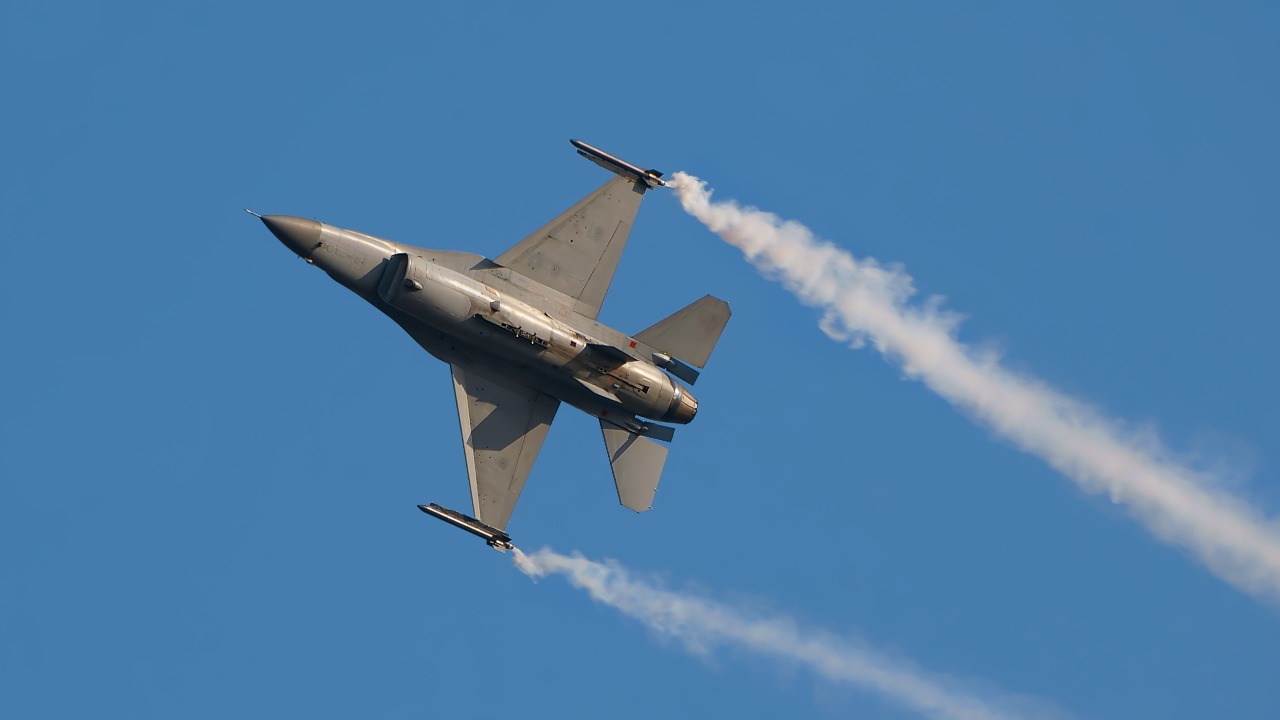

Single-engine jets remain some of the most extreme aircraft a pilot can strap into, and several of the fastest are still available to fly in frontline squadrons and training units today. Focusing on operational types that a qualified military aviator can actually get into, these five single‑engine designs combine raw speed with modern avionics, weapons, and survivability in ways that continue to shape airpower doctrine around the world.
1. The F-16 Fighting Falcon Tops the List at Mach 2.05
The General Dynamics, Lockheed Martin, F-16 Fighting Falcon is an American single-engine supersonic multirole fighter aircraft that has become one of the most widely flown combat jets in history. According to detailed performance data, the F-16 Fighting Falcon achieves a top speed of Mach 2.05, placing it among the fastest single-engine fighter jets still flying today and making it the quickest aircraft on this list that a large number of active-duty pilots can realistically fly. That performance comes from a powerful afterburning turbofan, blended with a relatively light airframe and a design that was optimized from the outset for high energy maneuvering, sustained turns, and rapid acceleration. The result is a fighter that can sprint to intercept, then still has the agility to fight in a close-in engagement, a combination that has kept it relevant even as newer designs have appeared.
Operationally, the F-16 has been adapted into countless variants, and the core airframe remains under production according to the long-running program history documented for the General Dynamics F-16 Fighting Falcon. That ongoing production, along with continuous avionics and weapons upgrades, means pilots in air forces across Europe, the Middle East, Asia, and the United States still train and deploy in the type, benefiting from its Mach 2.05 performance in both air defense and strike roles. The jet’s single engine also illustrates a broader trend highlighted in coverage of modern designs, where single-engine fighters are described as not just a thing of the past but as some of the most popular military planes in service today. For defense planners, that combination of speed, affordability relative to twin‑engine types, and a massive global support ecosystem explains why the F-16 remains a cornerstone of airpower and a realistic cockpit for thousands of current pilots rather than a museum piece.
2. Saab JAS 39 Gripen Hits Mach 2.0 with Agile Performance
The Saab JAS 39 Gripen is another single-engine fighter that pairs high speed with a compact, efficient design tailored to modern air forces that need capability without the cost and complexity of heavier jets. Reporting on current single‑engine fighters notes that the Saab JAS 39 Gripen reaches a top speed of Mach 2.0, placing it just behind the F-16 in outright velocity among operational single‑engine designs highlighted in recent rankings. That Mach 2.0 figure is only part of the story, because the Gripen’s delta-canard layout, advanced flight control system, and relatively low operating weight give it impressive acceleration and climb, allowing pilots to exploit its speed envelope quickly in both defensive and offensive missions. The aircraft was engineered to operate from short, dispersed runways, which means its high-speed performance is matched by rugged handling and quick turnaround times on the ground.
In service, the Gripen has been adopted by air forces that prioritize interoperability with Western weapons and sensors while keeping lifecycle costs under control, and its single engine is central to that equation. The Mach 2.0 top speed allows it to perform air policing, quick reaction alert, and long-range interception tasks that demand rapid response, while its modern radar and data links support networked operations alongside larger allies. For pilots, that means a cockpit that delivers both the thrill of true Mach 2 flight and the situational awareness needed in contemporary air combat, where information and coordination can matter as much as raw thrust. Strategically, the Gripen’s combination of speed, agility, and relatively modest support requirements has made it a template for smaller nations seeking high-end capability without committing to the cost profile of heavier fifth‑generation fighters.
3. Lockheed Martin F-35 Lightning II Cruises at Mach 1.6
The Lockheed Martin F-35 Lightning II represents a different philosophy in single‑engine fighter design, trading a bit of top‑end speed for stealth, sensor fusion, and multirole flexibility. Performance data on the incredible power of the F-35 Lightning notes that The Lockheed Martin F-35 Lightning II is a family of single-engine, stealth aircraft whose engine produces such thrust that “this incredible thrust allows the jet to reach Mach 1.6 (about 1,200 …),” explicitly tying the figures 35, 1.6, and 1,200 to its performance envelope. That Mach 1.6 top speed is lower than the F-16 and Gripen, but the F-35’s design is optimized to cruise efficiently at high subsonic and low supersonic speeds while remaining difficult to detect and track, giving pilots a different kind of advantage. Instead of relying on raw dash speed to survive, the F-35 uses low observability and advanced sensors to see threats first and engage from positions of relative safety.
For aviators who qualify on the type, the F-35’s single engine simplifies maintenance and logistics compared with twin‑engine stealth designs, while still delivering enough thrust for short takeoff variants and heavy internal weapons loads. Its Mach 1.6 capability ensures it can keep pace with legacy fourth‑generation fighters in mixed formations, yet its real strength lies in the way it fuses radar, electronic support measures, and offboard data into a single tactical picture. That shift in emphasis from maximum speed to information dominance reflects a broader trend in fighter development, where designers accept slightly lower top‑end numbers in exchange for survivability and mission effectiveness in heavily defended airspace. For air forces investing in the F-35, the stakes involve not just fielding a fast single‑engine jet, but reshaping entire concepts of operations around a platform that can quietly penetrate, sense, and strike while still outrunning many threats when needed.
4. HAL Tejas Achieves Mach 1.6 in Indian Service
The HAL Tejas is India’s indigenous single‑engine light fighter, developed to replace aging fleets and give the Indian Air Force a modern, domestically supported combat aircraft. In assessments of current single‑engine fighters, the HAL Tejas is credited with a top speed of Mach 1.6, placing it in the same speed bracket as the F-35 while offering a lighter, more compact airframe tailored to regional requirements. That Mach 1.6 performance is enabled by a single afterburning turbofan and a design that emphasizes agility, with a compound delta wing and relaxed static stability controlled by a digital fly‑by‑wire system. For Indian pilots transitioning from older types, the Tejas offers a significant leap in both speed and handling, giving them a platform that can keep pace with contemporary threats in the subcontinent’s crowded airspace.
Production of the Tejas continues, and the aircraft has entered squadron service in both air force and naval variants, underscoring its status as a jet that aviators are actively flying rather than a paper project. Its single‑engine configuration helps control acquisition and operating costs, which is critical for a country fielding a large fleet across multiple fronts. At the same time, the Mach 1.6 top speed ensures the Tejas can perform interception, air defense, and strike escort missions without being outclassed in straight‑line performance by neighboring fourth‑generation fighters. Strategically, the program carries stakes beyond pure performance numbers, because it represents a push for technological self‑reliance and industrial capability, with each Tejas sortie demonstrating that a domestically designed single‑engine fighter can match the speed benchmarks set by more established aerospace powers.
5. KAI T-50 Golden Eagle / FA-50 Reaches Mach 1.5 for Versatility
The KAI T-50 Golden Eagle and its FA-50 light attack derivative illustrate how a single‑engine platform can bridge advanced training and frontline combat roles while still offering true supersonic performance. Coverage of current single‑engine fighters and broader speed rankings notes that the KAI T-50 Golden Eagle / FA-50 reaches a top speed of Mach 1.5, placing it just below the Tejas and F-35 in outright velocity but giving it more than enough speed for air combat training, air policing, and light strike missions. The design borrows heavily from established fighter aerodynamics, with a sleek fuselage and swept wings that allow student pilots to experience high‑G maneuvering and supersonic flight in an aircraft that is less complex and costly than a full‑scale frontline fighter. When configured as the FA‑50, the same airframe can carry precision weapons and sensors, turning that Mach 1.5 performance into a practical tool for real-world operations.
For air forces that adopt the T‑50 family, the single‑engine layout simplifies maintenance and reduces fuel consumption, which is especially important in training environments where aircraft fly frequent sorties. At the same time, the ability to accelerate through Mach 1.5 means instructors can expose pilots to the handling characteristics and tactical considerations of supersonic flight before they transition to more advanced types like the F‑16 or F‑35. That versatility has strategic implications, because it allows countries to build a pipeline of pilots who are already comfortable with high‑speed operations while also fielding a light combat aircraft that can perform border patrols, close air support, or quick reaction alert. In effect, the T‑50 and FA‑50 show how a single‑engine jet can deliver both speed and flexibility, giving smaller air forces a way to participate in modern air operations without committing to the cost and complexity of heavier twin‑engine fleets.
More from MorningOverview