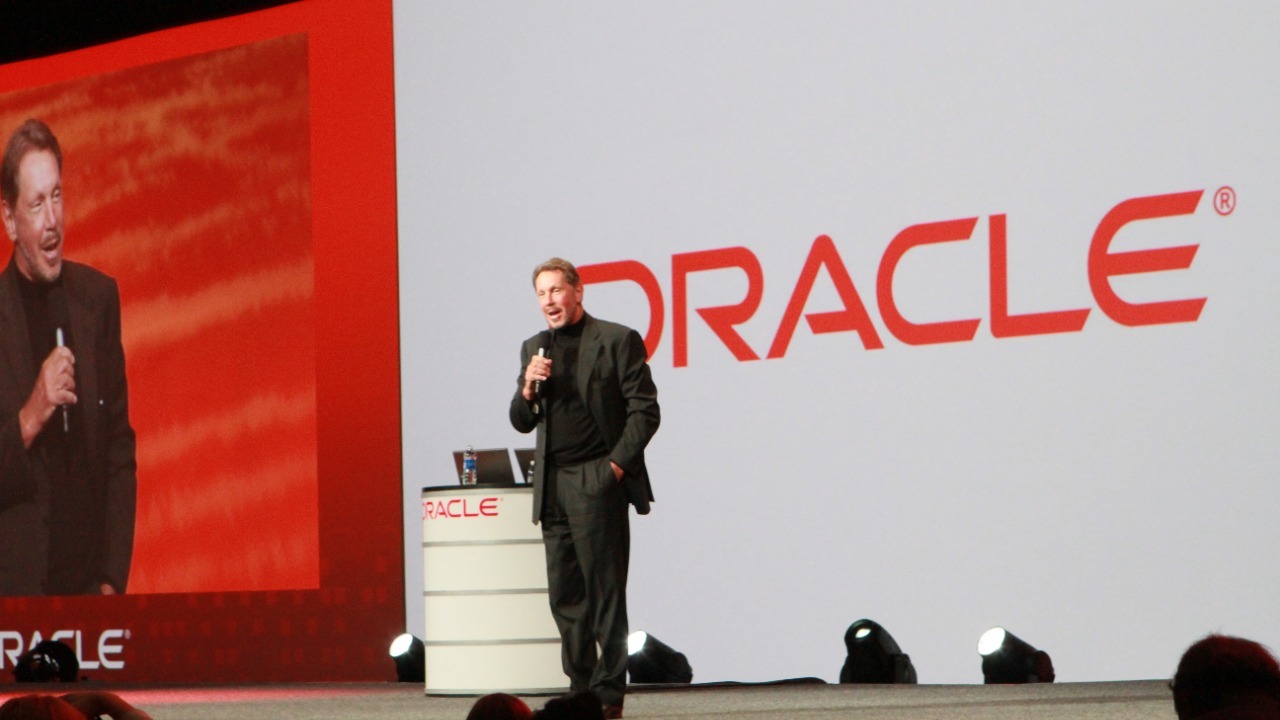

Oracle is trying to buy its way into the center of the artificial intelligence boom with one of the most aggressive infrastructure splurges in corporate history. The scale of that ambition has turned the company into a live test of how far financial markets will chase AI promises before asking whether the underlying engineering can actually deliver.
As capital spending surges, timelines slip and analysts question the payoff, Oracle’s AI push now looks less like a straightforward growth story and more like a stress test of the entire AI infrastructure trade. The company’s experience shows how quickly exuberant expectations can collide with the physical limits of data centers, chips and power, and how that collision can reshape both stock market narratives and balance sheets.
Oracle’s $300 billion swing at the AI future
Oracle has positioned itself as one of the most aggressive backers of AI infrastructure, with a headline commitment that has stunned even seasoned Wall Street watchers. The company’s plan to support AI workloads, particularly for large model providers, has been framed around a massive buildout of cloud capacity that has been described as a $300 billion bet, a figure that instantly places Oracle in the same conversation as the largest capital programs in tech and energy. That number is not a single line item on a balance sheet so much as a signal of the long term contracts, infrastructure commitments and financing structures Oracle is tying to the AI wave.
The sheer size of that $300 billion figure has turned Oracle into what some market participants now see as a barometer for AI exuberance, because it concentrates so much risk in one company’s ability to execute. When a single enterprise software vendor suddenly shoulders a capital plan on par with global oil majors, investors are forced to ask whether the economics of AI infrastructure are really as bulletproof as the hype suggests. The fact that this bet is being made by Oracle, a company still best known for databases and enterprise software licenses, underscores how dramatically AI has redrawn the strategic map for legacy tech firms.
From software stalwart to AI infrastructure heavyweight
Oracle’s pivot into AI infrastructure is not happening in a vacuum, it is anchored in a high profile relationship with one of the most important model developers in the world. Since Oracle has a huge deal with OpenAI, its engineering puzzle is now indistinguishable from its financial puzzle, because the company is effectively promising to stand up enough capacity to host and scale some of the most compute hungry workloads on the planet. That partnership has elevated Oracle from a second tier cloud player into a central character in the AI story, but it has also bound the company’s fortunes tightly to the success and resource demands of a single partner.
In practical terms, that means Oracle is racing to deliver data centers, networking and specialized hardware at a pace dictated by OpenAI’s roadmap rather than by Oracle’s traditional enterprise sales cycles. As one analysis put it, since Oracle is now so deeply tied to OpenAI, the question of whether its AI investment pays off is inseparable from whether it can physically build and operate the infrastructure it has promised. That is a very different risk profile from selling database licenses, and it exposes Oracle to the same supply chain, power and construction bottlenecks that have dogged hyperscale cloud providers for years.
Capex shock: when AI promises hit the income statement
The financial impact of Oracle’s AI push is already visible in its capital spending, which has surged far beyond what many investors expected. In its latest results, the company reported that capital expenditures soared to $12 billion, well above the $8.4 billion anticipated by analysts, as Capex ballooned on data centre buildout to meet demand for AI computing power. That kind of overshoot might be tolerated in a short burst, but as a pattern it raises questions about whether Oracle can keep funding its AI ambitions without eroding profitability or stretching its balance sheet.
Capital markets initially rewarded Oracle’s AI narrative, but the revenue miss that accompanied this Capex spike triggered a sharp selloff in the stock and a reassessment of how quickly AI infrastructure spending will translate into earnings. The fact that Capital expenditures are rising so much faster than revenue growth suggests a mismatch between the pace of investment and the monetization of that capacity. For a company that historically prided itself on high margins and disciplined spending, the new AI era is forcing Oracle to behave more like a capital intensive utility than a software vendor, and investors are still working out how to price that shift.
Backlog boom, execution risk
On paper, Oracle’s AI and cloud strategy looks well supported by a swelling pipeline of contracted business, which the company has highlighted as proof that the spending spree will eventually pay off. Oracle’s multi year backlog reached $523 billion, up $68 billion from the prior period, as Cloud backlog grows but execution risks persist. Those figures suggest that customers are signing long term commitments for Oracle’s cloud and AI services, giving the company a degree of revenue visibility that many rivals would envy.
The challenge is that a backlog is only as valuable as a company’s ability to deliver the services it has promised, at the margins it has implied. Oracle’s expansion into cloud infrastructure has reshaped its financial profile, and Rising capital expenditure and debt levels raise red flags for investors who worry that the company might be overextending itself to chase AI demand. As one assessment of Rising costs noted, the market is increasingly focused not just on Oracle’s ability to sign AI deals, but on whether those deals will generate sustainable profits once the full cost of infrastructure, financing and operations is taken into account.
Delays, data centers and the limits of physics
Behind the financial statements, Oracle is grappling with the physical realities of building out AI capacity at breakneck speed. Oracle Corp has pushed back the completion dates for some of the data centers it is developing for the artificial intelligence boom, a sign that even with ample capital, the company cannot simply will new capacity into existence on Wall Street’s preferred timetable. Construction bottlenecks, power constraints and the global scramble for high end chips all conspire to slow the rollout of new facilities, no matter how ambitious the budget.
Those delays matter because they expose the gap between the AI story investors are buying and the engineering grind required to make that story real. When Oracle tells the market it is committing hundreds of billions of dollars to AI infrastructure, it is implicitly promising that it can convert that spending into live, revenue generating capacity on a predictable schedule. The reality, as highlighted in coverage of Oracle’s 300B AI bet, is that the company is running into the same constraints that have slowed other hyperscalers, from limited grid connections to the complexity of building specialized AI data centers that can handle extreme power densities and cooling requirements.
Wall Street’s patience starts to fray
As the scale of Oracle’s AI gamble has become clearer, some analysts have begun to push back against the idea that the company is a straightforward beneficiary of the AI boom. One influential note initiated Oracle at a Sell rating, arguing that the market was overestimating the value the company would capture from its AI infrastructure push. That report set a price target on the stock of $175, which is about 40% less than its then current value, and Oracle shares were down 4% during Thursday morning trading after the call.
The core of that skepticism is not that Oracle cannot build data centers, but that the economic spoils of the AI boom may accrue elsewhere in the stack. The same analysis argued that Oracle’s large commitments to AI infrastructure primarily benefit partners like OpenAI, which capture more of the high margin platform and application value, while Oracle shoulders much of the capital burden. In that framing, Oracle looks less like a pure AI winner and more like a capital provider to others’ AI ambitions, a role that can be lucrative but is far less glamorous than the narrative that initially drove the stock higher. For investors who bought into Oracle as a way to gain exposure to AI software and services, that distinction matters.
The off balance sheet AI exposure
Complicating the picture further is the way Oracle’s AI commitments show up, or fail to show up, in its reported numbers. Credit analysts have flagged a potentially material shift in Oracle’s risk profile tied to long term AI infrastructure obligations that are not fully captured on the traditional balance sheet. One assessment described Oracle’s AI exposure as a $248 billion bet that is not entirely reflected in standard debt metrics, because it includes long dated contracts, leases and other commitments associated with its AI infrastructure strategy.
For bondholders and equity investors alike, that raises questions about how to evaluate Oracle’s true leverage and flexibility if AI demand does not grow as quickly as expected. Traditional measures of net debt and Capex may understate the extent to which Oracle has already locked itself into a particular AI heavy future, with limited room to pull back if economics shift. In that sense, the company’s AI strategy is not just a technological or competitive wager, it is a complex financial engineering exercise that ties Oracle’s fortunes to a specific vision of how the AI market will evolve over the next decade.
Bubble barometer or blueprint for the next decade?
Oracle’s AI push has become a kind of Rorschach test for how investors view the broader AI infrastructure cycle. To some, the combination of a $300 billion headline commitment, a $523 billion backlog and surging Capex looks like a textbook sign of a bubble, with capital flooding into a hot theme faster than the underlying engineering can absorb it. Brett Ewing, who has discussed Oracle’s role in the AI trade, has pointed to the company as a key reference point for how AI enthusiasm is reshaping expectations across business, finance and the markets, precisely because the numbers involved are so large and so concentrated in a single name.
Others see Oracle’s strategy as a rough blueprint for how legacy software vendors might reinvent themselves in an AI first world, even if the path is messy and the near term financials are volatile. From that perspective, the delays, cost overruns and analyst downgrades are the price of admission to a market that could eventually reward those who control scarce AI infrastructure with durable pricing power. Whether Oracle ultimately vindicates that view or ends up as a cautionary tale, its current trajectory offers a clear lesson: in the AI era, the line between visionary investment and overextended speculation is thin, and it runs straight through the hard, unglamorous work of engineering.
More from MorningOverview