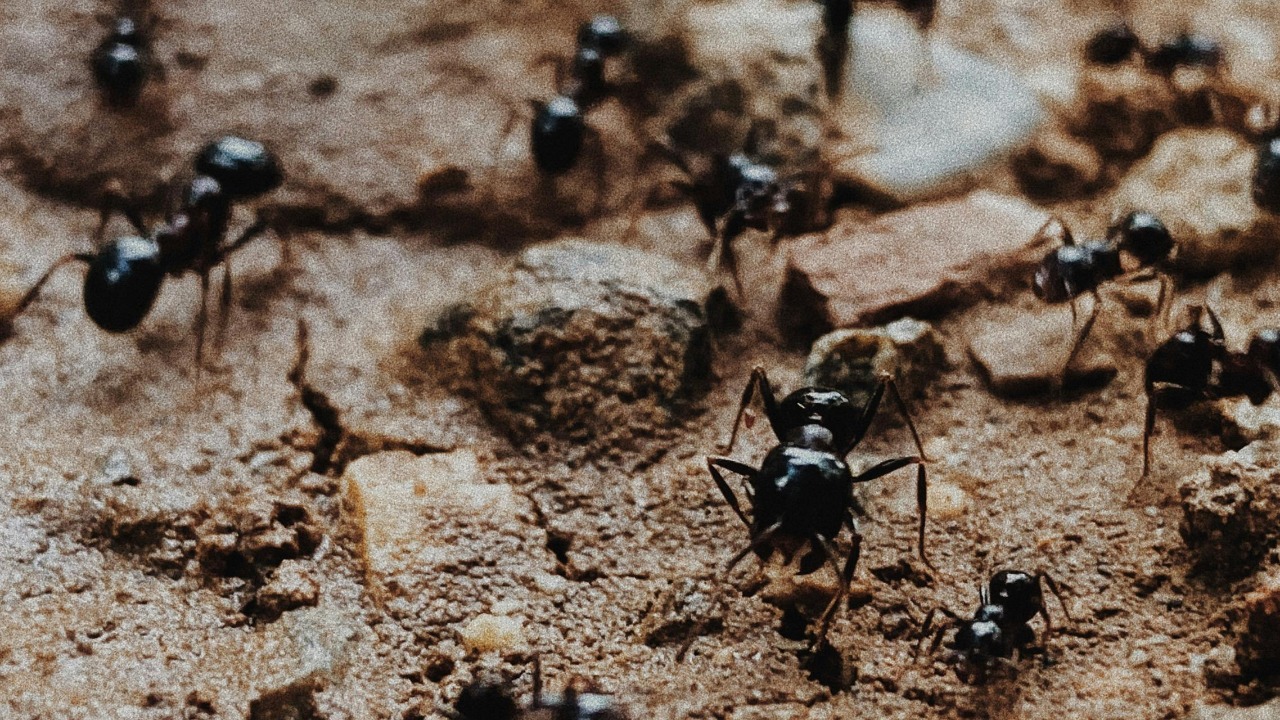

Ants are among the most physically fragile insects on the planet, yet they dominate almost every land habitat and outweigh many larger animals in total biomass. New research argues that this success is not despite their weakness but because evolution systematically traded individual toughness for the ability to build enormous, hyper-cooperative societies. In other words, the planet was not conquered by super-soldiers, but by tiny workers that thrive only when there are staggering numbers of them.
By probing how ant bodies are built and how their colonies scale, scientists are now sketching a clearer picture of what it takes for a species to become truly abundant. The emerging story is that ants leaned into vulnerability, thinning their armor and shrinking their frames so they could reproduce faster, spread farther and knit together into vast colonies that function almost like a single organism.
From armored tanks to paper shells
At first glance, an ant’s exoskeleton looks like a miniature suit of armor, a hard shell that should protect it from the rough edges of life on the forest floor. When researchers compared hundreds of species, however, they found that many ants are built more like paper cups than steel cans, with a surprisingly thin outer layer relative to their body mass. The team calculated that the ratio of body mass to cuticle thickness can vary from as little as 6 percent to as high as 35 percent, a spread that reveals just how much some lineages have pared back their protective coating to save material and energy.
That range, from 6 to 35 percent, is not a trivial anatomical quirk, it is a map of evolutionary tradeoffs that shows some ants investing heavily in a thick cuticle while others accept a flimsier shell in exchange for cheaper bodies that can be produced in huge quantities. Reporting on this work notes that the researchers ultimately identified this broad spectrum of body mass-to-cuticle composition while probing how ants managed to spread into so many ecosystems, and that the lighter built species tend to be the ones that form the largest, most populous colonies, a pattern that supports the idea that structural weakness at the individual level can be good for the colony as a whole, as described in detail in recent coverage of how ants conquered Earth.
The Science Advances study that reframed “weakness”
The most explicit case for this tradeoff comes from a study in the journal Science Advances, which set out to test whether ants that build bigger societies systematically sacrifice individual robustness. By comparing the exoskeletons of species that live in small, simple colonies with those that organize into sprawling, multi-queen supercolonies, the authors showed that the largest societies are often composed of the most physically fragile workers. In these species, the outer layer of the exoskeleton is thinner and less reinforced, which would make any one ant more vulnerable to crushing or desiccation but also makes each body cheaper to build.
In that analysis, the researchers argue that natural selection has shifted from optimizing the survival of a single ant to optimizing the performance of the colony, a pattern that is especially clear in species where workers are sterile and only queens reproduce. A report on the work explains that the study, published in Science Advances, frames this as a deliberate evolutionary bargain, with ants “making individuals weaker to build bigger societies” by shaving down the outer layer of the exoskeleton so that more workers can be produced from the same pool of resources, a conclusion summarized in coverage of how Science Advances linked exoskeletons to colony size.
Trading strength for numbers, and why it worked
Once you accept that an ant colony is the real unit of selection, the logic of this tradeoff becomes clearer. A thick, heavily armored worker might live longer and withstand more punishment, but it also costs more to produce and maintain, which limits how many can be supported by a given food supply. A lightly built worker, by contrast, can be produced quickly and in bulk, allowing colonies to flood their environment with foragers, soldiers and nurses that collectively overwhelm competitors and predators through sheer presence rather than individual prowess.
Researchers who modeled these dynamics found that species which trimmed back individual strength in favor of cheaper bodies were able to build colonies that are not just larger but also more complex, with specialized castes and division of labor that further amplify the benefits of scale. Reporting on this work notes that research published in Science Advances describes how some ant species traded strength for numbers and that this strategy “worked” in the sense that it enabled them to form vast, cooperative societies that dominate their ecosystems, a point captured in coverage of research on ants that traded strength for numbers.
How many ants are we talking about?
To grasp the scale of this strategy, it helps to put a number on the global ant population, and recent attempts to do so have produced figures that are almost hard to process. One widely cited estimate suggests that there are roughly 20 quadrillion individual ants alive on Earth at any given time, a 20 followed by 15 zeros. That tally implies that for every human, there are millions of ants, and that the combined mass of all those insects rivals or exceeds that of many larger animal groups.
Researchers who compiled this estimate did so by aggregating counts from dozens of field studies across continents and habitats, then extrapolating to regions that have been less thoroughly sampled. Reporting on the work notes that the number of ants on Earth is about 1 trillion times 20, or 20 quadrillion, and that their total biomass may amount to roughly a fifth of humans’ total biomass, a staggering share of the planet’s animal matter that underscores how successful the ant strategy has been, as summarized in coverage of the study that put the global ant count in the quadrillions.
Earth’s quiet majority and where they live
That 20 quadrillion figure also reframes how we think about who really dominates the land surface of the planet. While humans reshape landscapes and build cities, ants quietly occupy almost every terrestrial ecosystem, from leaf litter in tropical forests to cracks in urban sidewalks. A detailed synthesis of ant population data concluded that Earth hosts around 20 quadrillion ants and emphasized that this abundance is not evenly distributed, with the highest densities found in warm, humid regions that support rich plant and insect life.
The same work highlighted that such a vast population plays a central role in moving nutrients, aerating soil and controlling other insect populations, so any large scale decline in ants could upend ecosystems in ways that ripple up food webs. Reporting on the synthesis explains that Earth has 20 quadrillion ants and warns that shifts in climate or land use that disrupt this “hidden majority” of insects could destabilize entire ecosystems, a concern laid out in an analysis of how Earth’s 20 quadrillion ants underpin ecosystems.
Why the tropics are ant factories
When scientists mapped where those 20 quadrillion ants actually live, a clear pattern emerged, with numbers generally peaking in the tropics. Warm temperatures, abundant rainfall and dense vegetation create a buffet of seeds, nectar and prey that can support dense colonies, while relatively stable seasons allow ants to forage and reproduce year round. In these environments, the strategy of building cheap, lightly armored workers pays off especially well, because colonies can rapidly expand and exploit a constant flow of resources.
Analyses of global ant abundance note that their numbers generally peak in the tropics and argue that this underscores the importance of tropical regions in maintaining healthy ant populations, since any disruption to these habitats could disproportionately affect the global total. One summary of the work emphasizes that their numbers generally peak in the tropics and that this concentration highlights how critical those ecosystems are for sustaining the planet’s ant populations, a point made explicit in a discussion of how their abundance is tied to tropical habitats.
Ant societies as superorganisms
What makes ants so effective at turning individual weakness into collective strength is the way their colonies function almost like single organisms, with specialized parts that coordinate through chemical and tactile signals. Workers communicate using pheromones, touch and sound, allowing them to share information about food sources, threats and nest sites with remarkable efficiency. This communication underpins complex behaviors such as trail formation, nest construction and coordinated defense, which no single ant could manage alone.
General overviews of ant biology describe how these insects, though common, have unique capabilities that include legendary communication skills that allow their colonies to act as cohesive units. One such account notes that ants are common insects but that their ability to coordinate through chemical signals lets them build societies so dense that there can be up to a million ants for every human, a ratio that captures just how thoroughly they have filled available niches, as outlined in a profile of how ants use communication to build vast colonies.
Why fragility is a feature, not a bug
Seen through this lens, the thin cuticles and small bodies of many ants are not design flaws but features that make the superorganism work better. A colony that can afford to lose thousands of workers to predators, accidents or environmental shocks without collapsing is more resilient than one that depends on a smaller number of heavily armored individuals. By keeping the cost of each worker low, evolution has allowed ant societies to treat individuals as expendable components in a larger machine, which in turn makes the whole system more robust.
Reports that describe how weak ants conquered Earth using sheer numbers emphasize this point, noting that the same traits that leave a single ant vulnerable, such as a relatively thin exoskeleton and small size, also allow colonies to produce workers in extraordinary quantities. One account explains that researchers identified body mass-to-cuticle compositions ranging up to 35 percent and argue that this structural lightness, while not good for the individual ant, is good for the colony because it enables explosive population growth, a dynamic captured in coverage of how weak ants used numbers to dominate.
More from MorningOverview