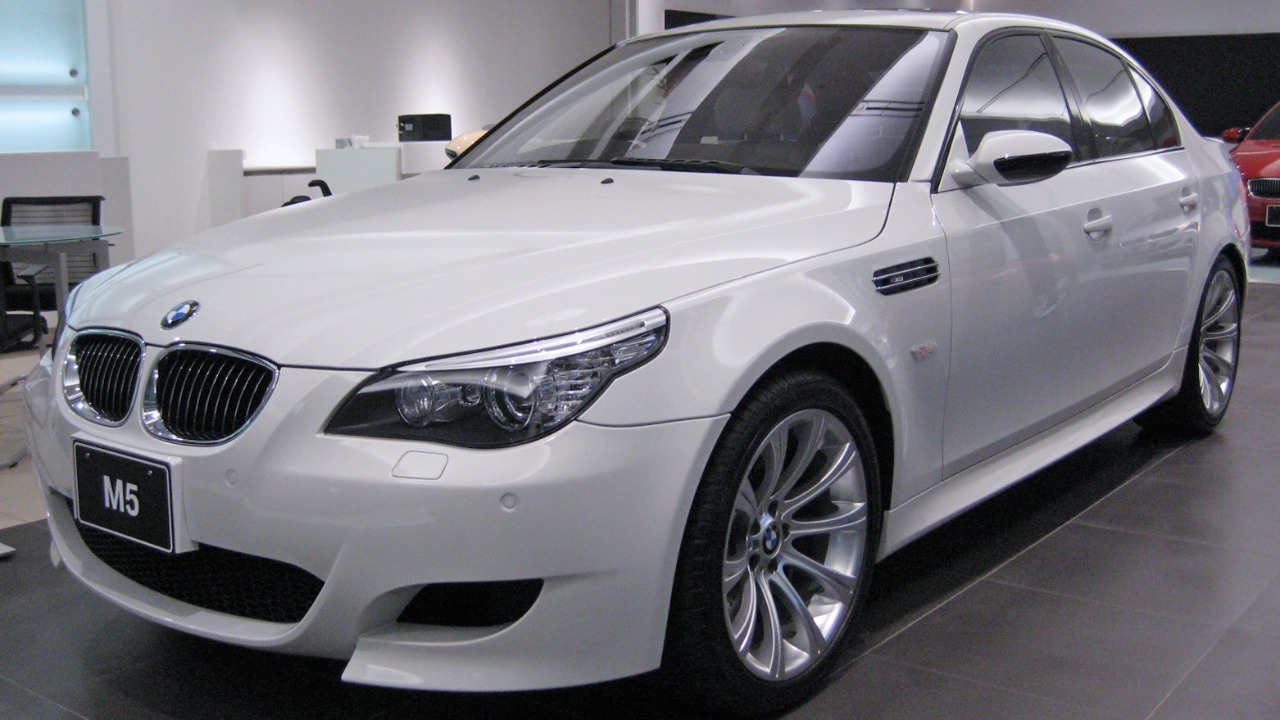

The idea of a 507 horsepower wagon that can haul kids, luggage, and then storm to 189 mph sounds like a fantasy, but BMW turned it into a very real, very loud reality. The E61-generation M5 Touring took the brand’s wildest V10 engine and wrapped it in a practical body, creating a family car that behaves like a long-roof supercar. It is a machine that treats the school run and the autobahn with the same ruthless seriousness.
By pairing a high revving engine with genuine load lugging space, this BMW wagon blurred the line between everyday transport and track toy in a way few rivals have matched. It did not just add speed to practicality, it redefined what a family hauler could be when engineers are allowed to chase numbers first and justify them with boot capacity later.
The V10 heart that turns a wagon into a missile
At the core of this car’s appeal is its 10 cylinder engine with high revving character, a powerplant that feels more at home in a supercar than in a wagon with roof rails. BMW’s S85 V10 displaces 5.0 liters, listed as 5.0 liter (4,999 cc) in technical tables, and was engineered to spin to stratospheric revs while still delivering the flexibility needed for daily driving. In the E61 M5 Touring, that engine was tuned to produce 507 horsepower from five liters, a figure that instantly pushed this wagon into exotic territory and made it the first long roof model to wear an M badge with such an extreme specification.
That output did not exist in a vacuum, it represented a step change over the previous generation of fast 5 Series. In period comparisons, the car was described as “Almost 100 Hp More Powerful Than Its Predecessor,” a blunt way of saying BMW had moved the goalposts for family performance by a full 100 horsepower. The S85’s willingness to rev, with reports noting how it eagerly climbed toward an 8,250 rpm redline, meant the Touring could surge forward with a ferocity that belied its size, turning every on ramp into an excuse to explore the upper reaches of the tachometer.
From autobahn bruiser to 189 mph reality
Raw power is only part of the story, because what transforms this wagon into a 189 mph projectile is the way that output is deployed. In standard form, factory figures for similar E61 M5 Touring models quote a limited top speed of 155 m, or 250 km, per hour, a cap imposed more by policy than by physics. When that electronic leash is removed, the same hardware has been documented reaching a v-max of 189 MPH, a number that shifts the car from “fast estate” into the realm of genuine supercar pace, especially for a vehicle that can still swallow a family’s holiday luggage.
Torque was a similarly abrasive part of the experience, with the V10 delivering its shove in a rising wave as revs climbed, rather than the instant hit of a turbocharged engine. That character meant the M5 Touring rewarded drivers who were willing to work the gearbox and keep the needle high, a trait more commonly associated with track specials than with practical wagons. At full chat, the combination of 507 horsepower, that 189 MPH potential, and the long roof’s inherent stability turned the car into a high speed tool that felt perfectly at home in the left lane of an unrestricted autobahn.
Chassis, gearbox, and the art of taming 507 hp
Putting this level of performance into a wagon demanded more than just a big engine, it required a chassis and drivetrain that could keep up. The E61 M5 Touring runs the familiar 507hp 5.0L V10 mated to the seven speed Sequential Manual Gearbox and a rear driven layout, a combination that gave drivers rapid fire shifts and a direct connection to the powertrain. That gearbox, essentially a robotized manual, could feel abrupt in traffic but came alive when driven hard, snapping through ratios in a way that suited the engine’s high revving nature.
Underneath, the car relied on M typical sport suspension, with firmer springs, adaptive damping, and specific geometry to keep the extra weight of the wagon body in check. Contemporary assessments noted that without the snappy transmissions and complex electronics of later turbocharged M5s, the E61’s balance felt more natural and communicative, even if it demanded respect when the road turned wet. The result was a chassis that could carry serious speed across a challenging road while still offering enough compliance to keep passengers comfortable, a delicate compromise that defined the Touring’s dual personality.
Practicality that justifies the madness
What makes this car more than a technical exercise is the way its practicality legitimizes its excess. Thanks to the M typical sport suspension and the roomy boot, the BMW M5 Touring was quickly seen as the perfect allrounder for drivers who refused to choose between family duties and high performance. The long roof body offered a generous load bay, split folding rear seats, and the kind of everyday usability that traditional supercars simply cannot match, all while hiding a 10 cylinder engine with high revving intent under the bonnet.
That practicality extended beyond cargo space to the way the cabin was laid out, with seating for five, Isofix points, and the same level of comfort and technology found in other high end 5 Series models of the era. Owners could load up bikes, dogs, or flat pack furniture without a second thought, then, with a prod of the starter button and a pull of the right paddle, unleash the full fury of 507 horsepower on an open stretch of road. It is this contrast, the ability to move seamlessly from domestic chores to high speed blasts, that turned the Touring into a cult favorite among enthusiasts who needed one car to do it all.
Legacy, rarity, and the long-roof M story
Although the E61 M5 Touring was never a volume seller, its impact on BMW’s performance narrative has been significant. Among the newest long roof performance models is the G99 generation BMW M5 Touring, which debuted at Pebble Beach and enters only its second chapter in the brand’s history of V8 hybrid power, a clear nod to the template set by the V10 wagon. That modern car leans on electrification and turbocharging, but it still follows the same basic recipe: super sedan power in a practical shell, aimed at drivers who want to cover ground quickly without sacrificing space.
The original V10 Touring’s rarity has only sharpened its appeal. Registry data lists examples with a curb weight around 1,955 kilograms, a 4,999 cc BMW S85 V10, a limited top speed of 155 mph (250 km/h), a 0 to 62 mph time of 4.8 seconds, and outputs quoted at 500 bhp (373 kW), figures that align closely with the more widely cited 507 horsepower rating. Those numbers, combined with the seven speed automated manual described in period specifications and the short production window from 2007 to 2010, have turned the car into a sought after modern classic. For enthusiasts, it stands as proof that when engineers are allowed to chase extremes, even a family wagon can become a 189 mph missile.
More from Morning Overview