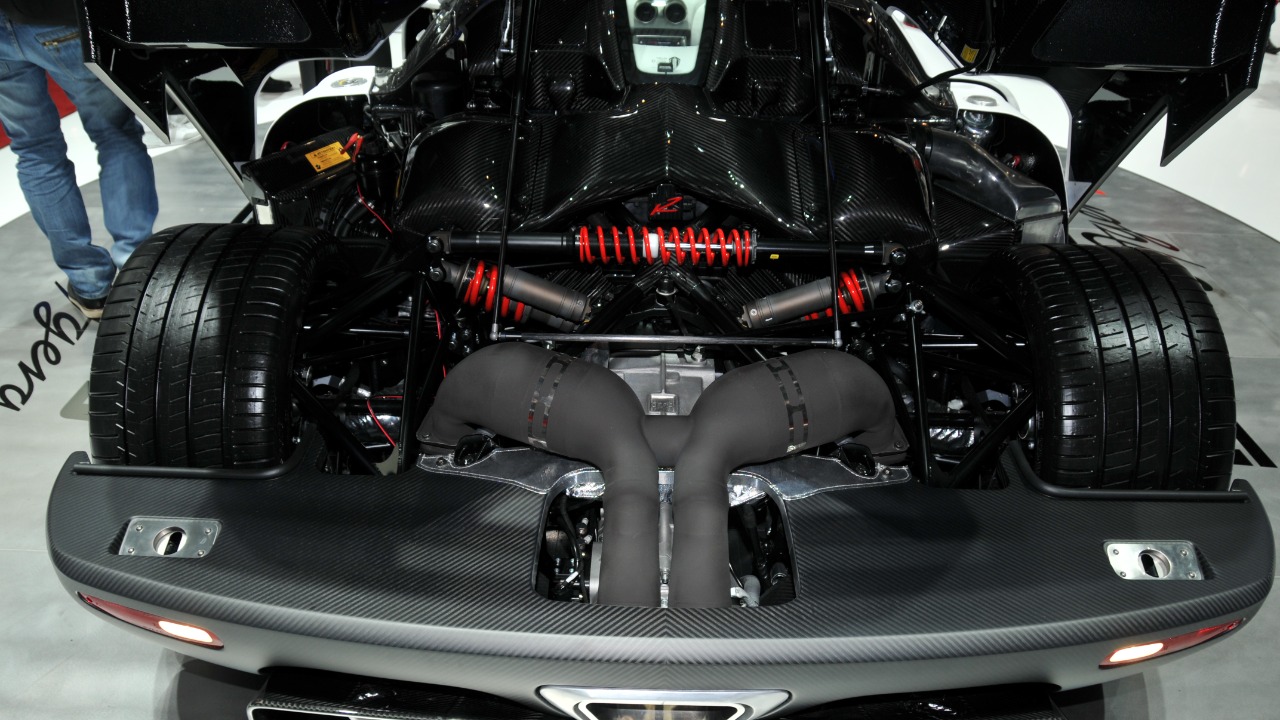

Downsized engines are no longer the underdogs of performance. With advanced turbocharging, electrification, and clever valvetrain tricks, several tiny powerplants now deliver output that rivals or exceeds classic muscle car V8s. I look at four compact engines whose numbers and technology prove that displacement alone no longer decides who wins the stoplight drag.
Koenigsegg Tiny Friendly Giant (TFG)
The Koenigsegg Tiny Friendly Giant, or Koenigsegg TFG, is a 2.0‑liter three‑cylinder that rewrites expectations for small engines. In the Gemera, combined hybrid output reaches 800 k and 1100 hp simultaneously, or 1400 hp when counted individually, figures that eclipse many big‑block legends. The combustion unit alone is rated at 600 hp, with Koenigsegg’s camless Freevalve system allowing each valve to be electronically controlled and infinitely adjustable for maximum efficiency and power.
Koenigsegg describes its camless 2.0L three‑cylinder twin turbo as putting out 600 hp and 443 lb⋅ft of torque, Nicknamed Tiny Friendly for how compact it is relative to its output. Earlier technical breakdowns of the Tiny Friendly Giant explain how the Koenigsegg TFG reaches 600 hp from just three cylinders, relying on advanced turbocharging and precise combustion control. For supercar buyers and regulators alike, this shows that extreme performance and aggressive downsizing can coexist.
Mercedes‑AMG M139 Hybrid Four‑Cylinder
The latest Mercedes M139 hybrid four‑cylinder proves that a compact inline‑four can outgun traditional V8s. In its newest performance application, the engine itself produces 469 hp and 402 lb‑ft of torque from just 2.0 liters, with a total hybrid system output of 671 hp. Those numbers put it squarely in the territory once reserved for big‑displacement American coupes, yet it does so with far better specific output and efficiency.
Earlier versions of the M139 were already described as the world’s most powerful production four‑cylinder, with the S‑version delivering 416 hp thanks to a twin‑scroll turbo and low‑friction internals. The new hybrid evolution builds on that foundation, using electrification to fill turbo lag and push total output beyond many naturally aspirated V8s. For performance brands, it signals a shift toward smaller, highly stressed engines paired with electric assistance rather than ever‑larger cylinders.
Toyota GR Corolla MORIZO Edition Three‑Cylinder
The Toyota GR Corolla MORIZO Edition shows how far a tiny three‑cylinder can be pushed in a road‑legal hatchback. Its 1.6‑liter turbocharged engine is part of the same family that powers other Toyota GR models, and in this track‑focused variant it delivers output that rivals older V8 pony cars despite having half the cylinders and a fraction of the displacement. Toyota combines aggressive boost, strengthened internals, and motorsport‑inspired cooling to keep the compact unit reliable at high specific power.
Because the Toyota GR Corolla MORIZO Edition is lighter and more focused than the standard GR Corolla, its small engine’s power‑to‑weight ratio becomes the key performance metric. The result is a car that can embarrass larger, heavier muscle machines on a twisty road or circuit while consuming less fuel and emitting less CO2. I see this as a template for enthusiast cars that prioritize clever engineering and chassis balance over sheer cubic inches.
Nissan DIG‑T Small‑Displacement Turbo
Nissan’s DIG small‑displacement turbo engines illustrate how mainstream brands are extracting big‑car performance from compact packages. In detailed breakdowns of the Nissan DIG TR unit, analysts compare its output to that of larger high‑performance engines and find that the tiny turbo four can match or exceed many naturally aspirated sixes and V8s in real‑world acceleration. By combining direct injection, high compression, and responsive turbocharging, Nissan squeezes remarkable torque from a modest swept volume.
Video explainers on the Nissan DIG architecture emphasize how carefully managed boost and fueling let the engine deliver strong midrange pull without sacrificing drivability. In practical terms, that means compact crossovers and hatchbacks can offer performance once limited to specialty muscle models, but with better economy and lower ownership costs. I view this as a crucial bridge technology as the market transitions toward electrification while drivers still demand punchy, engaging powertrains.
More from Morning Overview