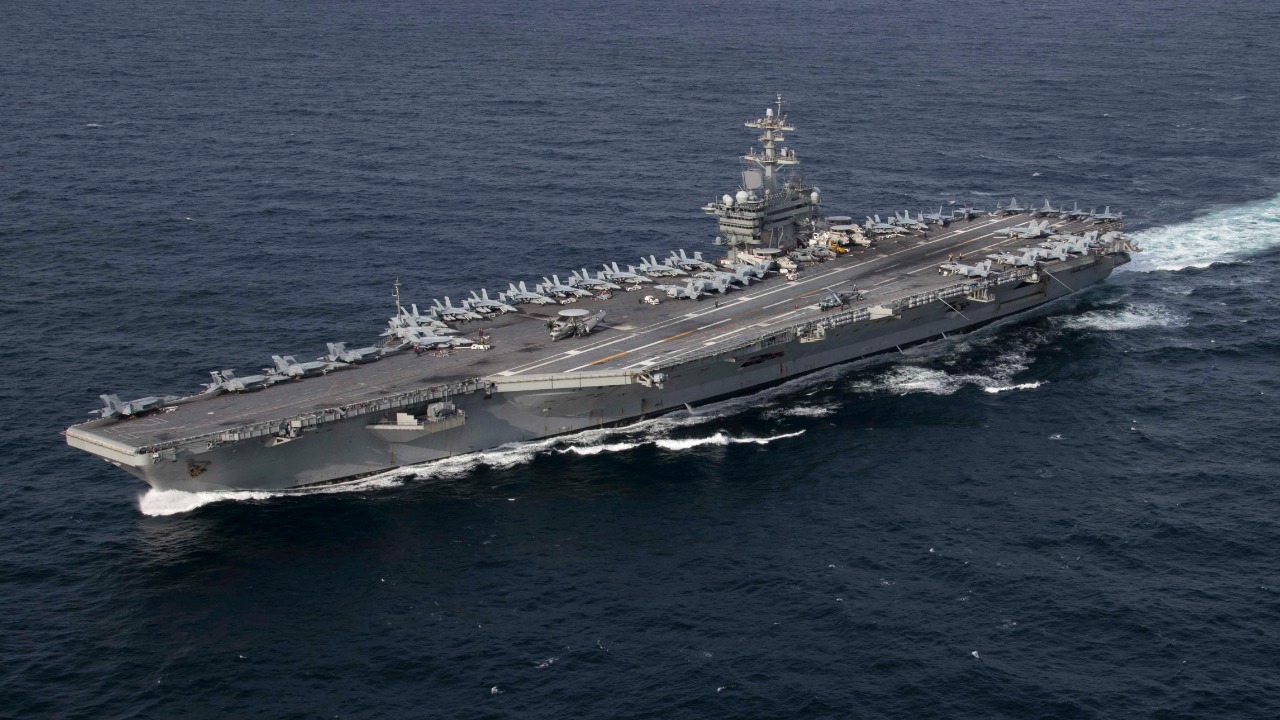

Two American carrier strike groups now bracket Iran from the Mediterranean and the Arabian Sea, putting roughly 180 U.S. combat jets within range of key targets if President Donald Trump orders a strike. The deployment gives Washington a fast, flexible war option at the very moment Tehran is warning that any attack will trigger what it calls all-out war. I see a classic high-stakes pincer taking shape, with air wings at sea and land-based squadrons in the region knitting together into a single, dense strike web.
At the center of that web is the USS Abraham Lincoln, a Nimitz-class carrier whose arrival in the Middle East completes a layered build-up that has unfolded over several weeks. Around it, destroyers, missile ships, and forward-based aircraft in Jordan and the Gulf states create overlapping arcs of fire that can reach deep into Iranian territory while also defending U.S. forces from missiles and drones.
Carriers close the gap on Iran
The most visible shift in the balance of power is the movement of the Abraham Lincoln Carrier Strike Group into the U.S. Central Command area of responsibility, placing a full carrier air wing within direct reach of Iran. The group, led by the Nimitz-class USS Abraham Lincoln, has been tracked moving steadily toward the region, and U.S. Navy officials now confirm it is operating under U.S. Central Command with its escorts and logistics ships. On the flight deck, Navy Aviation Boatswain’s Mate Handling 2nd Class Michael Cordova is one of the sailors directing aircraft, a reminder that this is not an abstract chess move but a live, armed platform ready to launch sorties at short notice.
The Lincoln’s arrival follows weeks of signaling that a carrier would be positioned closer to Iran, and regional media have tracked its approach as it moved toward the Middle East. According to open-source tracking cited in regional reporting, the carrier is accompanied by destroyers and missile ships equipped with hundreds of launchers capable of striking targets across Iran, including air defenses, missile sites, and regime command centers, a posture described in detail in one assessment. That mix of sea-launched cruise missiles and carrier-based jets is what turns a single ship into a theater-level strike tool.
Air wings and the “180 jets” strike web
What makes this build-up qualitatively different is the density of combat aircraft now within reach of Iranian airspace. Each Nimitz-class carrier typically embarks dozens of strike fighters, and the Abraham Lincoln’s air wing includes Boeing F/A-18E Super Hornet jets that have already been photographed landing on the Nimitz-class deck. U.S. officials have not publicly broken out the exact number of aircraft aboard, but standard air wing compositions, combined with a second carrier in the broader region, help explain how planners arrive at a figure of roughly 180 U.S. jets in strike range when land-based squadrons are added to the tally.
Those land-based squadrons are not hypothetical. Earlier this month, regional reporting detailed how dozens of U.S. fighter jets were quietly deployed to Jordan, alongside heavy cargo aircraft traffic that suggested a broader reinforcement of munitions and support equipment. When I add those aircraft to the carrier-based Super Hornets and other strike platforms, the picture that emerges is a layered strike web: jets on land for rapid, repeated sorties and jets at sea for survivable, mobile firepower that is harder for Iran to pre-target.
A two-carrier pincer and missile shield
The Lincoln is not sailing alone in strategic terms. U.S. officials have signaled that another carrier group is operating in the wider Middle East theater, effectively placing two large decks on different axes around Iran. One carrier is positioned closer to the Arabian Sea and Gulf approaches, while the other operates farther west, creating what amounts to a maritime pincer that can launch aircraft from separate directions and complicate Iranian air defense planning, a dynamic described by officials who noted an aircraft carrier reaching the Middle East to bolster options for Trump.
At the same time, the Lincoln’s escorts are not just there to protect the carrier. The destroyers and missile ships that sailed with it are equipped with vertical launch systems that can fire both defensive interceptors and offensive cruise missiles, giving the group a built-in missile shield and long-range strike arm. Reporting on the group’s composition notes that these ships bring hundreds of launchers to the region, a capability highlighted in the earlier analysis of the carrier’s escorts. In practical terms, that means the same ships that would try to intercept Iranian ballistic missiles or drones could also launch Tomahawk-style strikes at radar sites and command bunkers, clearing paths for the 180-jet strike package to operate.
Iran’s “all-out war” warning and regional anxiety
Tehran is not treating this as routine posturing. A senior Iranian official has been quoted as saying that “Everything is on high alert in Iran” ahead of the arrival of a U.S. military aircraft carrier strike group in the Middle East, and that any attack would be treated as all-out war. I read that as both a deterrent message to Washington and a domestic signal that the leadership is bracing the public for potential escalation. It also underscores how quickly a limited U.S. strike on nuclear or missile facilities could spiral into a broader conflict involving proxy militias and regional shipping lanes.
Regional governments are watching the build-up with a mix of quiet support and visible anxiety. Some Arab states see the U.S. posture as a necessary counterweight to Iranian missile and drone capabilities, while others fear that a miscalculation could drag their territory into the line of fire. Local media have reported that the U.S. carrier strike group is now in the Middle East region, with some sources suggesting the deployment is meant as much to forestall Iranian action as to prepare for a U.S. strike. That dual purpose, deterrence and readiness, is what makes the current moment so tense: both sides are arming for a fight they insist they do not want.
Trump’s leverage and the risk of miscalculation
For President Donald Trump, the twin carriers and the 180-jet strike web are leverage in an ongoing confrontation over Iran’s nuclear program, regional militias, and attacks on shipping. U.S. officials speaking about the carrier’s arrival in the region have framed it as a way to give Trump more options on Iran, from limited strikes to a show of force that stops short of actual combat. The United States Navy’s Abraham Lincoln carrier strike group, as one report put it, has arrived in the United States Central Command area of responsibility as part of a broader effort by The United States Navy to step up pressure on Iran.
Yet the same build-up that gives Washington options also raises the risk of miscalculation. The deployment of dozens of U.S. fighter jets to Jordan, combined with the Lincoln’s escorts and missile ships, means that any incident at sea or along the Jordanian border could escalate rapidly if commanders on either side misread the other’s intentions. U.S. Navy reporting has even highlighted how individual sailors like Navy Aviation Boatswain’s Mate Handling 2nd Class Michael Cordova are working on deck as part of a complex choreography that involves 36 aircraft movements in tight windows, a detail captured in coverage by Caitlyn Burchett. When that many moving parts are compressed into a contested airspace, the line between deterrence and war can be as thin as a misinterpreted radar track.
More from Morning Overview