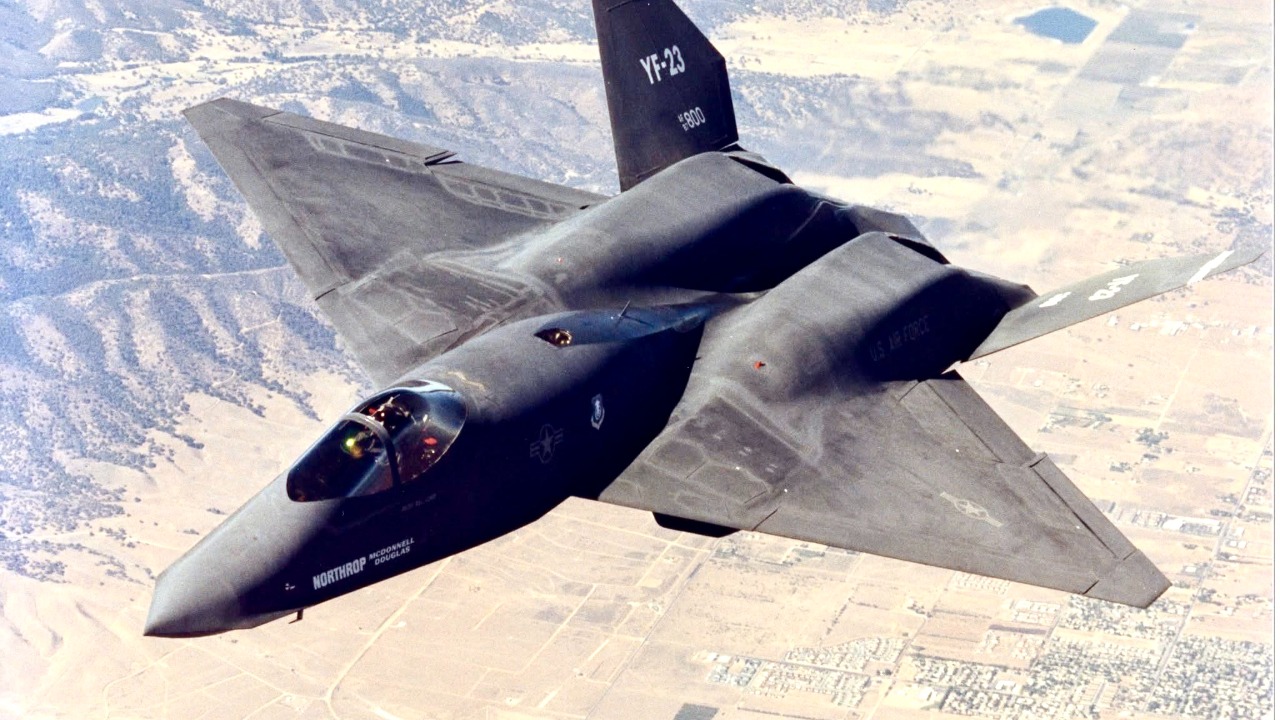

The Advanced Tactical Fighter competition is often remembered as a clean win for the F-22 Raptor, but the losing prototype, Northrop’s YF-23, has only grown in stature with time. As air combat shifts toward long-range missiles, sensor fusion, and extreme stealth, the jet that lost on paper increasingly looks like it was tuned for the kind of wars the United States is actually preparing to fight. The choice between them was never just about performance, it was about what kind of airpower doctrine the Air Force wanted to buy.
Looking back at the YF-23 against the F-22 is less a nostalgia exercise than a case study in how institutions weigh risk, cost, and culture when they pick a weapons system that will define a generation. The “wrong” jet, as some critics now call it, might have been smarter not because it was perfect, but because it aligned more closely with where technology and strategy were heading.
How the ATF race set up a clash of philosophies
The Advanced Tactical Fighter program was born from a simple problem: the Air Force needed something that could outfly and outfight the F-15 in a world where Soviet designs were catching up. Each contractor team was told to build two prototype air vehicles for what the program called Dem and Val, short for demonstration and validation, one airframe for each of the competing engine options. The YF-22 had its maiden flight on 29 Septembe, and the YF-23 followed, both meeting or exceeding the Air Force’s demanding requirements for speed, stealth, and agility according to the official prototype record.
On the surface, this was a straightforward flyoff, but underneath it was a clash of design philosophies. Lockheed’s YF-22 leaned into visible agility and familiar control concepts, while Northrop’s YF-23 pushed harder into low observability and high-speed cruise. Both aircraft hit the performance marks, yet the Air Force had to decide whether to double down on a fighter that looked like a more advanced F-15 or to embrace a stealthier, more unconventional shape that prioritized staying unseen over putting on an airshow.
Why the F-22 won: BLUF, cost, and comfort
Inside the Air Force, the decision was often boiled down to a Bottom Line Up Front, or BLUF, that favored the YF-22 on cost and perceived risk. An internal assessment, later described in detail, framed the choice in blunt terms: Why the YF-22 won and why the YF-23 lost came down to a belief that the Raptor would cost less to build and operate at scale. That judgment, captured in a program summary that literally labeled its key section “Why the YF” and “Bottom Line Up Front,” argued that the Lockheed design promised a smoother path to production and sustainment, a claim that has been linked to the Air Force’s preference for the YF-22.
There was also a cultural comfort factor that is harder to quantify but shows up in how test pilots and evaluators talked about the jets. The F-22’s prototype showed off dramatic high angle-of-attack maneuvers and thrust-vectoring that looked like the next logical step from the F-15 and F-16. The YF-23, by contrast, was quieter in the sky and more alien in silhouette, a diamond wing with canted tails that did not telegraph its strengths in a dogfight demonstration. When budgets tightened and the Air Force had to defend its choice to Congress, the more conventional-looking option with a clear “fighter pilot” appeal was always going to have an edge.
What the YF-23 did differently in the air
On paper, both prototypes were fifth generation, but the YF-23’s designers made a series of choices that pushed it further into the realm of stealth and long-range performance. Instead of the round, thrust-vectoring nozzles used on the YF-22, the YF-23 would have used Single Expansion Ramp Nozzles, or SERNs, that flattened the exhaust and buried it between the tail surfaces. Rather than relying on brute-force maneuvering, thrust from these engines flowed through trough-like channels that reduced infrared signature and radar returns, a configuration that analysts have highlighted as a key reason the YF-23 could supercruise efficiently while remaining hard to detect, as detailed in a technical review of its Single Expansion Ramp Nozzles.
Both the YF-22 and the YF-23 could maintain supersonic speeds without afterburner, but the YF-23’s planform and engine integration were optimized to do it with less fuel and less signature. That meant a jet that could loiter farther from its tanker support, sprint into missile range, and then slip away without lighting up every radar in the theater. In a world where long-range sensors and missiles dominate, that trade, less showy agility in exchange for better stealth and endurance, looks increasingly prescient.
The only pilot who flew both: a rare vantage point
Very few people have sat in the cockpits of both the F-22 and the YF-23, and one of them has been unusually candid about what he saw. In a detailed interview, the test pilot who flew both prototypes described how the YF-23 evolved from the paper stages and how its various iterations, including one called “Black Widow II,” changed his view of what a fifth generation fighter could be. He has shared pictures of those iterations and walked through how the aircraft handled at the edge of its envelope, insights that are captured in a long-form conversation about the competition, available in a video titled YF-23 vs. F-22.
That same pilot later reflected that his team “built a tremendous product that would stand side-by-side with anything else, and in many cases exceed the capabilities,” a line that underscores how close the race really was. He emphasized that both jets had areas where they held an advantage over the other, and that the final decision was less about a knockout blow in performance than about programmatic and political factors. His account, preserved in a detailed retrospective on the only man who flew both the F-22 and the YF-23, reinforces the idea that the YF-23 was not a failed design so much as a different answer to the same problem, one that could “stand side-by-side” with the Raptor according to his Nov recollection.
Stealth, range, and the long-range fight we actually got
When the Air Force picked the F-22, it was still heavily invested in the idea of close-in dogfighting, even as beyond-visual-range missiles were improving. The YF-23’s design emphasis on stealth and long-range engagements over dogfighting was seen as a liability, a choice that made it less exciting in a visual sense and harder to sell to a community that prized turning performance. A later analysis of the program put it bluntly, noting that this emphasis on staying hidden and striking from distance cost the YF-23 the race with the YF-22, even though in hindsight that focus on long-range engagements looks more aligned with how air combat has evolved, a point underscored in a detailed review of why the Air Force was not interested in the The YF.
Today, the Air Force itself describes the F-22 as its top-of-the-line fighter, a platform whose abilities remain largely classified but are widely understood to center on stealth, sensor fusion, and first-shot capability. In a widely viewed documentary segment, the Air Force is cited as considering the Raptor its premier air dominance asset even now, a status that reflects how well it has adapted to the long-range, networked fight. Yet that same segment also revisits the YF-23’s concept and asks whether a jet that leaned even harder into stealth and range might have been better suited to a world where dogfighting is increasingly redundant on the battlefield, a question raised in a video titled Was the YF-23 superior.
The internet’s verdict: cooler, more futuristic, maybe smarter
Outside official circles, the YF-23 has become a cult favorite, especially among aviation enthusiasts who see it as the more daring design. In one widely shared discussion, a user kicked off a thread with the prompt “Are you also someone who prefers YF-23 over the YF-22?” and the responses leaned heavily toward the idea that the YF-23 had the cooler, more futuristic concept. Commenters praised its sleek lines, its diamond-shaped wing, and its almost science-fiction profile, arguing that it looked like it had been pulled forward from a later era of air combat, a sentiment captured in the Are thread.
Another conversation, framed under the blunt question “why do people think the YF-23 is better than the YF-22?”, dug deeper into the performance assumptions behind that fandom. In the Comments Section, a user named MalcolmGunn argued that the speculation is based around the idea that the F-23 would have been a better fit for a future where beyond-visual-range missiles and stealth make traditional dogfighting increasingly redundant on the battlefield. That line, echoed by others in the same Comments Section, shows how online communities have internalized the idea that the YF-23’s design logic was ahead of its time, even if it lost the contract.
“In one word: mistake?” The growing YF-23 reconsideration
As the Raptor fleet ages and the Air Force looks toward its Next Generation Air Dominance program, a wave of retrospective analysis has cast the YF-23 in a new light. One recent assessment framed the entire saga with a provocative hook: Forget the F-22 Raptor and look again at The YF-23 Black Widow II Stealth Fighter Summed Up in One Word. That word, the piece argued, was “mistake,” as in the decision to walk away from a stealth fighter whose low-observable shaping and long-range performance might have been better suited to the Pacific theater and the missile-rich environments the United States now expects to face, a view laid out in a detailed Forget the analysis.
That reconsideration is not just about nostalgia for a cool-looking jet. It is rooted in specific attributes, such as the YF-23’s projected range, its ability to supercruise without afterburner, and its extremely low radar cross section from multiple aspects. Critics argue that in a world where tankers and forward bases are increasingly vulnerable, a fighter that can operate farther from support and stay hidden longer is worth more than one that can out-turn an adversary in a visual merge. The “mistake” framing is really a critique of how the Air Force weighted those factors in the early 1990s, and whether it underestimated how quickly the long-range, sensor-driven fight would dominate.
The Sea Widow that never was: navalizing the YF-23
One of the more intriguing what-ifs around the YF-23 is the idea of a carrier-capable variant sometimes dubbed the YF-23 Sea Widow Stealth Fighter. A detailed exploration of that concept argued that the YF-23’s basic airframe, with its long range and efficient supercruise, would have made an ideal starting point for an aircraft carrier fighter for the Navy. This capability, which meant it could maintain supersonic speeds without using fuel-guzzling afterburners, offered advantages in both range and survivability, allowing a carrier air wing to project power hundreds of extra miles according to an analysis that cited a combat radius measured in additional miles compared with legacy jets, as laid out in a study of the Sea Widow.
Navalizing the YF-23 would not have been trivial, of course. It would have required reinforced landing gear, folding wings, and corrosion protection, all of which add weight and complexity. Yet the idea that the Navy might have fielded a stealthy, long-range fighter based on the YF-23 instead of relying on upgraded F/A-18s and a delayed F-35C underscores how consequential the original ATF decision was. A Sea Widow on the deck of a Nimitz or Ford class carrier would have given the fleet a very different set of options in contested waters, particularly in the Western Pacific.
Could the YF-23 have replaced the Raptor outright?
Some analysts have gone further, arguing that the YF-23 was not just a missed alternative but a viable direct replacement for the F-22 concept itself. A detailed historical review of the program noted that in the 1980s, the Air Force sought to replace the F-15 with a new fighter jet, spurring a competition between the YF-22 and the YF-23. All in all, the YF-23 was assessed as at least as stealthy and as fast as the F-22A Raptor, with some evaluations suggesting it might have had an edge in certain regimes, a conclusion drawn in a retrospective that described how the In the Black Widow could have replaced the Raptor.
That assessment does not claim the YF-23 was perfect or that it would have been cheaper to build, only that it met the same core requirements with a different balance of strengths. In a world where the F-22 production line has long since closed and the Air Force is struggling to maintain a relatively small fleet, some observers wonder whether a YF-23 based production fighter might have been easier to evolve into a family of variants, including a naval version or a dedicated long-range interceptor. Those questions are unanswerable now, but they highlight how much strategic flexibility can hinge on a single procurement decision.
What the YF-23 vs F-22 choice tells us about future programs
Looking ahead to Next Generation Air Dominance and other sixth generation projects, the YF-23 story reads like a cautionary tale about how to balance near-term risk against long-term relevance. The Air Force’s choice of the F-22 made sense in a world where budgets were tightening and dogfighting still loomed large in doctrine, but it also reflected an institutional bias toward what looked and felt like a traditional fighter. The YF-23, with its more radical shaping and its emphasis on staying hidden and hitting from afar, was a harder sell even if it arguably lined up better with the trajectory of air combat.
For future programs, the lesson is not that the flashier or stranger design is always better, but that decision makers need to be brutally honest about the kind of fight they are buying for. If the next air dominance platform is expected to operate inside dense air defenses, rely on long-range weapons, and coordinate with uncrewed systems, then the logic that once favored the YF-23 over a more dogfight-centric approach may finally get its due. The “wrong” jet might have been smarter not because it was flawless, but because it was built for a future that has now arrived.
More from MorningOverview