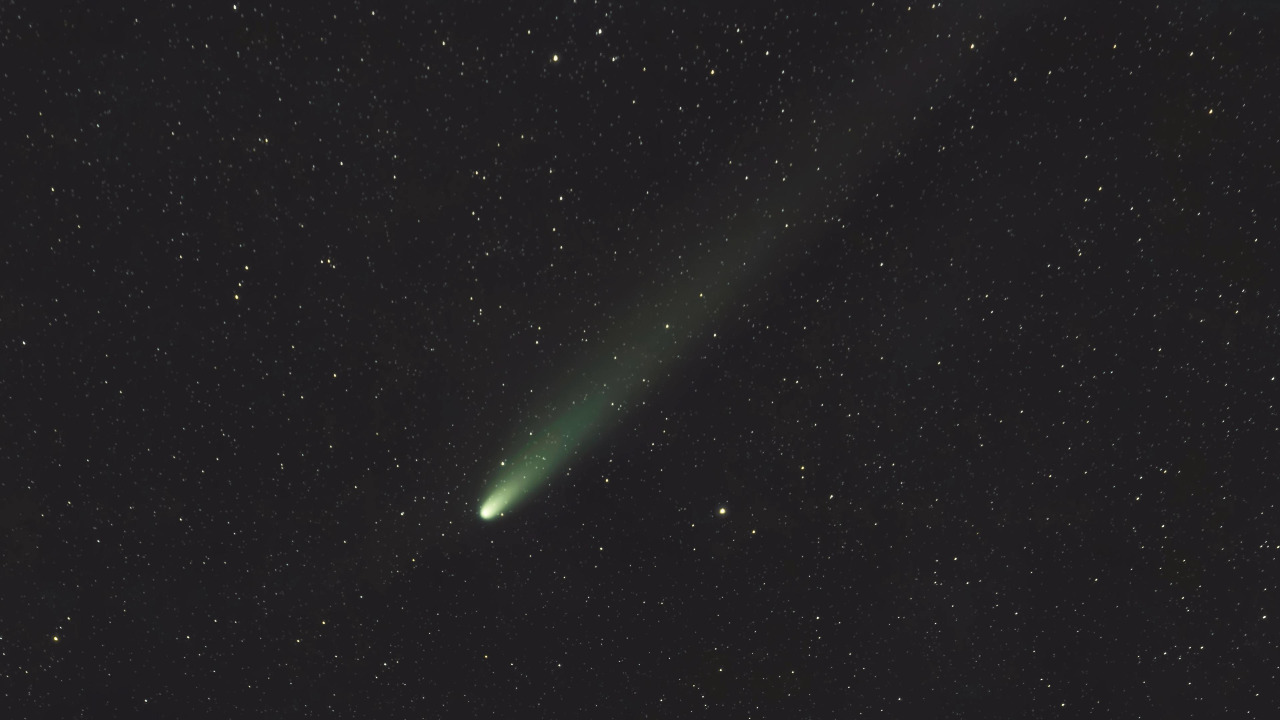

Comet C/2025 R3 (PanSTARRS) is already being talked about as the sky spectacle to watch in 2026, with some wondering if it might rise to the rare status of a “great comet.” The object is on track to brighten through early spring, lining up with other headline celestial events and giving observers across much of the world a realistic chance at a naked-eye visitor. Whether it truly becomes a once-in-a-generation sight will depend on a mix of orbital geometry, dust production, and sheer luck that astronomers are still working to pin down.
What astronomers already know about C/2025 R3 (PanSTARRS)
By early 2026, astronomers have a reasonably clear picture of the path C/2025 R3 (PanSTARRS) will take through the inner solar system, even if its final brightness remains uncertain. Orbital solutions show the comet on a long-period trajectory that brings it into the inner planetary region for the first time in recorded history, which is part of why expectations are high. Its discovery by the Panoramic Survey Telescope and Rapid Response System, better known as PANSTARRS, flagged it early enough that observers can track its evolution over many months and refine predictions as it approaches the Sun.
Ephemeris data and observing tools already map out where the comet will appear in the sky night by night, giving both professionals and amateurs a way to plan ahead. Dedicated pages for C/2025 R3 list its changing magnitude, distance, and coordinates, turning a once esoteric calculation into something any backyard observer can follow in real time through resources such as live comet data. That baseline of orbital information is solid, which means the remaining uncertainty is not where the comet will be, but how dramatically it will respond to solar heating as it swings inward.
Why some are calling it 2026’s headline comet
The reason C/2025 R3 is already being framed as the standout comet of 2026 is simple: among the known visitors on the calendar, it has the best chance to become bright enough for casual skywatchers. Forecasts suggest it could outshine other periodic and long-period comets expected over the year, potentially becoming the most prominent icy visitor of the season. That has led some commentators to ask whether it might be the year’s defining cometary event, even as they caution that the label of “great comet” is far from guaranteed.
Coverage of the object has emphasized that while it may well be the brightest comet of 2026, its ultimate performance is still an open question. Analysts note that the brightness of comets is notoriously hard to pin down in advance, especially for newcomers to the inner solar system, and that C/2025 R3 could end up as anything from a modest binocular object to a genuine showpiece. One detailed assessment puts it plainly, stating that Although Comet C/2025 R3 (PanSTARRS) could prove to be the brightest comet of 2026, it is not yet known how bright it will get or whether it will be easy to spot without optical aid.
How “great comets” are defined, and why the bar is so high
When astronomers and historians talk about a “great comet,” they are not just describing something pretty in a telescope. The term is usually reserved for comets that become obvious to the naked eye, often visible even from cities, and that develop striking tails or structures that dominate the sky for days or weeks. These are the comets that enter popular culture, remembered long after they fade, and they are rare enough that only a handful appear in a typical century. To reach that level, a comet needs a combination of intrinsic brightness, a favorable orbit that brings it close to both the Sun and Earth, and a physical structure that responds dramatically to solar radiation.
By that standard, C/2025 R3 faces a steep climb. It would need to brighten by several orders of magnitude compared with its early detections and maintain that output through perihelion and closest approach to Earth. Astronomers also watch for how quickly a comet’s coma and tail expand as it nears the Sun, since a sluggish response can signal a relatively inactive nucleus that never quite delivers the spectacle people hope for. The current consensus is that while C/2025 R3 has the potential to be a strong performer, it is far too early to place it confidently in the same category as the legendary great comets that have lit up the sky in past generations.
What the 2026 sky calendar tells us about its moment in the spotlight
Context matters for how any comet is perceived, and the broader 2026 sky calendar helps explain why C/2025 R3 is drawing so much attention. The year is already shaping up as a busy one for observers, with multiple comets, meteor showers, and eclipses competing for attention. Among those events, C/2025 R3 stands out because it is timed to reach peak brightness during a relatively quiet stretch in the spring, when nights are still long enough in many regions for comfortable viewing and the Moon’s phase can be favorable.
Roundups of the year’s comet activity highlight that 2026 promises dazzling comet sights, from rare interstellar visitors that likely follow a hyperbolic orbit to more familiar periodic objects such as 88P/Howell. In that lineup, C/2025 R3 is singled out as one of the potentially naked-eye showpieces, with guides noting that comet appearances in 2026 will range from modest binocular targets to objects that could be seen without equipment. That framing effectively positions PanSTARRS as the comet to watch if any object is going to break out of the specialist community and into mainstream awareness.
The critical April window and how bright it might get
The most important period for C/2025 R3 is expected to come in April, when the comet should reach its maximum brightness and best visibility. Forecasts suggest that around that time it will be well placed in the night sky for mid-latitude observers, potentially high enough above the horizon to escape the worst of atmospheric haze. If the comet’s activity ramps up as it approaches the Sun, that window could deliver the kind of sustained, easy viewing that helps an object cross over from a niche target to a widely discussed spectacle.
Event guides for 2026 already flag this period as a highlight, noting that observers will be able to See a bright comet in April as C/2025 R3 (PANSTARRS) reaches its “maximum brightness” around the middle of the month. One overview of the year’s major sky events states that the comet, known as C/2025 R3 (PANSTARRS), could be visible to the naked eye as a bright comet, depending on the weather, and encourages readers to mark their calendars. That timing also lines up with other events, such as meteor showers, which could make late April nights particularly rich for anyone willing to spend a few hours under dark skies.
How to find C/2025 R3 in the sky
Even if C/2025 R3 does not quite reach the level of a great comet, it is likely to be bright enough that many people will want to track it with binoculars or small telescopes. Locating a comet can be more challenging than finding a planet or a bright star, since its position shifts noticeably from night to night and its diffuse glow can be washed out by light pollution. That is where modern tools come in, turning what used to be a specialist’s task into something that any motivated observer can manage with a smartphone and a printed chart.
Dedicated online resources already provide detailed sky maps for C/2025 R3, showing its position against the background constellations at different resolutions. These Finder Charts allow users to zoom in on the comet’s location and even View in interactive star map formats that update as new orbital data comes in. One such tool, built around the comet’s evolving ephemeris, invites users to Click through charts that make it easier to plan an observing session, whether that means stepping into a backyard or driving to a darker rural site.
What experts say about the risks of overhyping a comet
Veteran comet watchers are quick to warn against declaring any object a guaranteed blockbuster too early, and C/2025 R3 is no exception. The physics of comet brightening is messy, driven by how sunlight penetrates the nucleus, how volatile ices sublimate, and how dust is lofted into space. A comet that looks promising on paper can fizzle if its surface is crusted over or if it fragments before reaching perihelion, while a seemingly modest object can surprise everyone with a late surge in activity. That history of surprises is why many astronomers prefer to talk in terms of probabilities and scenarios rather than firm predictions.
Analyses of C/2025 R3’s prospects emphasize that the brightness of comets is inherently unpredictable, especially when they are still far from the Sun. One widely cited discussion notes that the brightness of comets is notoriously difficult to forecast and that even with good orbital data, there is no guarantee that this object will live up to the most optimistic expectations. In that context, commentators have framed the question “Will Comet C/2025 R3 (PanSTARRS) be the ‘great comet’ of 2026?” as an open one, stressing that while it could become a standout, it might also remain a more modest binocular target, as explained in coverage that asks Will Comet C/2025 R3 (PanSTARRS) truly reach that elite status.
How C/2025 R3 fits into April’s broader night-sky show
One factor that could boost public interest in C/2025 R3, regardless of its exact brightness, is its timing alongside other high-profile events. Late April is already a magnet for skywatchers thanks to the Lyrid Meteor Shower, which produces fast, bright meteors that can be seen from much of the Northern Hemisphere. If the comet is visible in the same general period, observers may be able to enjoy both a meteor display and a comet in a single night, turning routine observing sessions into something more memorable.
Guides to 2026’s top astronomical events highlight this convergence explicitly, noting that April will feature C/2025 R3 (PANSTARRS) alongside the Lyrid Meteor Shower. One calendar points out that On April 22nd, the Lyrid meteor shower will peak and that On the 25th of the month, the comet should be near its best, framing the two as complementary targets for stargazers. That same overview, which bills the year as a complete stargazers’ calendar from comet PANSTARRS to the Blue Micromoon and the Geminids, underscores how April | C/2025 R3 (PANSTARRS) is being positioned as a centerpiece of the spring sky.
What observers should realistically expect
For anyone planning to step outside and look for C/2025 R3, the most realistic expectation is that the comet will be at least a rewarding binocular object, with a decent chance of becoming visible to the naked eye from dark locations. That means the best views are likely to come to those who can get away from city lights, give their eyes time to adapt to the dark, and use simple tools like star charts or mobile apps to zero in on the right patch of sky. Even if the comet does not sprout a dramatic tail that stretches across the heavens, a bright, condensed coma with a short tail can still be a striking sight, especially for observers who have never seen a comet before.
At the same time, it is worth remembering that comets are dynamic, evolving objects, and that their appearance can change noticeably over the course of days. Early in the apparition, C/2025 R3 may be a faint smudge that requires optical aid, while later it could brighten enough that it becomes obvious once you know where to look. I would advise readers to treat the “great comet” label as a possibility rather than a promise, to follow updated forecasts from tools that track C/2025 R3 (PANSTARRS) in real time, such as PANSTARRS ephemeris, and to enjoy the process of watching a comet evolve, whether or not it ultimately lives up to the most ambitious hopes.
More from MorningOverview