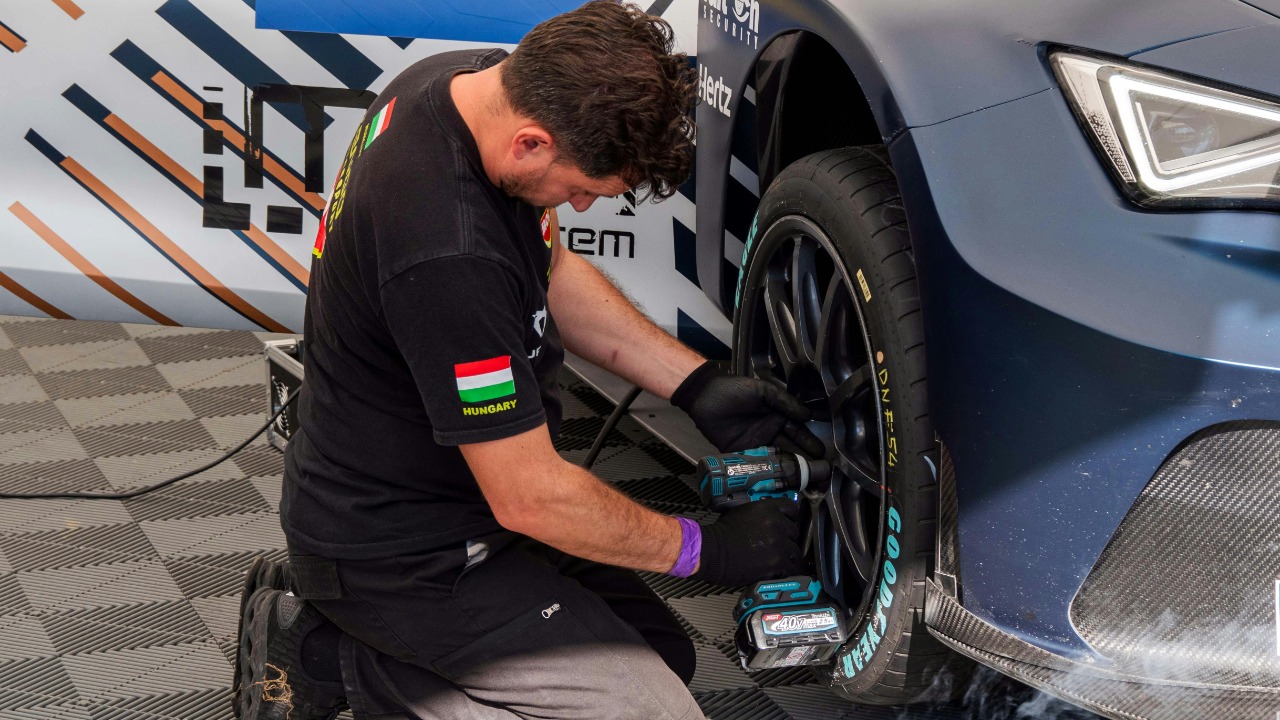

Wheel fasteners that feel rock solid in the service bay can quietly loosen once you are back at highway speed, which is why many technicians urge drivers to have their wheels re-torqued about 100 miles after a tire rotation or change. That short follow-up visit gives the hardware a chance to settle under real-world loads, then be tightened again to the specification your vehicle needs. I see it as one of the simplest, cheapest ways to avoid a wheel-off incident that can escalate from a vibration to a full loss of control in seconds.
What “re-torquing” actually means
When I talk about re-torquing, I am not describing a quick once-over with an impact gun, but a deliberate second pass on the lug nuts with a calibrated torque wrench after the vehicle has been driven. In the language of Feb, the step sits squarely in “Understanding the Basics” and answers the question “What is Retorquing” by defining it as revisiting and tightening the lug nuts on a wheel that was already installed. The goal is not to crank the nuts tighter than before, but to bring each one back to the manufacturer’s specified torque after the wheel, hub, and fasteners have had time to shift slightly in use.
That second pass matters because torque is not just about how hard someone leaned on a wrench, it is about the clamping force that holds the wheel flat against the hub. If the nuts relax even a little, the clamping load drops and the wheel can start to move on its seat, which accelerates loosening. Feb’s section on “Understanding the Basics” of “What” “Retorquing” is explicit that skipping this follow-up can pose serious safety risks, and that is exactly what I see when drivers treat wheel work as a one-and-done job instead of a two-stage process.
Why wheels loosen after a rotation
Even when a technician tightens every nut correctly during a rotation, the joint they create is not finished until the vehicle has been driven through a few heat cycles and load changes. As the wheel is clamped to the hub, tiny irregularities in the paint, rust, or machining marks compress, and the mating surfaces bed in under the weight of the car. Earlier guidance on “Initial Retorque” explains that after your tires are installed, a follow-up torque check is recommended specifically to account for any settling that may occur once the vehicle is back on the road, which is exactly what happens in the first 50 to 100 miles of mixed driving.
That settling is not a sign that the shop did poor work, it is a normal part of how metal parts behave under stress. The studs stretch slightly, the nuts relax as friction changes, and the wheel can shift a fraction of a millimeter on its seat, all of which can reduce the effective clamping force even though the nuts still feel snug to the touch. Feb’s explanation of “Initial Retorque” after installation underscores that this is a predictable phase in the life of a newly mounted wheel, which is why I treat a 100-mile recheck as finishing the job rather than fixing a mistake.
The safety stakes if you skip the 100-mile check
When lug nuts lose clamping force, the first symptom is often a faint vibration or a rhythmic clicking that many drivers ignore, but the underlying risk is that the wheel can eventually work itself free. Automotive safety guidance on “When” to re-torque stresses that regularly rechecking your lug nuts is essential because loose fasteners can lead to wheel separation, which instantly puts you and others at risk at any speed. I have seen cases where a driver dismissed a mild shimmy after a rotation, only to discover that two studs had already sheared off by the time they reached a shop.
The danger is not limited to the vehicle that loses the wheel. A detached wheel can bounce into oncoming traffic, strike pedestrians, or cause following drivers to swerve and collide. The same “When” and “Here” guidance frames this as a simple maintenance step with outsized consequences, noting that regularly retorquing your lug nuts is one of the most direct ways to avoid putting you and others at risk. That is why I treat the 100-mile re-torque as a safety appointment, not a courtesy.
What engineering says about re-torquing
From an engineering standpoint, the need to re-torque comes down to how the wheel, nut, and stud interact under load. Once the wheel attaching nuts have been properly tightened, the joint is still subject to micro-movements as the vehicle corners, brakes, and hits bumps, especially on vehicles that use tapered or ball seat mounting systems. Technical guidance under “Why Re” explains that even after the initial torque, the combination of thermal expansion, vibration, and seating of the wheel can justify a second torque check, because the original clamping force may no longer match the specification once the parts have settled.
That same engineering analysis, introduced with “Once the” nuts are tightened, points out that the interface between the nut seat and the wheel is particularly sensitive to any loss of contact area. If the wheel shifts slightly on a tapered or ball seat, the load can concentrate on a smaller patch of metal, which accelerates wear and further loosening. The section that begins “Acco” makes clear that this is not hypothetical, it is a known behavior of these mounting systems, which is why I see the 100-mile re-torque as aligning with how the hardware was designed to be used rather than as an optional extra.
Why many shops recommend a 50 km to 100 mile window
Service departments often translate engineering theory into a simple mileage rule, and the most common version is a check somewhere between 50 km and 100 miles after wheel work. Continental’s guidance on “Checking for” loose lug nuts states that garages and tire dealers will typically retorque the fasteners about 50 km after a tire change, and that a follow-up check is also necessary. In North American practice, that figure is often rounded to roughly 50 to 100 miles, which gives drivers enough time to put the wheels through a few heat cycles and real-world loads without waiting so long that a loose nut can progress to a dangerous condition.
The same “Why” guidance explains that wheels are subjected to a mix of stresses that include supporting the vehicle’s weight, absorbing road shocks, and transmitting braking and acceleration forces, all of which can influence how the nuts settle. A related section on these stresses notes that if this follow-up check were skipped and the nuts continued to loosen, users would be at risk, which is why I see the 50 km to 100 mile window as a compromise between practicality and safety. It is short enough that most drivers can schedule a quick stop within a week of service, but long enough that any initial settling has already occurred and can be corrected.
How real-world stresses work your lug nuts loose
Once you leave the shop, every mile you drive starts to test the joint between the wheel and the hub. Guidance on “Checking for” loose lug nuts explains that these fasteners are constantly dealing with the vehicle’s weight, cornering forces, and impacts from potholes or curbs, and that these stresses include supporting the load, absorbing bumps, and handling braking torque. Over time, that combination can cause minute shifts in the wheel’s position and changes in friction at the nut seat, which is why a joint that was perfect on the lift can be compromised after a few days of commuting.
Another section that begins “This is because” spells out that after a tire change, the wheel and nuts are still settling into their final position while you are on the road, and that is precisely when a re-torque is most valuable. The guidance notes that this bedding-in process happens while you are driving, not while the car is parked, which is why I advise drivers to come back after they have logged some actual miles rather than immediately after leaving the bay. By timing the check for that early-use window, you catch any loosening that those real-world stresses have introduced before it can escalate into visible wobble or damage.
Common causes of loose lug nuts
Not every loose wheel is the result of normal settling, and understanding the other culprits helps explain why a re-torque is a safeguard, not a cure-all. Fleet safety analysis under “Several” common factors lists over-torquing, under-torquing, and improper mating surfaces as key reasons nuts come loose. “Over” tightening beyond the manufacturer’s specification can stretch studs and damage threads, while “Tightening” too little fails to generate enough clamping force in the first place, and both errors make it easier for vibration to back the nuts off over time.
The same safety discussion points to “Improper mating surfaces” where non-flat, dirty, or painted faces prevent full contact between the wheel and hub, which can allow the joint to relax as those high spots compress. It also notes that regular torque checks are one of the simplest ways to prevent costly wheel-off incidents, because they catch the symptoms of these underlying problems before a wheel separates. I see the 100-mile re-torque as a chance for a second set of eyes to spot any of these issues, especially on vehicles that have just had aftermarket wheels installed or have visible corrosion on the hubs.
How to get a proper re-torque (and what I look for)
When I bring a car back for a re-torque, I treat it as a quick but structured inspection rather than a formality. The technician should use a calibrated torque wrench, follow the correct star or crisscross pattern for your bolt circle, and tighten each nut smoothly up to the specified value instead of hammering away with an impact gun. Guidance on “Retorquing Tires: A Comprehensive Guide” explains that the process of revisiting and tightening the lug nuts is only effective if it is done with the right tool and technique, because the goal is to restore the correct clamping force, not to guess at it by feel.
I also pay attention to how the shop frames the visit. The same Feb material that defines “Understanding the Basics” of “What” “Retorquing” is clear that this step is part of a complete service, not an upsell, and many reputable shops will perform it at no charge. When I see a service advisor proactively schedule that 100-mile check and note it on the invoice, it signals that they understand both the mechanical realities and the safety implications, which is exactly the mindset you want from the people who just had your wheels off the car.
Why I treat re-torquing as non-negotiable
After looking at the engineering, the safety data, and the real-world behavior of wheels under load, I have come to see the 100-mile re-torque as a non-negotiable part of any tire rotation or change. The combination of initial settling, the stresses described in the “These stresses include” guidance, and the known failure modes outlined in the “Several” common factors analysis all point in the same direction: a joint that is perfect on day one can be meaningfully looser by day three. A brief stop to have the nuts checked and corrected is a small price to pay to avoid the cascade of problems that can follow.
That view is reinforced every time I see a driver arrive with a wobbling wheel that could have been caught with a simple follow-up. The safety advice that regularly retorquing your lug nuts helps ensure you do not put you and others at risk is not abstract, it reflects what happens on real roads when fasteners are left to their own devices. For me, building the 100-mile re-torque into my routine is as automatic as fastening a seat belt: it is a quick, evidence-backed habit that quietly keeps a lot of bad days from ever happening.
More from MorningOverview