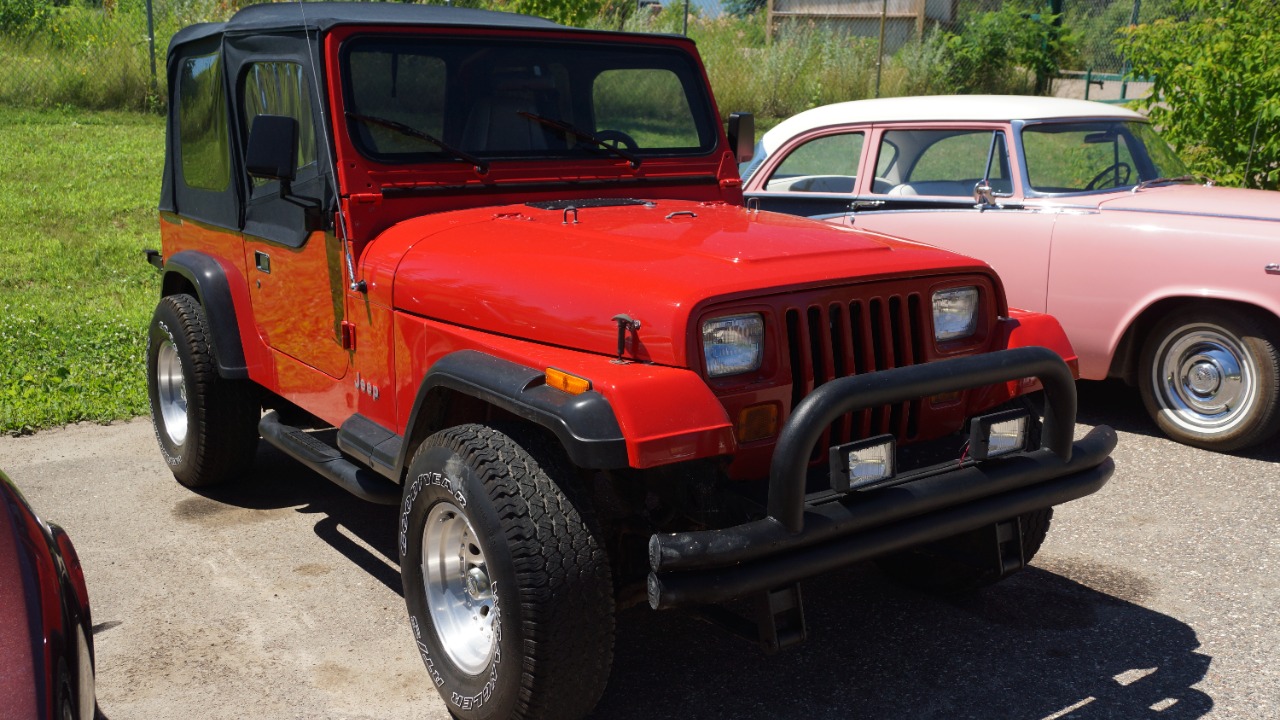

Jeep has never been shy about trying oddball engineering solutions in the name of off-road capability, but one of its strangest experiments hid in plain sight inside an automatic gearbox that effectively offered two different second gears. Instead of a simple linear climb from first to top, this transmission could choose between a short, punchy second and a taller, more relaxed one, depending on how the driver asked for power. I want to unpack why that happened, how it worked, and what it reveals about the way modern drivetrains juggle performance, efficiency, and driver feel.
How a Jeep ended up with two second gears
The story starts with a corporate tangle as much as a mechanical one. During the DaimlerChrysler era, Jeep engineers were working with a mix of legacy American hardware and European-influenced control strategies, and the result was a transmission calibration that behaved like something out of a soap opera, with shifting personalities depending on throttle input. In that context, the decision to create two distinct second-gear experiences was less a gimmick and more a workaround for conflicting goals: strong low-speed pull for a heavy 4×4, acceptable fuel economy on the highway, and a smooth, carlike feel in daily driving.
Reporting on this odd gearbox notes that the unit could behave as if it had one second gear in gentle driving and a different one when the driver demanded full power, which is why it has been described as an odd Jeep transmission with two second gears. Rather than redesign the entire mechanical layout, the engineers leaned on software and valve-body logic to create two distinct operating points that both sat in what would traditionally be called “second,” one used in normal upshifts and the other accessed when the transmission kicked down under heavy throttle.
What “two second gears” actually means mechanically
On paper, a conventional automatic lists one numerical ratio for each forward gear, and second is just the step between first and third. In practice, especially with electronically controlled automatics, the same physical gearset can be used in different ways, with clutches and bands engaging in alternate combinations to create slightly different effective ratios or to hold a gear longer under certain conditions. When people say this Jeep had two second gears, they are really describing a calibration that let the transmission choose between a shorter, more aggressive second and a taller, economy-minded one, both occupying the same conceptual slot in the shift pattern.
From the driver’s seat, that meant the vehicle could feel like it had a brisk, tightly spaced second gear when accelerating hard, yet slip into a lazier, fuel-saving version of second when easing away from a stop or climbing a gentle grade. The underlying idea is similar to how high-performance gear ratios are chosen to balance acceleration and top speed, with multiple ratios available so the engine can stay in its ideal power band under different driving conditions. In the Jeep’s case, the engineers simply stacked two different “second-gear” behaviors into one slot, then used throttle position and vehicle speed to decide which one the driver would feel.
Kickdown, driver intent, and the hidden second gear
The key to unlocking the more aggressive version of second gear was kickdown, the familiar automatic-transmission behavior where a hard stab of the accelerator forces a downshift. When a driver floors the throttle, the transmission control unit interprets that as a demand for maximum acceleration, drops one or more gears, and lets the engine rev higher to deliver more power. In this Jeep, that same kickdown logic was used not just to pick a lower gear, but to decide which flavor of second gear to serve up, effectively hiding the shorter ratio behind a deliberate, full-throttle request.
Driving instructors often teach learners that a firm push on the accelerator will trigger kickdown, explaining that this forces the car to shift into a lower gear and speed up quickly, a point captured in guidance that sums it up as “Remember, Kickdown equals go.” Jeep’s two-second-gear trick simply added another layer to that logic: a gentle squeeze of the pedal would keep the transmission in its taller, calmer second, while a decisive kickdown would call up the shorter, more urgent second that made the SUV feel livelier when overtaking or merging.
Why engineers wanted two different second-gear behaviors
Second gear is a crucial pivot point in any automatic, especially in a heavy SUV that spends much of its life shuttling between city traffic and highway ramps. If the ratio is too short, the engine screams and fuel economy suffers; if it is too tall, the vehicle feels sluggish off the line and hesitant when the driver asks for more speed. By effectively giving the Jeep two second gears, the engineers tried to square that circle, reserving the shorter ratio for moments when performance really mattered and leaning on the taller one to keep revs and fuel consumption in check during everyday driving.
This compromise mirrors the broader logic behind multi-ratio transmissions in performance cars, where multiple gear ratios are used so the engine can deliver strong acceleration without sacrificing cruising comfort. In the Jeep’s case, the stakes were not lap times but drivability: a family SUV that could crawl over rocks, tow a trailer, and still feel reasonably refined on the school run. Two distinct second-gear behaviors, one tuned for punch and the other for calm, gave the calibration team another lever to pull in that balancing act.
Parallels with modern two-speed reducers and multi-speed systems
Although the Jeep’s solution was buried inside a conventional automatic, the underlying idea is not far from what modern electrified powertrains do with dedicated two-speed reducers. In those systems, a compact gearbox offers a low ratio for strong launch torque and a higher ratio for efficient cruising, switching between them to keep the motor in its sweet spot. The goal is the same: use different gearing strategies to improve both performance and efficiency without forcing the driver to think about what is happening under the floor.
Suppliers now sell dedicated multi-speed reducer units that explicitly promise this kind of flexibility, describing how a 2-speed reducer, or gear reducer, can improve powertrain efficiency by using different gear ratios to ensure optimum efficiency in all driving conditions. One such multi-speed reducer is pitched as a way to give electric and hybrid vehicles both strong low-speed pull and relaxed high-speed running, a philosophy that echoes what Jeep’s engineers were trying to achieve when they effectively split second gear into two personalities inside a traditional automatic.
Smoother shifts, ideal spacing, and the calibration challenge
Creating two distinct behaviors in the same nominal gear only works if the transitions between them feel natural, which is where shift quality and gear spacing come into play. Drivers notice when an automatic hunts between ratios or slams into a downshift, so calibration teams spend enormous effort smoothing those edges. The aim is to make the gearbox feel predictable and composed, even as it juggles competing demands from emissions rules, fuel-economy targets, and customer expectations for quick response.
Automakers often talk about how smoother shifts are achieved through ideal gear spacing, with ratios carefully chosen and calibrated so there are no awkward gaps or surges in acceleration between steps. In one example, a compact sedan’s automatic was tuned so that smoother shifts and ideal ratios would be immediately noticeable to the driver, with the control software filling in the gaps between gear changes. Jeep’s two-second-gear trick lived in that same world of calibration nuance, relying on careful mapping so that the switch between its calmer and more aggressive second-gear behaviors felt like a natural response to driver input rather than a jarring personality change.
How the dual-second-gear behavior shaped real-world driving
On the road, the practical effect of this unusual setup was that the Jeep could feel like two different vehicles depending on how it was driven. In relaxed commuting, the taller second gear kept revs low, reduced noise, and helped the SUV feel more like a comfortable family hauler than a rock crawler. The transmission would short-shift out of first, slide into its gentler second, and then move up the range in a way that prioritized smoothness over drama, which suited drivers who treated their Jeep as an everyday car.
Press the accelerator harder, however, and the character changed. A decisive kickdown would summon the shorter, more urgent second gear, letting the engine spin higher and deliver stronger acceleration for passing or merging. That duality meant the same Jeep could lope along quietly on the highway yet still feel eager when asked to sprint, a split personality that made sense for a brand that sells both rugged image and daily usability. The two-second-gear behavior was not a party trick so much as a way to reconcile those roles without resorting to a completely different transmission.
What this odd gearbox says about the future of transmissions
Looking at this Jeep’s transmission today, it feels like a transitional technology, a bridge between the purely mechanical automatics of the past and the highly adaptive, software-driven drivetrains that are now common. By carving two distinct behaviors out of one gear, the engineers were effectively using code to stretch the hardware, anticipating a world where the same physical components would be asked to deliver multiple driving personalities. That mindset is now everywhere, from selectable drive modes to hybrid systems that blend electric and combustion power in complex ways.
As more vehicles adopt multi-speed reducers, sophisticated control algorithms, and electrified powertrains, the idea of a fixed, single-character second gear looks increasingly old-fashioned. Instead, transmissions are becoming tools for character tuning, able to feel relaxed one moment and aggressive the next, all within the same set of ratios. Jeep’s two-second-gear experiment fits neatly into that trajectory, an early example of how clever calibration can make one gearbox behave like several, and a reminder that even something as familiar as “second gear” can hide surprising complexity when engineers start bending the rules.
More from MorningOverview