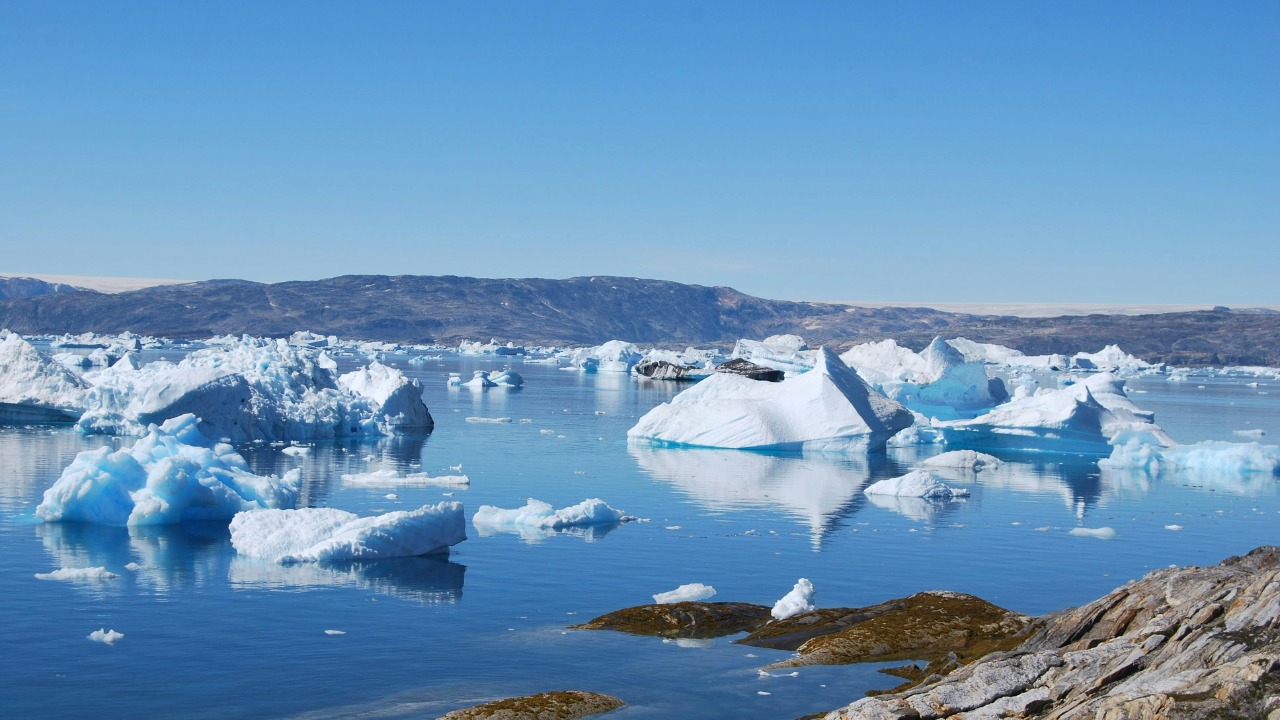

Greenland has shifted from a remote curiosity on the map to a frontline laboratory for understanding how fast the planet is changing. Its vast ice sheet, fragile ecosystems and strategic location in the Arctic now concentrate some of the most consequential questions in climate science, from future sea levels to the stability of global ocean circulation. What happens on this island of ice will help determine which coastal cities endure, how weather patterns evolve and how quickly the world must adapt.
Where Greenland fits in the global climate system
To grasp why scientists focus so intensely on Greenland, I start with its basic geography and scale. The island is the world’s largest, and most of its surface is buried under a continuous cap of ice that reaches several kilometers thick in places. That ice sheet is one of the two dominant frozen reservoirs on Earth, alongside Antarctica, and together they anchor the long term balance of the climate system. When I look at maps and satellite images of Greenland, what stands out is how much of the Northern Hemisphere’s fresh water is locked up there, poised above sea level.
Researchers emphasize that the ice sheets in Greenland and Antarctica may be remote, yet their evolution directly affects the entire Earth system state. When land based glaciers and ice sheets lose mass, the added fresh water does more than raise sea level, it also alters ocean density and circulation. In the North Atlantic, that freshening can weaken the conveyor belt of currents that transports heat from the tropics toward Europe, a process that one Arctic newsletter, numbered 572, links to the way surface water near the equator cools and sinks. Greenland, in other words, is not just a local ice problem, it is a control knob on planetary circulation.
Sea level stakes for every coastal community
The most immediate reason I see Greenland as a critical hotspot is its potential to reshape coastlines worldwide. Scientists have calculated that if the Greenland ice sheet melted entirely, global sea levels would rise by roughly 7 meters, enough to redraw maps of cities from Miami to Mumbai. Even partial loss is alarming. One study has warned that the current trajectory of warming has already committed the ice sheet to raise sea levels by nearly a foot, regardless of future emissions cuts, because of the inertia built into ice dynamics and ocean heat. That warning builds on the basic fact that Greenland is the world’s largest island and that surface melt, not just iceberg calving, now causes the biggest ice losses.
Policy analysts looking at the Greenland ice sheet and sea level rise have tried to translate those abstract numbers into concrete risks for coastal communities. Their work shows that the melting of the Greenland ice sheet is already contributing measurably to higher water levels that threaten low lying neighborhoods, ports and infrastructure, even in regions far from the Arctic. One assessment of Greenlandic melt stresses that planners must take many factors into consideration, from local land subsidence to storm surge, when they design defenses. Another analysis of the melting ice sheet underscores that the impacts will be felt even in the Southern Hemisphere, where rising seas will test the resilience of coastal communities that had little role in driving Arctic warming.
Greenland as a living archive of past and present climate
Beyond its future impact, Greenland is indispensable because it preserves a detailed record of Earth’s climate history. Deep beneath the surface, the ice is layered like pages in a book, each year’s snowfall compacted into a thin sheet that traps tiny bubbles of ancient air. When scientists drill long cylinders of this ice, known as ice cores, they can reconstruct temperature, greenhouse gas concentrations and even volcanic eruptions stretching back hundreds of thousands of years. An Introduction to this work explains that the ice encloses small bubbles of air that preserve past levels of carbon dioxide, methane and nitrous oxide, turning the Greenland ice sheet into a natural archive of atmospheric chemistry.
What makes this archive so powerful is that it links directly to the rapid changes scientists now observe on the surface. As Ice cover shrinks across Greenland, researchers can compare modern melt rates and glacier retreat with conditions thousands of years ago, when natural climate swings unfolded much more slowly. One recent synthesis notes that Understanding the current dynamics of ice loss requires a long term perspective that only these cores and geological records can provide. For me, that combination of living change and deep time context is what makes Greenland uniquely revealing: it shows both where the climate has been and where it is heading.
Arctic feedbacks and the “Island of Ice” in motion
Greenland also sits at the heart of a web of Arctic feedbacks that can amplify global warming. As the ice sheet and surrounding glaciers retreat, they expose darker rock and ocean water that absorb more solar energy than bright snow, a shift that accelerates local warming. The island’s outlet glaciers, which once flowed steadily into fjords, are now thinning and retreating, changing how icebergs are delivered to the sea. A detailed account of Greenland, Island of describes how land based glaciers and ice sheets, when they melt, add fresh water that can disrupt the sinking of dense water in the North Atlantic, a key engine of global circulation. That same report frames the changes as part of Impacts of Climate on the Arctic, where warming is already outpacing the global average.
On the ground, the transformation is visible in the way glaciers calve icebergs into fjords and in the expansion of meltwater lakes and rivers across the ice surface. A widely cited image from Aug 3, 2017, shows a glacier in southeastern Greenland shedding ice into a fjord, a process that has only intensified as air and ocean temperatures climb. Another analysis of shrinking Greenland ice cover stresses that for most people, the first encounter with these changes comes through dramatic photographs, but for scientists, the real story lies in the measured acceleration of melt over decades. I see these feedbacks as a warning that once certain thresholds are crossed, the system can shift into a new state that is much harder to reverse.
Science, sovereignty and the fight to keep Greenland open
As Greenland’s scientific value has become clearer, so have the geopolitical tensions around who controls access to its data and research sites. Climate researchers have long depended on international collaboration and the generosity of local communities to maintain field stations, drill cores and monitor glaciers. One recent report describes how Her research on lake sediments has helped reconstruct the island’s past climate, work that relies on the openness of Greenlandic society to visiting scientists. At the same time, political debates in Washington have sharpened, with President Donald Trump’s interest in acquiring the territory reframed by some advisers as a matter of strategic dominance rather than partnership. One analysis notes that His advocacy of the United States taking control of Greenland, possibly by force, signals a shift from dealmaking to dominance and raises alarms that tighter control could threaten climate science.
Scientists have pushed back against any move that would curtail open research or sideline Greenlandic voices. In one account of the political debate, What emerges is a portrait of a research community that sees Greenland not as a prize to be claimed but as a shared observatory whose findings belong to the world. Experts who study Antarctica draw parallels, warning that any erosion of international norms in the Arctic could spill over into other polar regions. For me, this is the final reason Greenland has become the most critical hotspot for climate science: it concentrates not only the physical forces reshaping the planet, but also the political choices that will determine whether we understand those forces in time to respond.
More from Morning Overview